

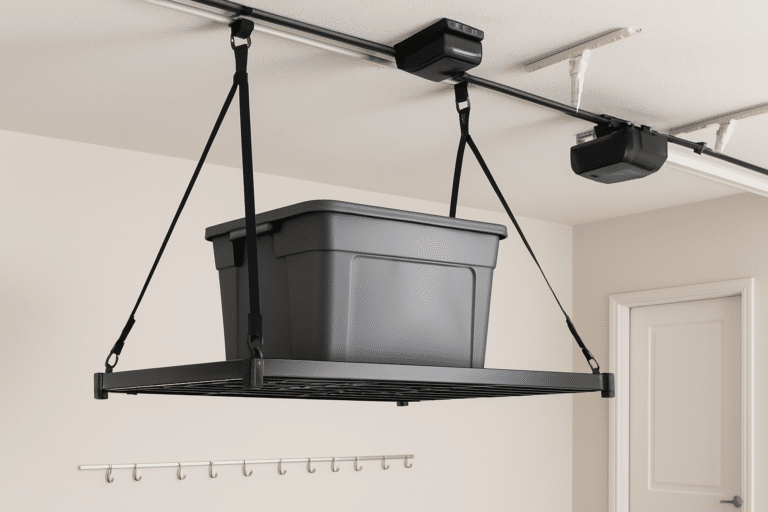
Your garage ceiling is prime real estate that’s probably going completely to waste right now. While you’re playing Tetris with bins and boxes on the floor, there’s a whole unused zone above your head just waiting to solve your storage problems. Ceiling storage lifts let you hoist heavy, bulky items up and out of the way, and they’re particularly brilliant for things like kayaks, paddle boards, bikes, and those plastic tubs of holiday decorations that only see daylight once a year.
The big question is whether you should go manual or motorized, and which system will actually work with your ceiling height, garage layout, and the specific stuff you need to store. Let’s break down the best options available and what makes each one worth considering.
Manual vs. Motorized: Which Type Makes Sense for You?

Manual pulley systems are simple. You pull a rope, your stuff goes up. You release it carefully, your stuff comes down. They’re reliable because there’s almost nothing to break, and they don’t require any electrical work or outlets near your ceiling. Most use a rope-and-pulley configuration with a locking cleat to secure the load at whatever height you want.
The downside is obvious: you’re doing all the work. For a 50-pound kayak, that’s totally manageable. For a 150-pound cargo box full of camping gear, you’ll feel it in your shoulders. Manual systems also require you to maintain steady control while lowering items, which can get tricky with awkward or heavy loads.
Motorized lifts do the heavy lifting for you with the push of a button or flick of a switch. They’re ideal for heavier items (many handle 200-400+ pounds), for anyone with physical limitations, or if you’ll be accessing stored items frequently. The trade-off is higher cost, the need for a power source, and more potential points of failure since you’re dealing with motors and electronics. If you’re planning a complete garage overhaul with smart technology integration, motorized lifts fit perfectly into a modern setup.
Top Manual Pulley Systems
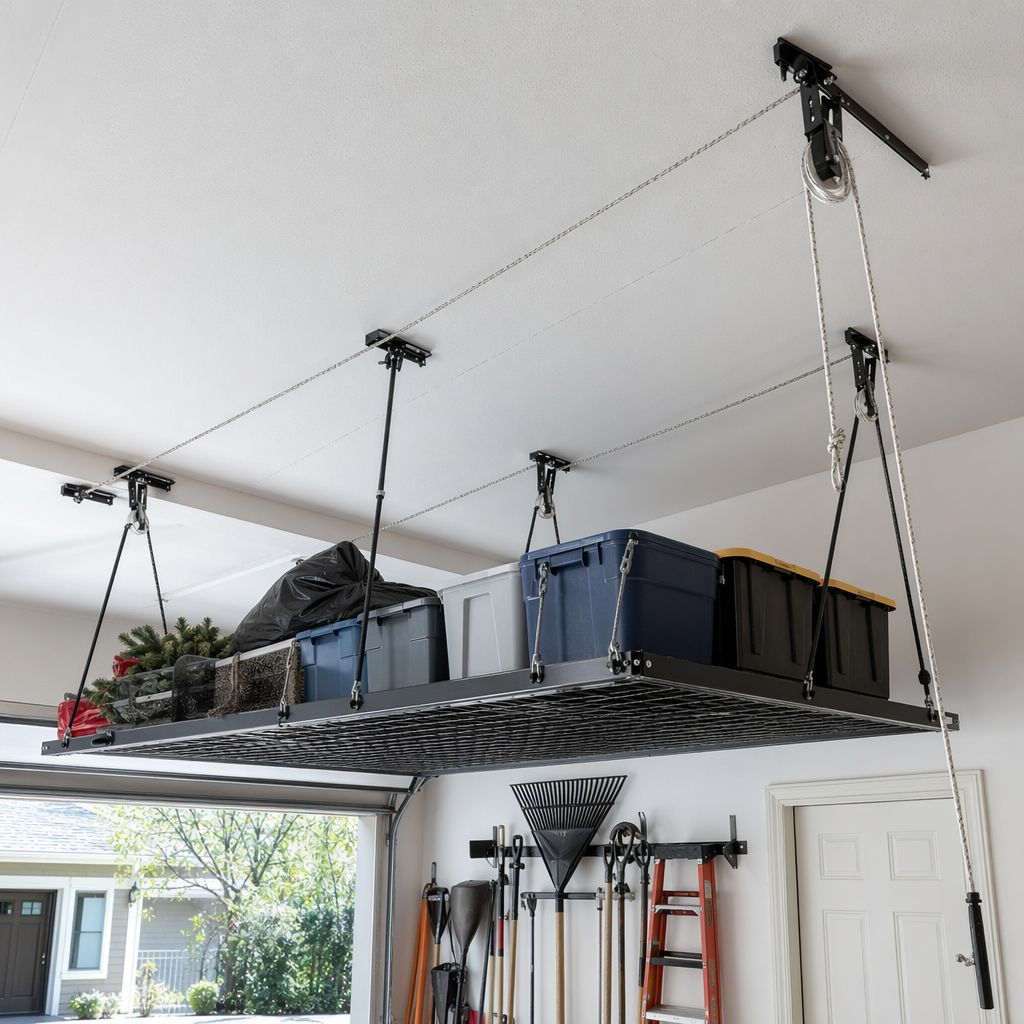
The RAD Sportz Kayak Hoist is one of the most popular manual options for good reason. It handles up to 125 pounds and works perfectly for kayaks, canoes, bikes, or ladders. The system uses two separate pulley sets that you mount to your ceiling joists, connected by a rope that runs through all four pulleys. This distributes the weight evenly and makes lifting feel easier than you’d expect.
Installation takes about 30 minutes if you’re comfortable with a drill and finding ceiling joists. The rope locks with a simple cleat system mounted on your wall. One thing to watch: make sure you have at least 10 feet of ceiling height for this to work properly with longer items like kayaks. Before installing any ceiling storage system, it’s important to properly measure your garage space to ensure everything fits correctly.

RAD Sportz Kayak Hoist Pulley System
Perfect entry-level manual system for kayaks, bikes, and lighter loads up to 125 pounds
For heavier items, the Harken Hoister steps up the game with a 200-pound capacity. Harken actually makes sailing equipment, so they know a thing or two about pulleys and load management. This system includes a 4-to-1 mechanical advantage, which means you’re only pulling about 50 pounds of force to lift a 200-pound item.
The Harken uses a locking mechanism that’s more secure than basic cleats. You pull the rope down to lift, and it automatically locks in place when you stop pulling. To lower, you pull a separate release line. It’s a smarter design that prevents accidental drops, which matters when you’re hoisting expensive bikes or gear over your car.
Best Motorized Ceiling Storage Lifts
The StoreYourBoard Motorized Ceiling Storage Lift hits the sweet spot for most homeowners. It lifts up to 250 pounds, operates with a wireless remote, and includes a platform that measures 24″ x 48″. That’s big enough for multiple bikes, a canoe, or several storage bins stacked together.
The motor is quiet and smooth, and the remote gives you precise control over height. Safety features include an automatic stop if it detects an obstruction, plus a manual override if the power goes out. You’ll need a standard 120V outlet within reach of the 8-foot power cord, but installation is more straightforward than you might think. The entire unit mounts to ceiling joists with heavy-duty lag bolts.

StoreYourBoard Motorized Ceiling Storage Lift
Top motorized choice with 250-pound capacity, wireless remote, and reliable safety features
The Racor PHL-1R Pro HeavyLift is the beast of motorized systems, handling up to 250 pounds with a larger 4′ x 4′ platform. This one’s built for serious storage like multiple kayaks, a whole season’s worth of decorations, or your collection of camping gear.
What sets it apart is the cable-driven system with steel aircraft cables rated well beyond the stated weight limit. The motor has thermal overload protection, and the remote includes up and down controls with a stop button. Installation requires mounting to at least three ceiling joists, and you’ll want two people for the job since the unit itself weighs about 45 pounds.
Weight Capacity: Don’t Cut It Close
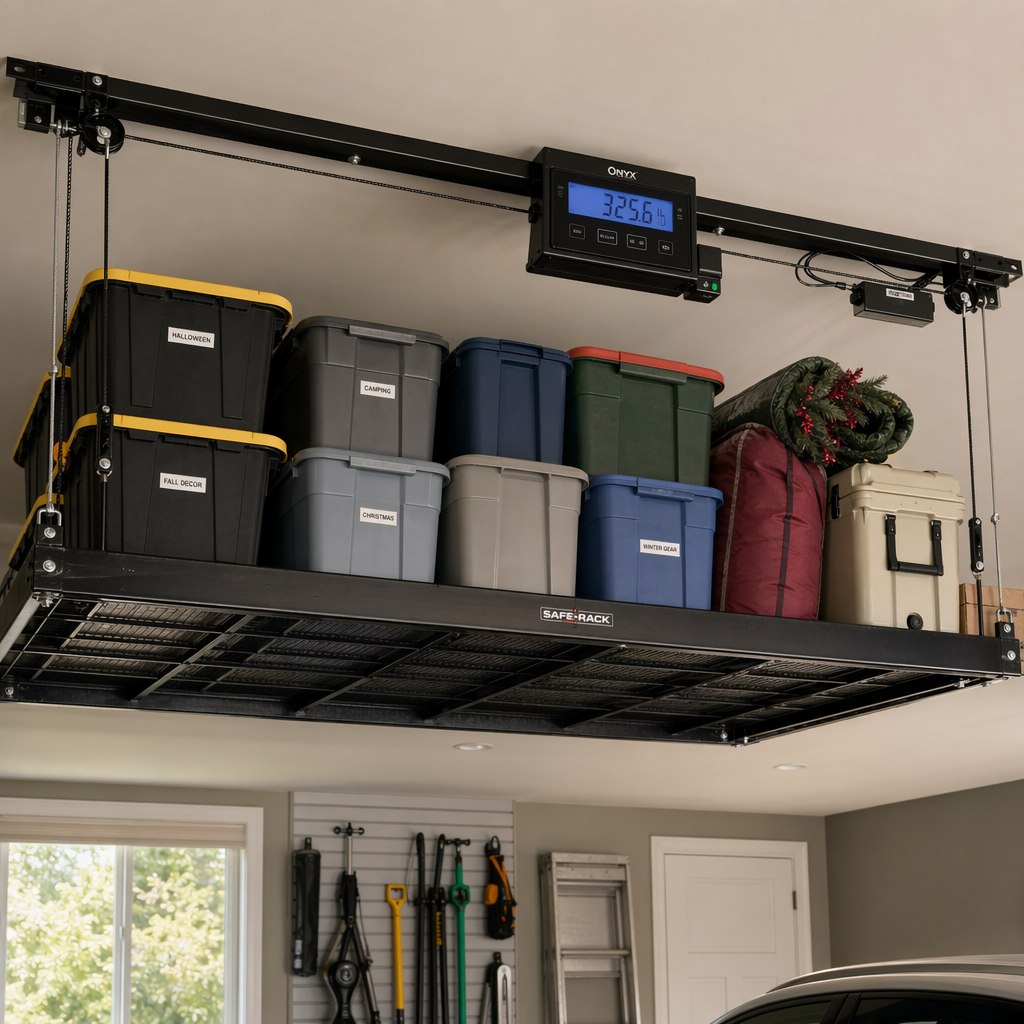
When manufacturers list a weight capacity, they’re talking about the absolute maximum under ideal conditions. You don’t want to run your system at 100% capacity regularly. Aim to stay at 75-80% of the rated limit for safety and to extend the life of your lift.
Here’s a reality check on what things actually weigh: A typical recreational kayak runs 40-80 pounds. Adult bikes are usually 25-35 pounds each. A Rubbermaid storage bin filled with decorations can easily hit 50-60 pounds. Two bikes plus a storage bin puts you at 110-125 pounds already.
Also consider the distribution of weight. A 100-pound kayak distributed across 12 feet is different from 100 pounds of weights concentrated in a 2-foot area. Long items distribute force better and actually put less stress on mounting points. Concentrated weight in the center of your platform can create flex and strain that reduces the effective capacity.
Ceiling Height and Clearance Requirements
You need enough vertical space for your items to clear your vehicles and still have lifting room. Here’s the math that matters: Start with your ceiling height, subtract the height of your tallest vehicle (including roof racks if applicable), subtract the height of whatever you’re storing, then subtract about 6-12 inches for clearance.
For most single-car garages with 8-foot ceilings, manual hoists work well for flatter items like bikes or small storage platforms. Anything taller than about 18 inches gets tight. Standard 9-10 foot ceilings give you much more flexibility and can accommodate kayaks stored horizontally.
Motorized platforms typically need 12-18 inches of clearance above the platform itself when fully raised, depending on the model. Check the specifications carefully. The motor housing and cable system take up space that cuts into your available height.
One trick: measure your ceiling height at multiple points. Many garage ceilings aren’t perfectly level, and garage door tracks can create obstacles near the door. You want to install your lift in a spot where you have consistent clearance and solid joist access.
Installation Complexity and What You Actually Need
Every ceiling lift must anchor into solid wood ceiling joists, not just drywall. A stud finder with joist-finding capability is essential. The better ones show the full width of the joist and mark the center, which is where you want to drill.
Manual systems are genuinely simple to install. You’re mounting brackets or eye bolts into joists, threading rope through pulleys, and screwing a cleat to the wall. Basic tools cover it: drill, appropriate drill bits, wrench or socket set, and a ladder. Figure 30-60 minutes for most manual setups.
Motorized systems require more work. You’re mounting a motor unit, running cables, securing the platform, and routing power. The motor unit can be heavy and awkward to position while you’re drilling mounting holes. Having a second person makes this exponentially easier. Plan on 2-3 hours for your first motorized installation. For a detailed step-by-step guide, check out our overhead ceiling storage installation guide.
The garage ceiling lift installation kits available on Amazon often include extra lag bolts, cable management clips, and installation templates that make the process cleaner. Some motorized systems include paper templates you tape to the ceiling to mark exact drilling locations.
Safety Features That Actually Matter
Auto-stop or obstruction detection on motorized lifts prevents the platform from crushing items (or people) below. This usually works through current sensing in the motor. When resistance increases beyond normal, the motor stops. It’s a must-have feature, not a luxury.
Rope quality on manual systems makes a huge difference. Look for braided nylon rated well above your use case. Some cheap systems include thin rope that frays or stretches over time. Replacing it with quality
