

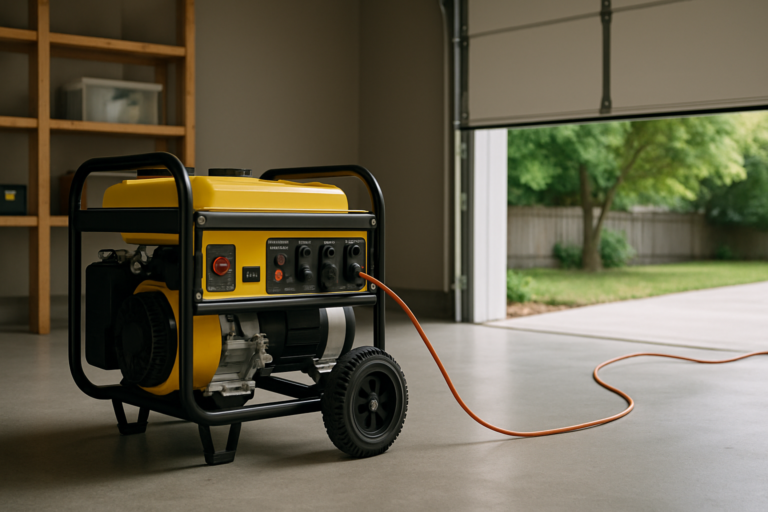
Power outages don’t wait for convenient times. When the grid goes down, you need your garage door opener, refrigerator, power tools, and critical equipment to keep running. A quality portable generator can make the difference between a minor inconvenience and a major disaster.
But here’s what most people get wrong: not all portable generators work the same way, and picking the wrong one for garage backup can leave you underpowered when you need it most. Let’s break down what actually matters when choosing a generator for garage use, from wattage calculations to the safety features that could save your life.
Understanding Generator Wattage for Garage Needs
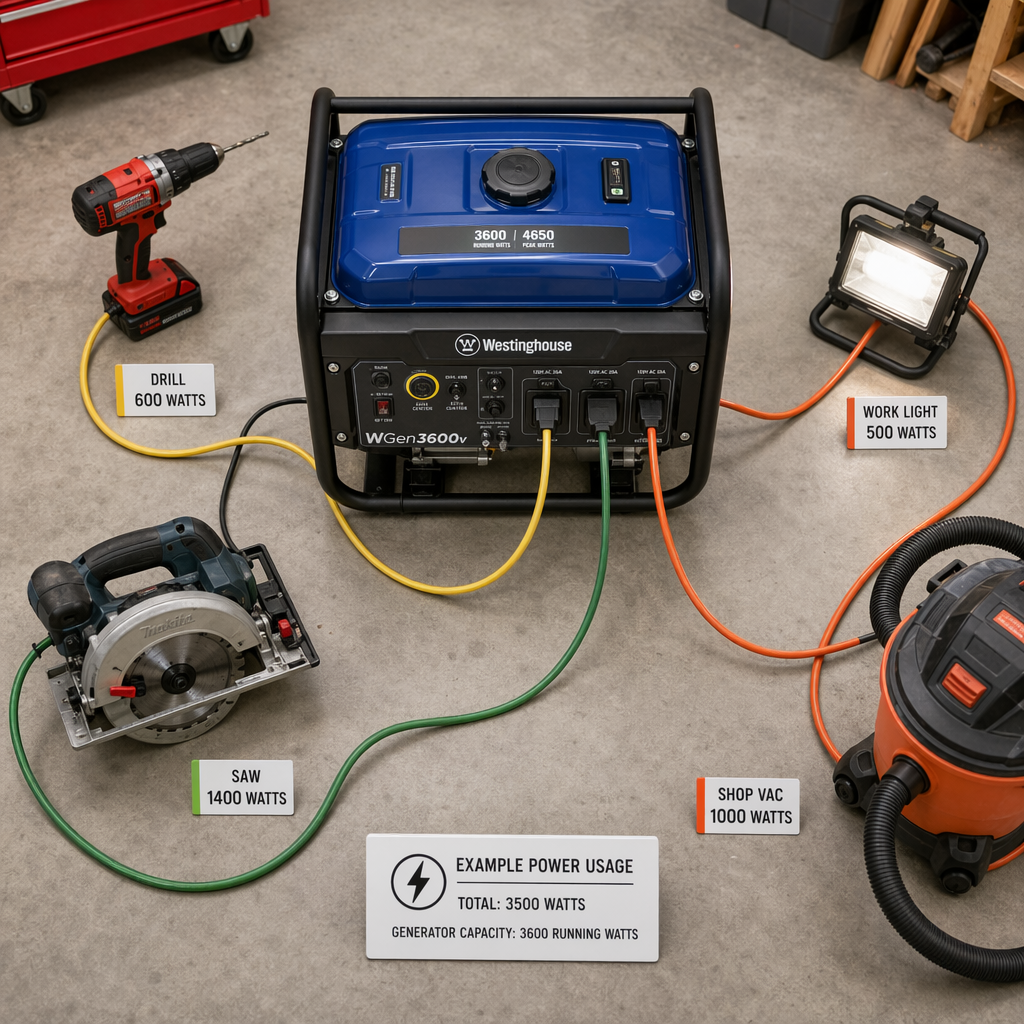
Your garage doesn’t need the same power capacity as running your entire house, but you still need to calculate carefully. Most garage door openers draw 500-1000 watts during operation, with a surge of 1500-2000 watts when starting. Add in lights, a refrigerator or freezer, and basic power tools, and you’re looking at 3000-4000 watts minimum.
Generators list two wattage ratings: running watts and starting (surge) watts. The 3500-watt class works well for most garage backup needs, while serious workshop users should consider 7000-watt models or higher.
Don’t forget about power factor. Inductive loads like motors and compressors need more starting power than the nameplate suggests. A 1-horsepower air compressor might only draw 1000 watts running, but it can pull 3000 watts on startup. Always add a 20-30% buffer to your calculations.
Top Portable Generator Picks for Garage Backup
Champion 3800-Watt Dual Fuel Generator
Champion’s dual fuel capability gives you flexibility that gas-only models can’t match. This unit runs on either gasoline or propane, with 3800 starting watts on gas and 3420 on propane. You’ll get about 9 hours runtime on a full 3.4-gallon tank at 50% load.
The electric start feature matters more than you’d think when you’re fumbling in the dark during a power outage. Just turn the key and you’re running. The unit includes a wireless remote that works up to 80 feet away, so you can start it from inside your house before heading out to the garage.

Champion 3800 Watt Dual Fuel Generator
Best overall choice for garage backup with dual fuel flexibility and remote start capability
Noise level sits at 68 dBA from 23 feet, which is comparable to a household vacuum cleaner. Not whisper-quiet, but reasonable for outdoor use. The engine runs smooth enough that vibration won’t rattle tools off your workbench.
Honda EU2200i Inverter Generator
Honda’s inverter technology delivers the cleanest power you can get from a portable generator. This matters if you’re running sensitive electronics, battery chargers, or modern garage door openers with circuit boards. The 2200 starting watts won’t power your whole garage, but it handles essentials without breaking a sweat.
Runtime reaches an impressive 8.1 hours at quarter load, and the Eco-Throttle system automatically adjusts engine speed to match demand. You’ll burn less fuel and create less noise when you’re only running a few items. At rated load, it produces just 48 decibels, quieter than normal conversation.
The parallel capability deserves mention. Buy two EU2200i units and connect them with Honda’s parallel cable kit, and you’ve got 4400 watts of inverter power. That’s enough for serious garage operations while maintaining clean, stable electricity.

Honda EU2200i Inverter Generator
Premium choice for clean power and ultra-quiet operation, ideal for sensitive electronics
Westinghouse WGen7500 Portable Generator
When you need serious power for running multiple tools, welders, or a full garage setup, the WGen7500 delivers 9500 starting watts and 7500 running watts. This beast powers everything simultaneously without worrying about load calculations.
The 6.6-gallon fuel tank provides up to 11 hours of runtime at half load. Westinghouse includes both electric start and a traditional recoil backup, plus a remote start key fob. The all-steel frame and never-flat wheels handle rough garage floors and outdoor positioning.
Four 120V household outlets, one 120V/240V twist-lock outlet, and one 120V/240V RV outlet give you plenty of connection options. The built-in digital hour meter helps you track maintenance intervals, and the low oil shutdown protects the engine from damage.
Fuel Type Considerations: Gas, Propane, and Dual Fuel
Gasoline generators cost less upfront and deliver maximum power output. You’ll get the highest wattage from gas, and fuel availability isn’t usually a problem. But gasoline degrades within 30 days without stabilizer, and storing large quantities in your garage creates fire hazards.
Propane burns cleaner, stores indefinitely, and produces less carbon monoxide. A standard 20-pound barbecue cylinder connects easily to most dual-fuel units. The downside: you’ll lose about 10% power output compared to gasoline, and propane performs poorly in extreme cold.
Dual-fuel generators like the Champion models offer the best of both worlds. Run gasoline for maximum power when you need it, switch to propane for cleaner operation and easier long-term storage. Keep both fuel types on hand and you’ve got true backup security.
Natural gas conversion kits exist for some models, but installation requires professional help and permanent mounting. This works better for whole-house standby generators than portable garage units.
Critical Carbon Monoxide Safety
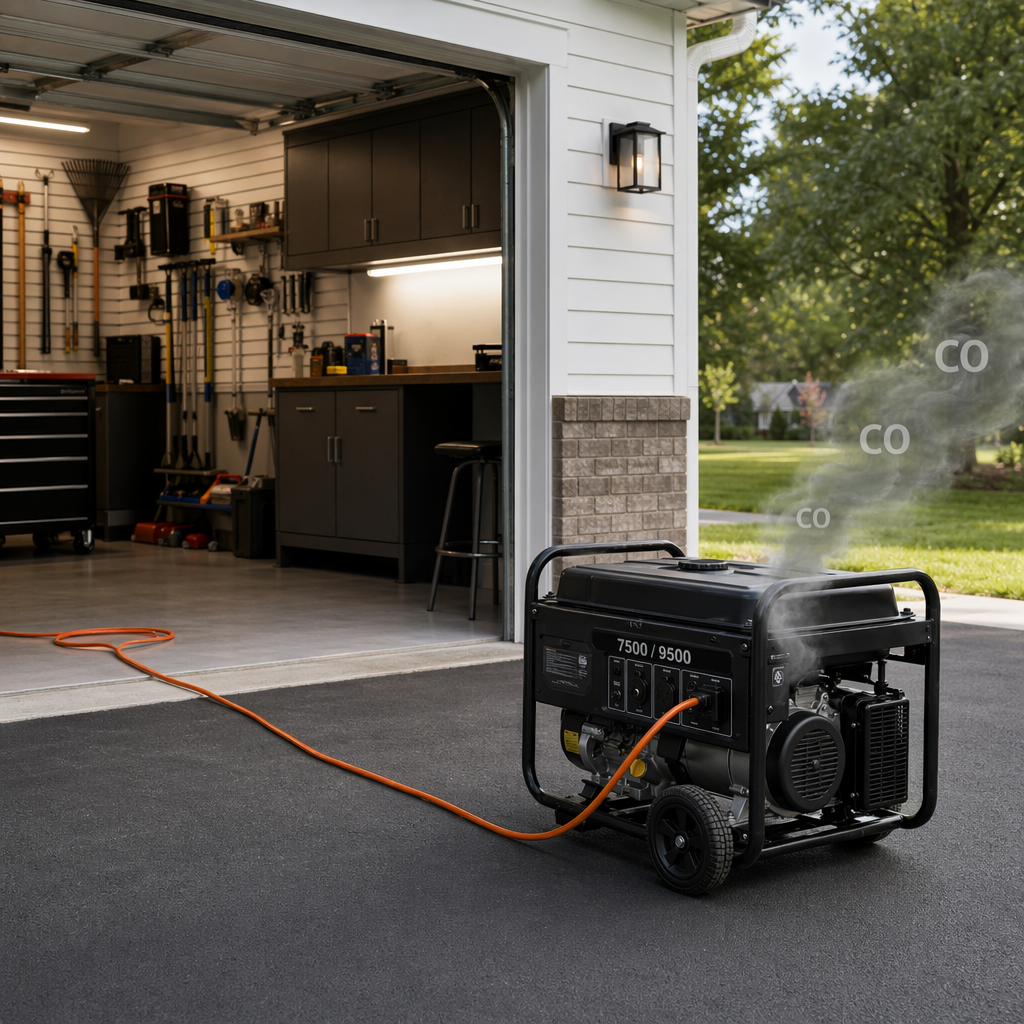
This isn’t optional information you can skip. Generators produce deadly carbon monoxide gas that kills people every year. Running a generator inside your garage, even with the door open, can kill you and your family in minutes.
Always position generators outdoors, at least 20 feet from windows, doors, and vents. Carbon monoxide seeps into your home through tiny gaps you can’t see. The exhaust needs to point away from structures, and you need proper airflow around the entire unit. If your garage has poor ventilation, consider installing a screen door to improve airflow when the garage door is closed.
Install battery-powered carbon monoxide detectors in your garage and adjacent living spaces. Test them monthly and replace batteries twice yearly. Some newer generators include built-in CO shutdown sensors, but don’t rely on these alone.
Never use a generator in rain or wet conditions without a proper generator cover or tent. Water and electricity don’t mix, and you risk electrocution or equipment damage. These covers allow exhaust ventilation while keeping the unit dry.
Proper Garage Storage and Maintenance
Store your generator in a dry, accessible spot where you can move it quickly during an outage. Keep it elevated off the floor on a wheeled dolly or platform to prevent moisture damage and make transport easier.
Drain the carburetor and fuel tank before long-term storage, or add fuel stabilizer and run the generator for 10 minutes to circulate treated fuel through the system. Old fuel gums up carburetors and prevents starting when you actually need power.
Change oil after the first 20 hours of use, then every 50-100 hours depending on your model. Use the manufacturer’s recommended weight. Most generators take standard 10W-30 motor oil, but check your manual. Keep a spare maintenance kit with oil, spark plugs, and air filters on hand.
Test-run your generator monthly for 15-20 minutes under load. This keeps the engine lubricated, charges the battery on electric-start models, and confirms everything works before you need it in an emergency. Attach a heavy-duty extension cord and run a space heater or work light to create load. Just like keeping your garage door opener properly lubricated, regular maintenance ensures reliable operation when you need it most.
Transfer Switches and Connection Safety
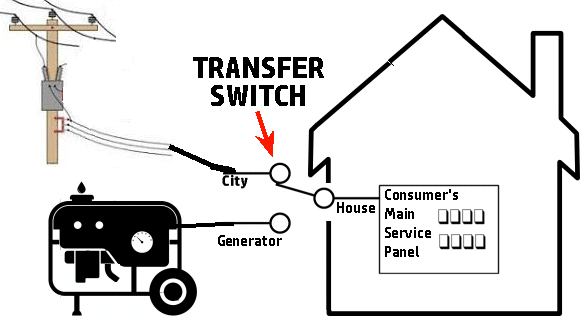
Never backfeed your house by plugging a generator into a wall outlet. This energizes utility lines, creates fire risks, and can electrocute utility workers trying to restore power. It’
