

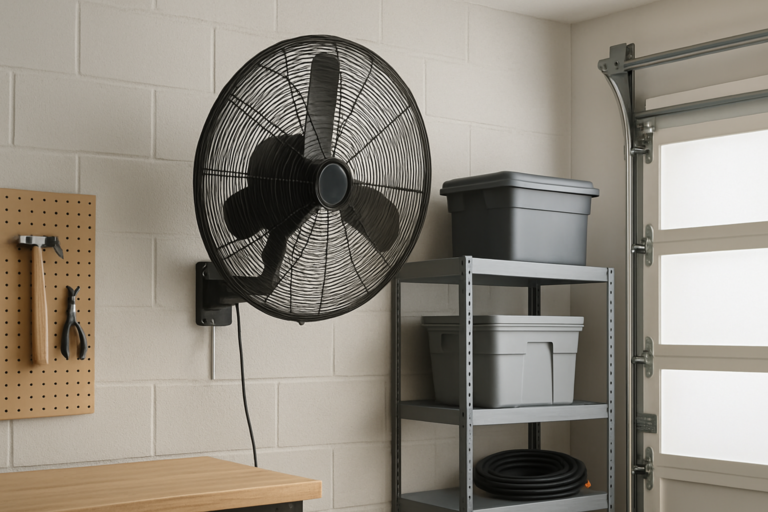
Working in a sweltering garage during summer months can turn even simple projects into endurance tests. A quality wall-mounted fan changes everything by keeping air moving without eating up precious floor space. Unlike portable fans that you’ll constantly trip over or ceiling fans that require major installation work, wall-mount fans give you powerful airflow exactly where you need it.
The right garage fan needs to handle dust, temperature swings, and the occasional spray of whatever you’re working with. I’ve tested and researched dozens of models to help you find one that’ll actually survive garage life while keeping you comfortable.
Why Wall-Mount Fans Beat Other Options
Floor fans take up space in an area where you’re already fighting for every square foot. They’re also magnets for getting knocked over or rolled over by equipment. Ceiling fans work great if you have the height and don’t mind a complicated install, but most garages aren’t set up for them.
Wall-mounted models give you the best of both worlds. They clear your floor space completely, mount at whatever height works best for your workspace, and typically install in under an hour with basic tools. You can position them to blow directly on your work area or angle them to create circulation throughout the whole garage.
The other advantage is flexibility. Many wall-mount fans let you adjust the tilt and direction even after installation, so you can redirect airflow as your projects change.
Top Wall-Mount Garage Fans Worth Considering
Hurricane Wall Mount Fan
The Hurricane brand consistently delivers commercial-grade performance that holds up to serious garage use. Their wall-mount models come in 16-inch, 18-inch, and 20-inch sizes, with the 20-inch version pushing over 6,000 CFM when you crank it up. That’s enough airflow to cool a two-car garage effectively.
What separates Hurricane fans from cheaper options is the metal construction and sealed bearings that keep working even when exposed to sawdust, metal shavings, or humidity from a partially open bay door. The three-speed pull chain is old-school reliable, and the fan head tilts nearly 90 degrees for maximum positioning control.
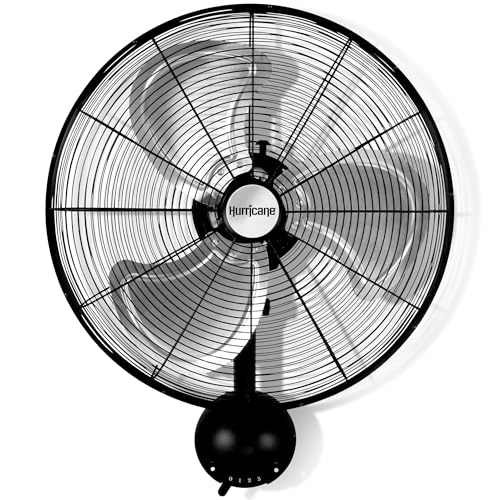
Hurricane 20 Inch Wall Mount Fan
Heavy-duty construction with exceptional CFM output for larger garages
Air King Commercial Wall Mount Fan
Air King specializes in industrial settings, and their garage fans reflect that pedigree. The 9018 model delivers around 2,400 CFM with less noise than you’d expect from that kind of airflow. At just 63 decibels on high speed, you can still hear your phone ring or hold a conversation.
The permanently lubricated motor means zero maintenance beyond occasional blade cleaning.
The pivoting fan head and adjustable mounting bracket give you precise control over airflow direction. I particularly like that the control switch mounts separately on the wall rather than requiring you to reach up to the fan itself.
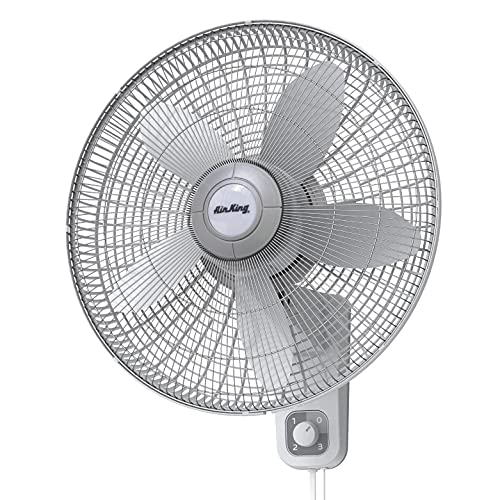
Air King 9018 Wall Mount Fan
Quiet operation with separate wall switch makes this ideal for workshops where you need to hear what you’re doing
Maxx Air Wall Mount Fan with Oscillation
Oscillating wall fans spread airflow across a wider area instead of blasting one spot. The Maxx Air oscillating models sweep roughly 90 degrees, which works perfectly if you move around your garage or want to cool multiple work zones without repositioning anything.
These fans include a remote control, which sounds like a luxury until you realize how often you’ll use it. Adjusting speed from across the garage beats walking over to pull a chain, especially when your hands are covered in grease or paint.
The Maxx Air fans push around 5,000 CFM on the highest setting. They run slightly louder than the
Simple Deluxe Heavy Duty Metal Fan
For those working with tighter budgets, the Simple Deluxe wall mount fans deliver solid performance without premium features. You get a 16-inch three-speed fan with about 2,000 CFM and basic tilt adjustment.
The all-metal construction handles garage conditions better than plastic alternatives. These fans don’t have remote controls or oscillation, but they mount easily and push enough air for single-car garages or focused work areas in larger spaces. The straightforward pull-chain controls won’t impress anyone, but they won’t break either.
Key Specs That Actually Matter
Airflow (CFM) Reality Check
CFM ratings tell you how many cubic feet of air the fan moves per minute. For garage use, you want at least 1,500 CFM for every 400 square feet of space. A standard two-car garage is about 400-600 square feet, so look for fans pushing 3,000 CFM or more.
Keep in mind that manufacturers measure CFM under ideal conditions. Real-world performance typically runs 10-20% lower, especially on lower speed settings. A fan rated for 5,000 CFM probably delivers closer to 4,000-4,500 CFM when mounted on your wall and angled downward.
Noise Levels You Can Live With
Decibel ratings help, but they don’t tell the whole story. A fan rated at 70 decibels might sound quieter than one at 65 decibels if it produces a smooth whooshing sound instead of rattles or whistles.
For reference, normal conversation happens around 60 decibels. Fans in the 60-70 decibel range let you talk without raising your voice. Anything over 75 decibels gets annoying quickly during extended work sessions.
Metal blade fans tend to run louder than plastic blade models, but they’re also more durable and less likely to warp or crack over time. It’s a trade-off worth making for garage applications.
Weather Resistance Features
Garages with bay doors that stay partially open expose fans to humidity, temperature swings, and airborne debris. Look for sealed bearings, rust-resistant coatings, and motors rated for damp locations (not just dry indoor use).
IP ratings (Ingress Protection) help identify truly weather-resistant models. An IP44 rating means the fan handles water splashing from any direction. That level of protection works for most garage situations where you’re not dealing with direct spray or standing water.
The electrical components matter too. Fans with thermally protected motors shut down if they overheat rather than burning out completely. This feature extends the fan’s life considerably in garage environments where dust buildup can restrict airflow through the motor housing.
Installation Tips From Experience
Mount your fan at least 7 feet off the ground to keep it above head height while maximizing airflow coverage. The optimal position is usually on a side wall aimed toward your primary work area, angled down about 15-20 degrees.
Use the mounting bracket that comes with the fan rather than improvising. These brackets are designed to handle the torque and vibration from extended operation. Secure the bracket to wall studs with lag bolts, not just drywall anchors. A 20-inch fan spinning at high speed generates surprising force.
Wire the fan to its own dedicated circuit if possible, especially for larger models that draw 200+ watts. Running it on the same circuit as your compressor or welder invites breaker trips. Most wall-mount fans use standard 120V power, so installation just requires basic electrical knowledge and following local codes.
Consider adding a separate wall switch even if your fan has pull chains. You’ll appreciate the convenience every time you walk into the garage with your hands full.
Frequently Asked Questions
Can I leave a wall-mount fan running all the time in my garage?
Quality fans with thermally protected motors handle continuous operation without issues. Running your fan constantly during hot months actually helps reduce humidity and prevents heat buildup that can damage stored items. Just clean the blades monthly to prevent dust accumulation that reduces efficiency. Most commercial-grade models are designed for 24/7 operation in warehouses and factories, so garage use is well within their capabilities.
What size fan do I need for a two-car garage?
Most two-car garages (400-600 square feet) need a minimum 18-inch fan pushing 3,500+ CFM for effective cooling. A 20-inch fan rated for 5,000+ CFM provides better circulation and lets you run lower speeds more often, which reduces noise and extends motor life. Larger fans also create better air movement in garages with 10-foot or higher ceilings where heat accumulates at the top.
Do I need an oscillating fan or will a fixed fan work?
Fixed fans work great if you have a dedicated workspace and want maximum airflow in one direction. Oscillating fans make more sense for garages where you move between different areas or want to distribute air throughout the space. Oscillating models cost slightly more and have additional moving parts that could eventually need maintenance, but the coverage area they provide often justifies the extra investment for larger garages or multi-purpose spaces.
This article contains affiliate links. We may earn a small commission at no extra cost to you.
