

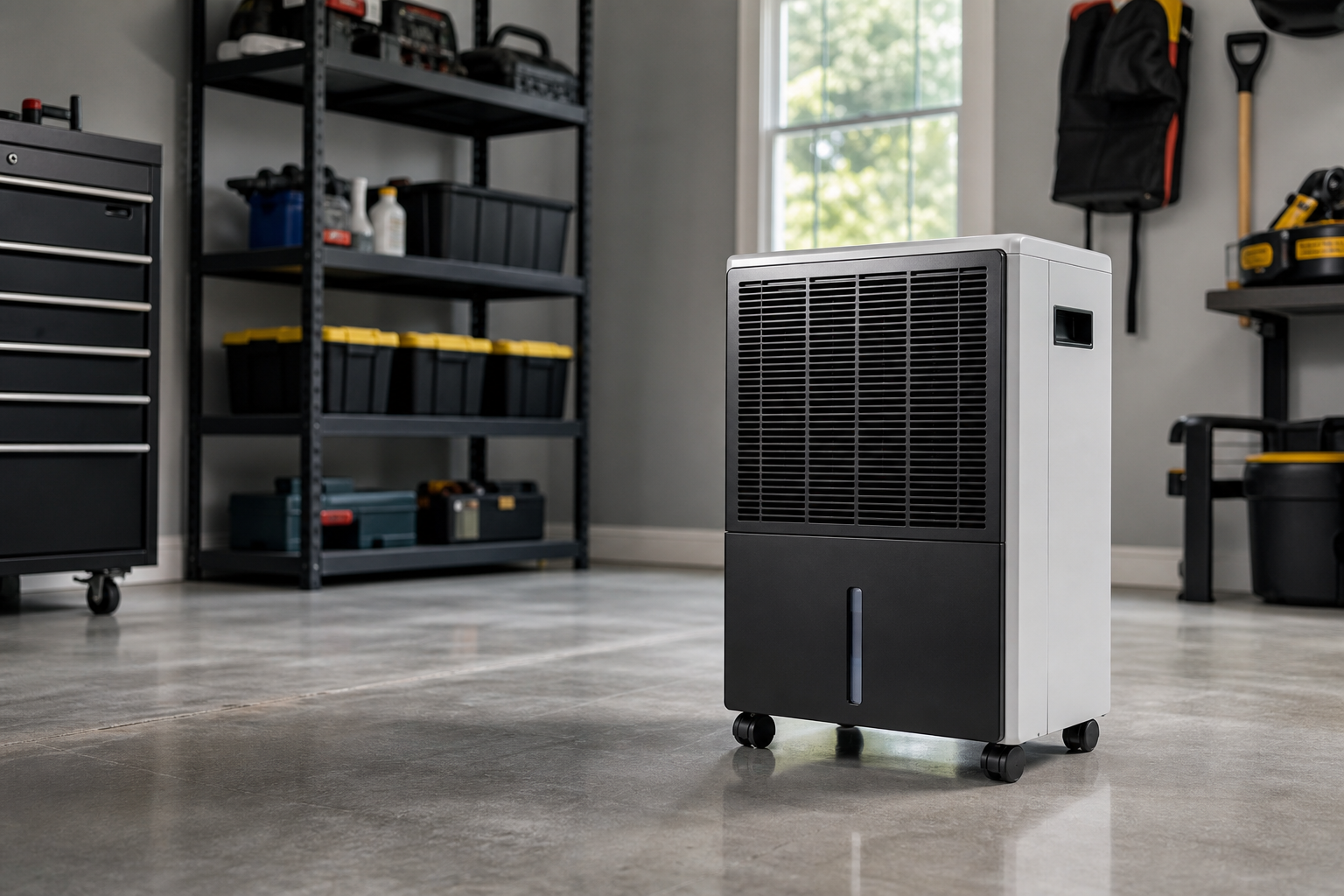
Picking the right garage dehumidifier isn’t about finding the highest star rating. It’s about matching product strengths to your needs: durability, ease of installation, or budget constraints.
Below, you’ll find honest assessments of top contenders, what separates them, and which ones fall short of their marketing. Check Amazon for current pricing.
Understanding the Basics
A garage dehumidifier removes moisture from the air to prevent rust on tools, mold on stored items, and that musty smell that settles into everything. Unlike basement dehumidifiers, garage units face temperature extremes, dust, and often operate in unheated spaces where condensation forms quickly on metal surfaces and concrete floors.
Capacity matters more than brand recognition. A 30-pint unit handles roughly 1,500 square feet in moderate humidity. A 50-pint model covers the same space in high humidity (70% or above) or stretches to 2,500 square feet in moderate conditions. A 70-pint unit is overkill for most single-car garages but necessary for two-car spaces in humid climates or garages that double as workshops with moisture-generating activities.
Humidity levels above 60% create ideal conditions for mold and corrosion. Below 30% can dry out wood, crack rubber seals, and make the space uncomfortably dusty. Target 40 to 50% year-round. A built-in hygrometer (humidity sensor) lets the unit cycle on and off automatically to maintain that range without running continuously.
Operating temperature range separates garage-appropriate units from basement models. Standard dehumidifiers shut down or ice up below 65 degrees. Low-temperature models with auto-defrost operate effectively down to 41 degrees, which covers most attached garages in winter. Detached garages in cold climates need units rated to 33 degrees or a supplemental heat source to keep the dehumidifier functional.
Drainage setup determines whether you’re emptying a bucket daily or running hands-off for weeks. Bucket-only models work if you’re in the garage regularly and don’t mind the routine. Continuous drain via gravity (a hose running to a floor drain or outside) eliminates manual emptying entirely. Pump-equipped models push water upward or across distances when gravity drain isn’t an option. The pump adds cost but solves layout problems where the nearest drain sits higher than the unit or across the garage.
Durability and Build Quality
Garage environments beat up appliances faster than climate-controlled spaces. Dust infiltrates motor housings. Temperature swings stress plastic components. Vibration from garage door operation and workshop tools loosens connections over time.
Steel or heavy-duty plastic housings outlast thin injection-molded cases. Check the caster wheels. Flimsy plastic wheels crack under the unit’s weight when you move it for cleaning or seasonal storage. Rubberized or ball-bearing wheels handle concrete floors and repeated repositioning without failing.
Washable filters save money and extend lifespan. Permanent filters rinse clean under a hose. Disposable filters add significant replacement costs, and garages clog filters faster than living spaces due to sawdust, drywall dust, and general grime. A unit requiring monthly filter replacement becomes expensive and annoying.
Coil design affects frost resistance and efficiency. Aluminum coils transfer heat well but corrode in salty coastal air or garages where road salt tracks in. Copper coils cost more but resist corrosion better. Some manufacturers coat aluminum coils with corrosion-resistant treatments, which splits the difference on price and durability.
Control placement matters in a dusty space. Top-mounted controls stay cleaner than front-panel buttons that collect grime. Digital displays with membrane buttons seal better against dust intrusion than mechanical dials and exposed switches. External control panels that detach for wall mounting let you operate the unit without crouching down or clearing workspace clutter.
Compressor warranties reveal manufacturer confidence. A one-year parts warranty suggests budget construction. Three to five years on the compressor indicates they expect the unit to survive typical garage abuse. Extended warranties rarely pay off on dehumidifiers, but the base warranty length signals build quality.
Capacity and Coverage
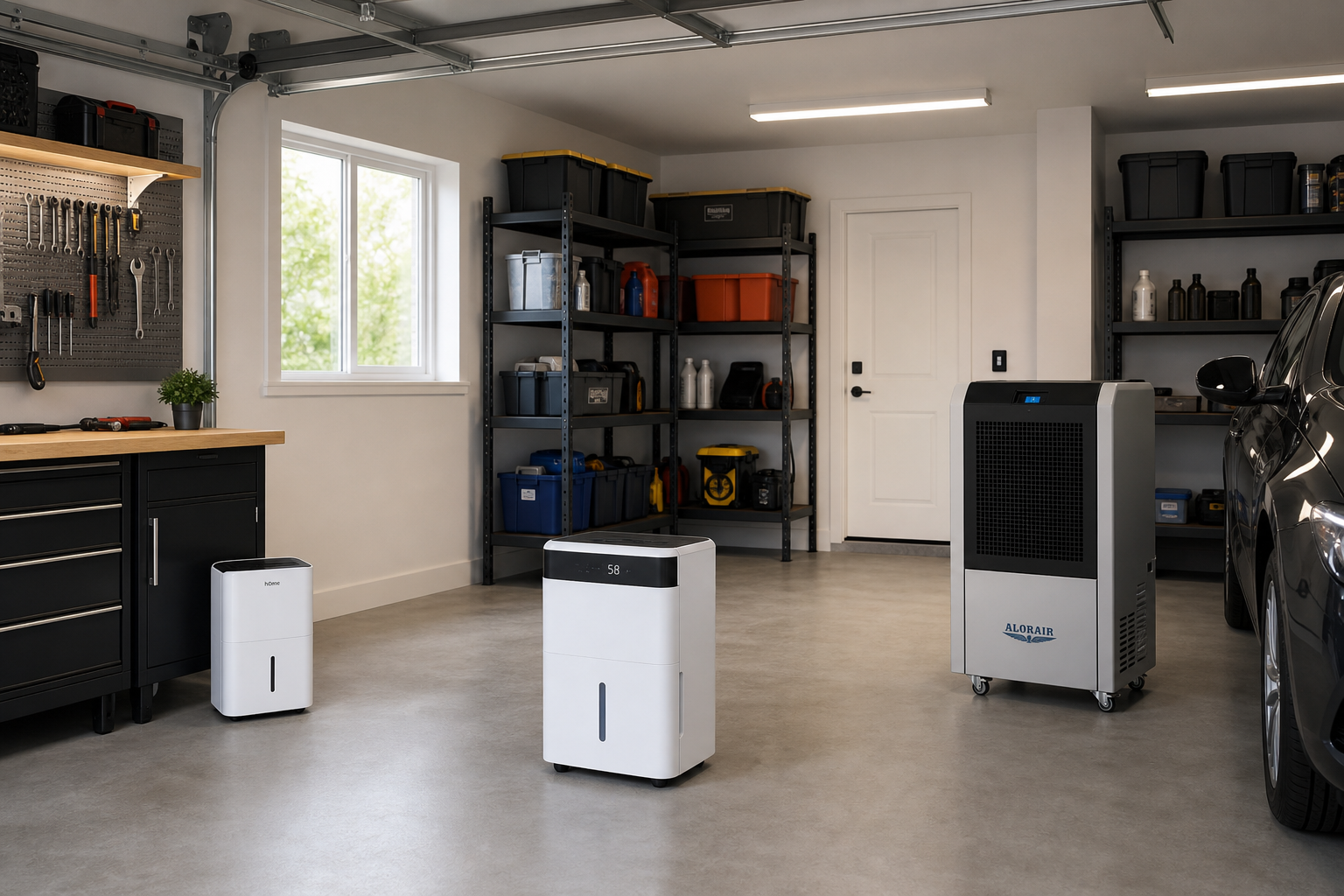
A standard two-car garage (roughly 20 by 20 feet, or 400 square feet) needs a 30-pint unit in moderate climates. High-humidity regions (Gulf Coast, Southeast, Pacific Northwest) bump that to 50 pints. Add another 10 to 20 pints of capacity if you store wet items (snow-covered vehicles in winter, lawn equipment after use, pressure washer gear). Quality floor mats can help protect against tracked-in moisture while the dehumidifier works to maintain ideal humidity levels.
Ceiling height affects capacity calculations. An 8-foot ceiling is standard. A 10-foot ceiling increases cubic footage by 25%, which means 25% more air to dehumidify. A 12-foot ceiling doubles the air volume of an 8-foot space. Most capacity ratings assume 8-foot ceilings, so adjust upward for tall garages or you’ll run the unit constantly without hitting target humidity.
Concrete slabs transmit ground moisture through capillary action, especially older slabs without vapor barriers. This adds moisture load beyond what humidity calculations predict. If your concrete floor sweats or shows efflorescence (white mineral deposits), increase capacity by one size class. A garage that should need a 30-pint unit actually requires a 50-pint model to handle both airborne humidity and slab transmission. Properly sealing any existing floor cracks before addressing other moisture issues can significantly improve your dehumidifier’s effectiveness.
Attached garages connected to conditioned living space dry faster than detached garages. Air exchange with the house provides some dehumidification for free. Detached garages are sealed boxes where humidity has nowhere to go except through the dehumidifier. If your garage shares a wall with the house and you crack the interior door occasionally, you can size down slightly. A fully detached garage needs the full rated capacity or more.
Workshop activities generate surprising amounts of moisture. Wet-sanding drywall, concrete work, spray-painting, or washing tools and equipment all add humidity. If you do more than park cars, oversize the dehumidifier by at least one capacity step. A 50-pint unit priced moderately higher than a 30-pint model costs less than running a marginal unit at maximum load year-round.

50 Pint Dehumidifier
Best balance of capacity and cost for most two-car garages
Energy Efficiency and Operating Cost
Energy Star ratings compare similar-capacity units but don’t account for runtime. A slightly less efficient unit that cycles off more often (because it’s properly sized) costs less to operate than an Energy Star model running continuously because it’s undersized. Match capacity to space first, then compare efficiency within that capacity class.
Measure efficiency in liters per kilowatt-hour (L/kWh). Higher numbers mean more water removal per unit of electricity. A rating of 1.85 L/kWh is average. 2.5 L/kWh or above is excellent. Below 1.5 L/kWh wastes energy. Units at the low end of the efficiency range cost significantly more per month to operate in continuous use compared to efficient models.
Operating cost depends on local electricity rates and runtime. At typical rates, a 50-pint dehumidifier rated at 600 watts costs roughly competitively priced2 per hour to run. If it runs 8 hours per day in summer, monthly costs add up. An Energy Star model at 500 watts reduces operating expenses. Over a humid six-month season, the efficient model saves money, which doesn’t offset a significant price premium but adds up over the unit’s lifespan.
Auto-shutoff when the bucket fills or target humidity is reached prevents wasted runtime. Some budget units lack true automatic operation and just turn off when the bucket overflows, which means they’ve been running pointlessly for hours before shutdown. Look for models that monitor humidity continuously and stop when the set point is achieved, then restart only when humidity climbs back above target.
Fan-only modes let you circulate air without running the compressor, which helps in shoulder seasons when humidity is borderline but not high enough to justify full dehumidification. This mode uses roughly one-tenth the power of full operation. It’s a nice-to-have feature, not essential, but it extends the dehumidifier’s usefulness into spring and fall when temperatures are mild but air movement alone solves minor stuffiness.
Auto-Defrost and Cold-Weather Operation
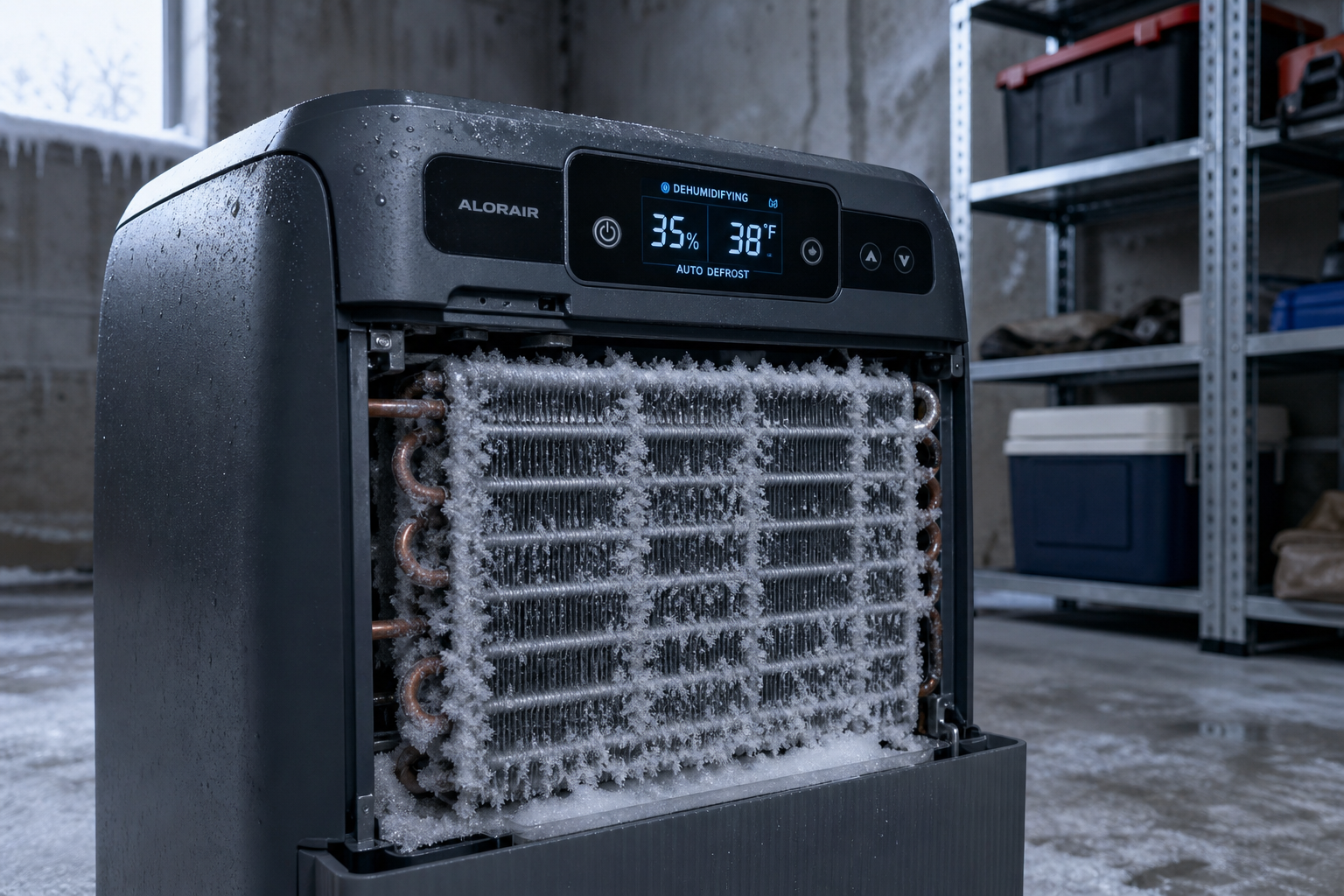
Standard dehumidifiers ice up when coils drop below the dew point in cold conditions. Ice blocks airflow, shuts down moisture removal, and forces the unit to work harder when it finally melts. Auto-defrost stops the compressor periodically and runs the fan alone to melt accumulated frost before it builds up enough to cause problems.
Hot gas defrost reverses refrigerant flow briefly to warm the coils. This method defrosts faster than fan-only cycles but adds mechanical complexity. It’s common on mid-range and premium units. Budget models often use simpler fan-only defrost, which works but takes longer and reduces effective dehumidification time in cold weather.
Low-temperature operation down to 41 degrees covers most attached garages in winter. Detached garages in northern climates drop below that threshold regularly. If your garage hits freezing or near-freezing temps, you need either a unit rated to 33 degrees or you accept that dehumidification shuts down in deep winter. Since winter air is naturally drier in cold climates, seasonal shutdown isn’t always a problem. Proper winterization of plumbing systems becomes critical when dehumidifiers shut down for the season.
Compressor protection circuitry prevents startup in extreme cold, which avoids damage but also means no dehumidification when you might want it. Some units display error codes and refuse to run below rated temperature. Others attempt to start, fail, and cycle repeatedly, which stresses components. A unit that clearly communicates “too cold to operate” is better than one that pretends to work while accomplishing nothing.
Frost sensors detect ice buildup and trigger defrost cycles automatically. Cheaper units use fixed-interval defrost timers that run whether frost is present or not, wasting time. Sensor-based defrost responds to actual conditions and minimizes downtime. This feature shows up in spec sheets as “intelligent defrost” or “frost sensor technology.”
Drainage Options
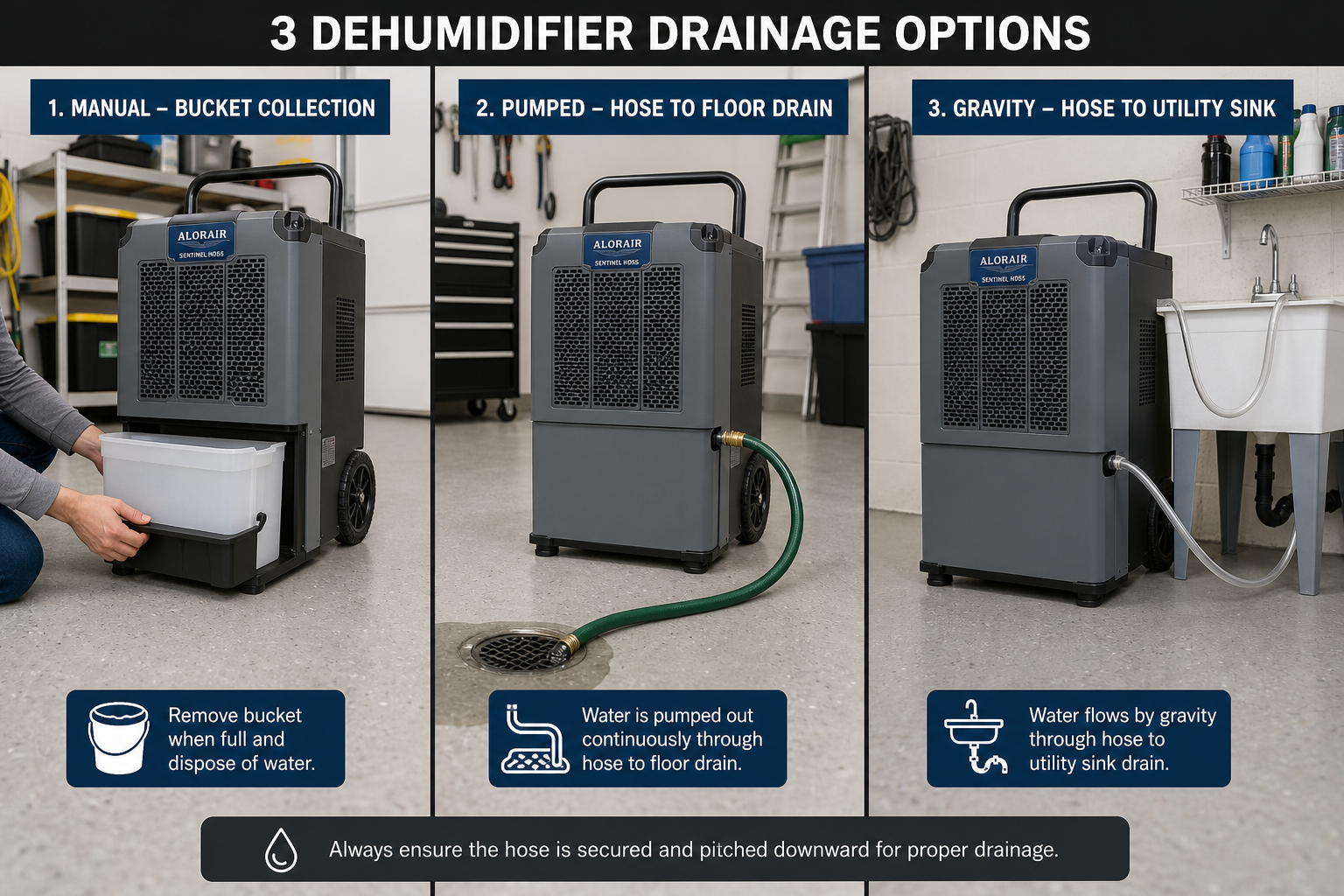
Bucket-based collection works for spaces where you’re present daily and a full bucket isn’t a crisis. A 30-pint bucket fills in roughly 24 hours at peak humidity. A 50-pint bucket gives you two days. If you forget, the unit shuts off and humidity climbs back up until you empty it. Bucket systems have one advantage: they’re portable, no installation required, and you can relocate the unit anywhere.
Continuous gravity drain uses a standard garden hose connection to route water to a floor drain, sump pit, or outside. The drain outlet needs to sit lower than the unit’s drain port for gravity to work. A gentle slope (1/4 inch per foot minimum) keeps water moving. Flat or uphill runs cause backups. Position the dehumidifier on a platform or shelf if the drain is only slightly lower than the unit’s base.
Condensate pumps handle situations where gravity won’t work. The pump lifts water vertically up to 15 feet or pushes it horizontally 50+ feet. Built-in pumps add cost to the unit price. External condensate pumps cost less and connect to any dehumidifier with a hose port. Pumps require power and add a failure point, but they’re the only option when the nearest drain is across the garage or outside a wall.
Hose diameter affects flow rate. Most dehumidifiers use a 5/16-inch or 3/8-inch outlet. Standard garden hoses (5/8-inch) work but require an adapter. Smaller-diameter hose matches the outlet exactly but kinks easier and slows drainage if the run is long. For runs over 20 feet, use 1/2-inch tubing to maintain flow and prevent backups.
Check the drain connection for secure attachment. Some models use a simple friction fit that loosens with vibration or bumps. Threaded connections stay
