

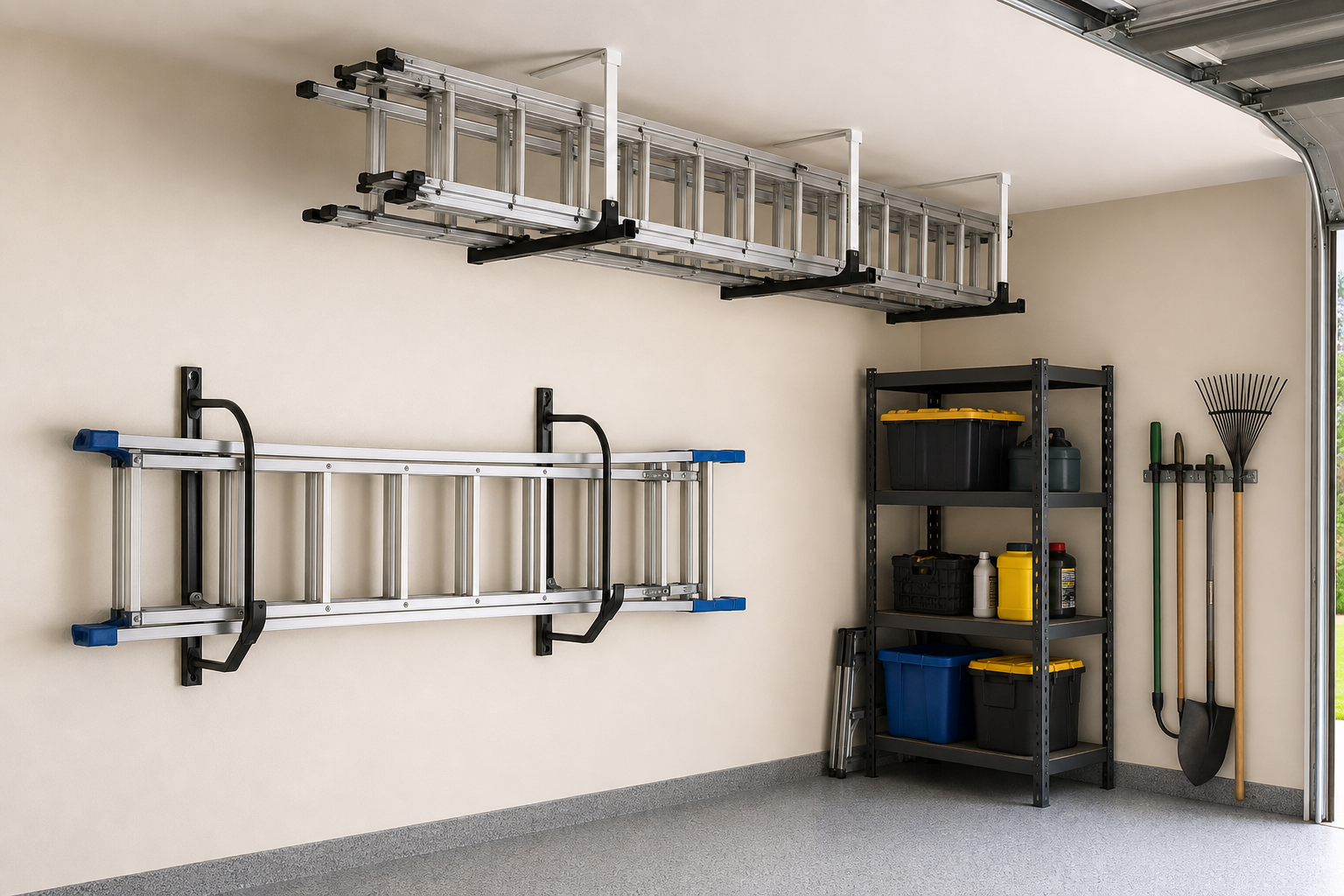
Picking the right garage ladder storage racks isn’t about finding the highest star rating. It’s about matching product strengths to your needs: durability, ease of installation, or budget constraints.
Below, you’ll find honest assessments of top contenders, what separates them, and which ones fall short of their marketing. Check Amazon for current pricing.
Understanding the Basics
Effective garage storage uses walls and ceiling as primary surfaces, keeping the floor clear for vehicles and work. Wall-mounted track systems, overhead ceiling racks, and sturdy cabinets provide organized access without eating into parking or workspace.
Weight capacity is critical and often misunderstood. Wall systems in studs hold 50 to 75 pounds per linear foot. On drywall alone, that drops to 15 to 25 pounds before failure. Ceiling racks rated for 600 pounds assume even distribution – concentrating weight in one area can cause failure well under the total limit.
Ladder storage adds another layer of complexity. Extension ladders typically weigh 25 to 50 pounds and stretch 16 to 28 feet when extended. Step ladders run 15 to 40 pounds depending on height and material. That weight matters when choosing between a simple wall hook and a full horizontal ceiling rack.
Your ceiling joists run one of two directions: parallel or perpendicular to your garage door. If they’re perpendicular, you can mount a horizontal ladder rack across multiple joists for solid distribution. If they run parallel, you’ll need to install blocking between joists or use a different mounting strategy. Check this before buying anything.
Mounting height matters more than most people think. A ceiling-mounted rack needs enough clearance below for your tallest vehicle plus a foot or two of buffer. If you’re dealing with garage door issues, that affects your clearance calculations too.
Measure from the garage floor to the bottom of your open garage door’s track assembly. That’s your ceiling clearance constraint. Subtract your vehicle height plus 18 inches, and what remains is your usable vertical space for racks.
Clear plastic bins beat cardboard for garage storage in every way: moisture resistance, pest resistance, visibility, and stackability. Label each bin on the front for easy identification. A label maker and 20 minutes of work saves hours of searching over the coming years.
Wall-Mount Ladder Racks
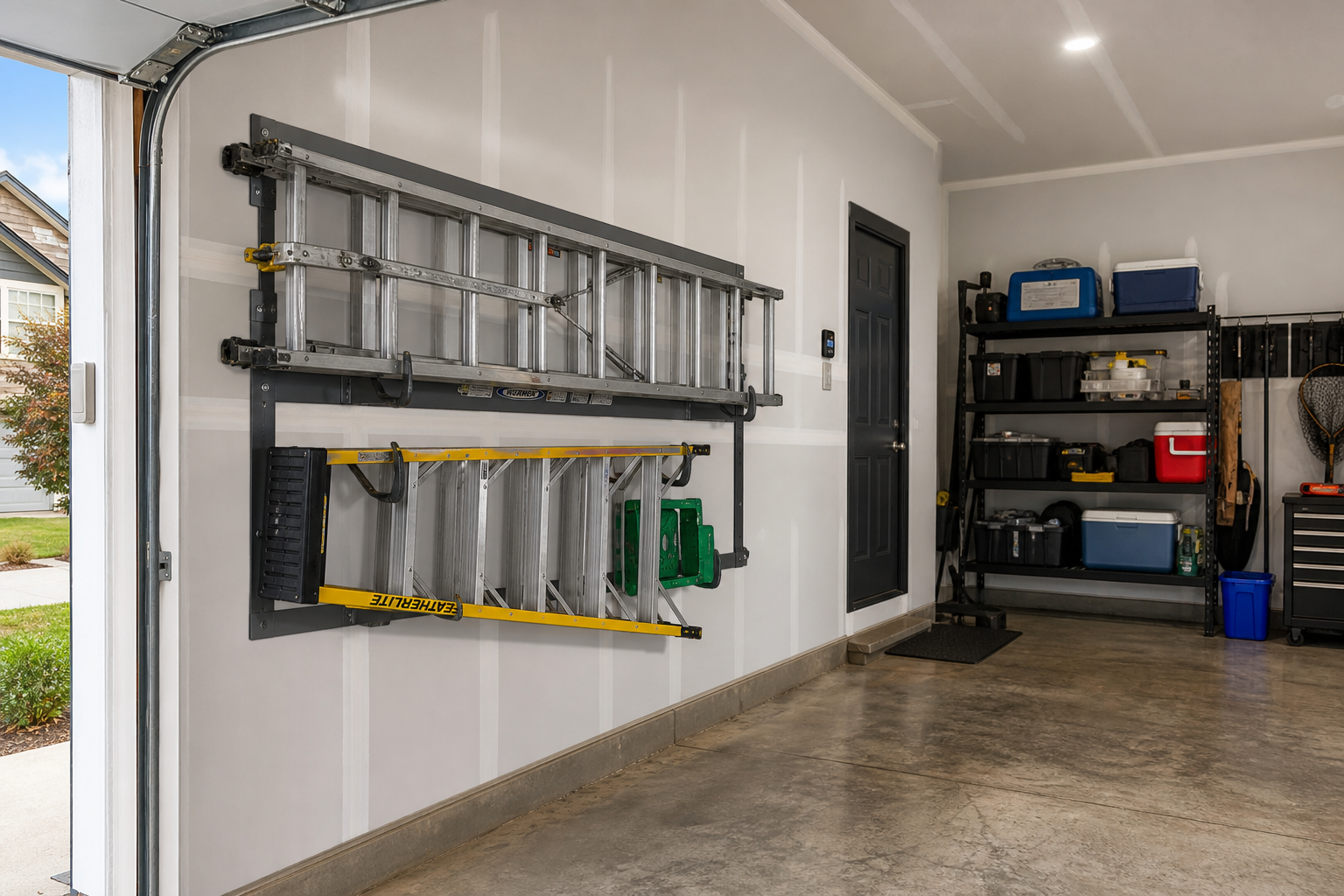
Wall-mounted racks work best for single ladders stored vertically or at an angle. They take up minimal space and install faster than ceiling systems. Most use two to four mounting points into wall studs.
Vertical Storage Racks
Vertical racks hold the ladder upright against the wall. They’re compact but require tall ceilings and enough wall height to accommodate your longest ladder. An 8-foot ceiling barely fits a 6-foot step ladder stored vertically once you account for the rack hardware and clearance.
Angled Storage Racks
Angled racks tilt the ladder away from the wall at 30 to 45 degrees. This position is easier to load and unload than vertical storage, and it works in garages with standard 8-foot ceilings. The tradeoff is floor intrusion. A 6-foot ladder on a 45-degree rack projects about 4 feet from the wall at its base.
J-Hook Systems
J-hook systems are the simplest wall-mount option. Two heavy-duty J-hooks spaced along the ladder’s length hold it horizontally against the wall. Installation is basic: locate studs, drill pilot holes, drive lag screws. The downside is accessibility. Lifting a 28-foot extension ladder on and off wall hooks is a two-person job.
Folding Arm Racks
Folding arm racks pivot down when you need the ladder and fold flat against the wall when you don’t. They handle ladders up to 40 pounds. The hinge mechanism adds a failure point, and cheaper models develop sag after a year of use. Look for steel construction with a locking pin that secures the arm in both positions.
Horizontal Wall Tracks
Horizontal wall tracks with adjustable hooks give you flexibility. Mount the track once, then reposition hooks as your storage needs change. Tracks run 4 to 8 feet in length. Weight capacity depends on stud placement. If you can hit studs every 16 inches, you’ll get the full rated capacity. Miss a stud and you’re relying on drywall anchors, which won’t hold a ladder safely.

Garage Ladder Wall Mount Hooks
Simple J-hooks provide the most reliable wall mounting for extension ladders
Ceiling-Mount Ladder Racks
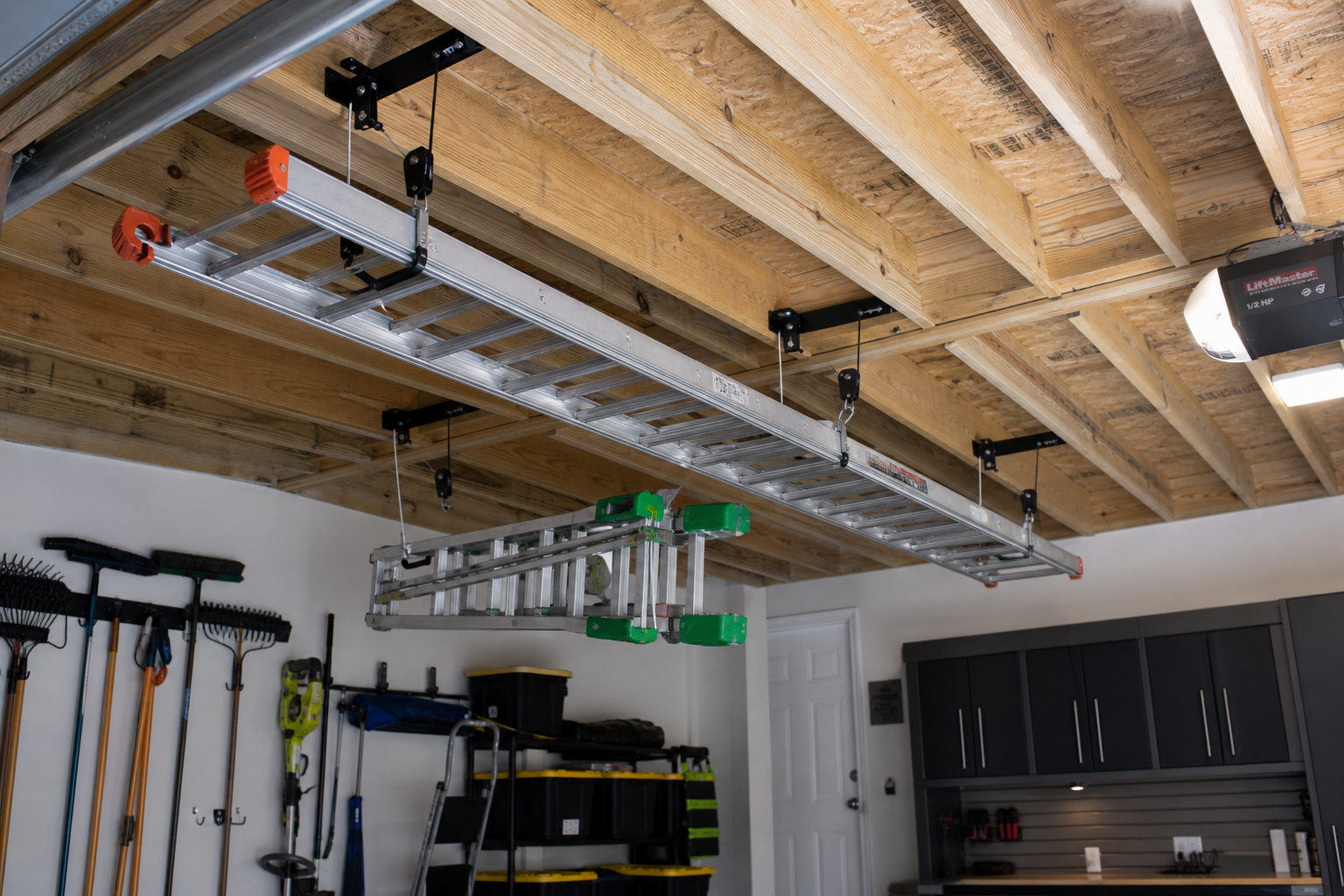
Ceiling racks store ladders horizontally overhead. They clear floor and wall space entirely but require careful installation and adequate ceiling height.
The most common design uses two parallel rails mounted perpendicular to ceiling joists. Rails are typically 4 to 8 feet long and spaced 12 to 18 inches apart. The ladder rests across both rails. This setup distributes weight across multiple joists and can handle extension ladders up to 300 pounds.
Motorized Hoists
Motorized hoists lift ladders to the ceiling with a remote or wall switch. They solve the ergonomic problem of lifting a heavy ladder overhead. The motor mounts to joists, and straps or hooks attach to the ladder. Push a button and the ladder rises. Most hoists lift 100 to 150 pounds and include automatic stop sensors.
The catch with motorized systems is maintenance. Pulleys, cables, and motors wear out. Budget for replacement parts every few years. If the motor fails while the ladder is raised, you’ll need manual override instructions and possibly a second person to lower it safely.
Fixed Horizontal Racks
Fixed horizontal racks without motors are silent, don’t need electricity, and have no moving parts to fail. The tradeoff is manual lifting. Getting a 40-pound extension ladder overhead solo is awkward and risks back strain. Plan on a helper or accept slower, more careful lifts.
Adjustable-Width Racks
Adjustable-width racks accommodate different ladder sizes. Slide the rails closer together for a narrow step ladder or spread them apart for a wide extension ladder. This flexibility costs more than fixed-width racks but pays off if you store multiple ladders or upgrade equipment later.
Ceiling Track Systems
Ceiling track systems with hooks work like wall tracks but overhead. Mount the track to joists, hang hooks where needed, rest the ladder across hooks. They’re versatile but require more ceiling height because the track, hooks, and ladder all stack vertically. Measure twice.
A quality ceiling storage rack makes a noticeable difference in results. Check current options and reviews on Amazon to find the right match for your project and budget.
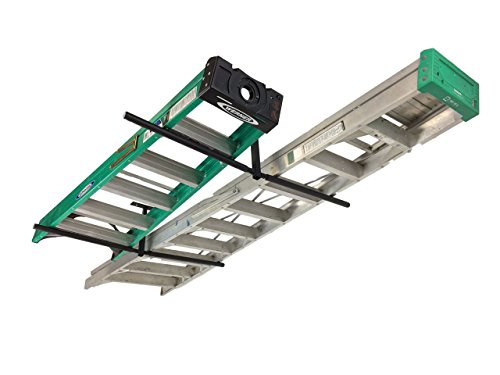
Garage Ceiling Ladder Storage
Overhead storage keeps floors clear while maximizing vertical space
Freestanding Ladder Racks
Freestanding racks lean against a wall or stand independently. They don’t require drilling into studs or joists, which appeals to renters and people hesitant about permanent installations.
Metal A-frame racks hold one or two ladders vertically. They weigh 20 to 30 pounds and need floor space roughly 3 feet wide by 2 feet deep. Stability comes from the wide base, not wall attachment. Place them on level concrete. Uneven floors cause tipping.
Rolling ladder carts store and transport ladders. They’re common in commercial settings but overkill for most home garages unless you move ladders between job sites regularly. Wheels add mobility but also add bulk.
The limitation with freestanding racks is floor space consumption. If your garage barely fits two cars, a freestanding rack eats into that clearance. Wall and ceiling mounts preserve floor access.
Installation Realities
Most ladder racks claim “easy installation” in the product description. Reality depends on your garage construction and your comfort with power tools.
Finding Studs and Joists
Stud-finding is the first hurdle. Electronic stud finders work on drywall but struggle with textured or painted surfaces. A magnet stud finder detects screws in the drywall, which indicate stud locations. The old-school method (knock along the wall and listen for a solid thud) still works. Studs in garages are typically 16 or 24 inches on center.
Proper Hardware
Lag screws into studs provide the strongest hold for wall-mounted racks. Drill a pilot hole slightly smaller than the screw diameter to prevent wood splitting. Use a washer under the screw head to distribute load. For 50-pound loads, 3/8-inch lag screws are standard. Heavier loads need 1/2-inch.
Ceiling installations require drilling into joists. Joists are usually 16 inches on center but verify before mounting. Missing a joist and hitting only drywall is a recipe for failure. Use 1/2-inch lag screws for ceiling mounts. The extra diameter compensates for the downward pull of gravity on overhead loads.
When You Need Blocking
Some ceiling racks require blocking between joists if your ladder length doesn’t align with joist spacing. Blocking is a horizontal 2×4 or 2×6 installed between joists to create additional mounting points. It’s not complicated but adds time and materials to the project.
Toggle bolts and heavy-duty drywall anchors are marketed as alternatives to studs and joists. They’ll hold light items (under 20 pounds) but shouldn’t be trusted for ladder storage. A falling ladder is a safety hazard and potential vehicle damage.
Leveling matters. An unlevel rack causes ladders to slide toward one end. Use a 4-foot level during installation. Shim if necessary. A ladder sliding off a rack mid-storage isn’t just annoying, it’s dangerous.
Material Considerations
Steel racks dominate the market because steel handles weight without flexing. Powder-coated steel resists rust in humid climates. Uncoated steel will rust in a Midwestern garage with seasonal temperature swings and road salt exposure. Spend the extra amount for powder coating.
Aluminum racks are lighter and naturally corrosion-resistant but cost more. They’re common in coastal areas where salt air accelerates rust. Weight capacity per dollar favors steel in most cases.
Plastic and resin racks exist but they’re designed for lightweight items, not ladders. A 40-pound ladder will warp a plastic rack over time. Avoid them for this application.
Rubber or foam padding on contact points prevents scratches and reduces noise when loading or unloading ladders. Not all racks include padding. Add adhesive foam strips yourself if needed. It takes five minutes and prevents ladder damage.
Space Efficiency Strategies
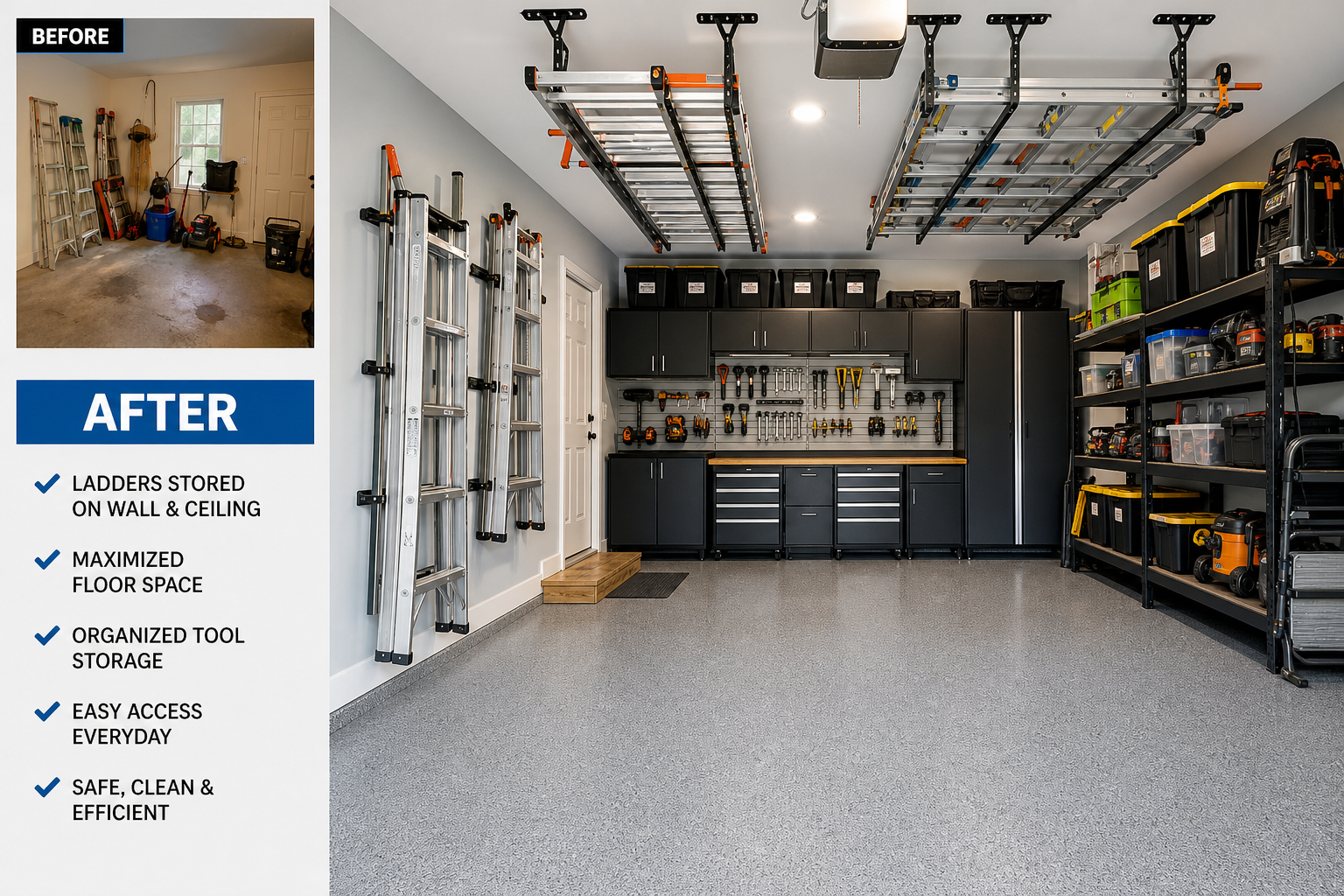
Combining ladder storage with other overhead storage maximizes ceiling real estate. Ceiling storage lifts designed for totes and seasonal items can often accommodate a ladder in the same footprint if you plan dimensions carefully.
Store shorter ladders vertically on walls and longer ladders horizontally overhead. This tiered approach uses both surfaces without conflict. A 6-foot step ladder fits vertically on a wall in a space where an extension ladder wouldn’t.
Dead space above garage door tracks is often wasted. Some ladder racks mount specifically in this zone. Measure the depth between the door track and the ceiling. If you have 18 inches or more, that’s usable storage for a compact step ladder.
Corner racks exploit the 90-degree wall intersection. They hold ladders diagonally across the corner, using space that’s typically empty. Corner racks cost about the same as standard wall mounts but require precise angle cuts during installation if you’re building your own.

Garage Corner Ladder Rack
Corner mounting uses otherwise wasted space efficiently
Budget Breakdown
Basic wall hooks (J-hooks or U-hooks) are the entry point for budget-conscious storage. Add materials for lag screws and washers if not included.
Mid-range wall-mount racks with folding arms or adjustable hooks handle more weight and offer better ergonomics than simple hooks.
Premium wall systems with integrated track and modular components are overkill if you’re storing a single ladder but make sense if you’re outfitting a full wall with mixed storage.
Ceiling racks (non-motorized) work well for most applications depending on length and weight capacity. Installation hardware is usually included.
Motorized ceiling hoists start at basic models and top out at units with smartphone controls and quiet motors. Factor in ongoing maintenance costs.
Freestanding racks range from basic A-frames to commercial-grade rolling carts. They don’t require installation labor but consume floor space.
Professional installation adds cost depending on rack complexity and regional labor rates. A handyman can typically install a ceiling rack in one to two hours. Wall mounts take 30 to 60 minutes.
Climate and Durability
Midwestern garages swing from 95 degrees in summer to below zero in winter. Metal racks expand and contract with temperature changes. Lag screws can loosen over time. Check mounting hardware every six months and retighten if necessary.
Humidity causes rust on uncoated steel. Coastal and Southern garages deal with this year-round. Powder-coated or galvanized steel racks hold up better. Budget extra for corrosion resistance.
Freeze-thaw cycles stress ceiling-mounted racks more than wall mounts because gravity constantly pulls downward. Inspect ceiling racks annually for cracks, rust, or sagging. Catching a problem early prevents a failure that could damage vehicles or injure someone.
Plastic components (clips, locking pins, hinge covers) become brittle in cold temperatures. A plastic locking pin that works fine in May can snap in January. Metal pins cost more and don’t fail in cold weather.
Additional Considerations
Zone your garage before buying products. Common zones: tools/workbench, automotive, seasonal items, sports gear, lawn/garden, and household overflow. Each zone stays self-contained so everything for a given task lives in one spot.
Ladder storage often belongs in the automotive or tools zone since ladders support maintenance and repair tasks. Placing it near your workshop area or vehicle bay reduces trips across the garage.
Practical Planning Tips
Research local building codes and permit requirements for your specific project. Electrical work, structural modifications, and HVAC installations often require permits and inspections. Working without required permits can create liability issues, insurance complications, and problems when selling the home.
Ladder storage itself typically doesn’t require permits, but ceiling-mounted racks that involve cutting or reinforcing joists might trigger structural code reviews in some jurisdictions. Check with your local building department if you’re modifying framing.
Prioritize your projects based on impact and urgency. Safety issues (faulty wiring, CO risk, structural problems) come first. Comfort improvements (insulation, lighting, climate
