

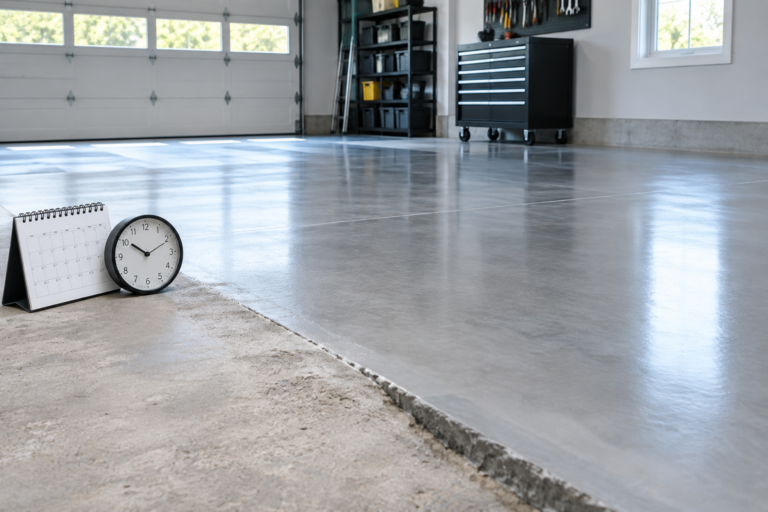
You just had a new garage slab poured and you’re itching to get that epoxy or polyaspartic coating down before dust and tire marks ruin the clean concrete. The problem is that fresh concrete doesn’t work on your timeline. Coat it too early and you’re not risking a few peeling spots, you’re risking a full failure where the entire coating lifts off in sheets within months.
Calendar age is only part of the story. Two slabs poured on the same day can cure at completely different rates depending on thickness, weather, humidity, and what’s underneath them. Here’s what actually determines when your new garage floor is ready for a coating.
The 28 Day Minimum, and Why It’s Just a Starting Point
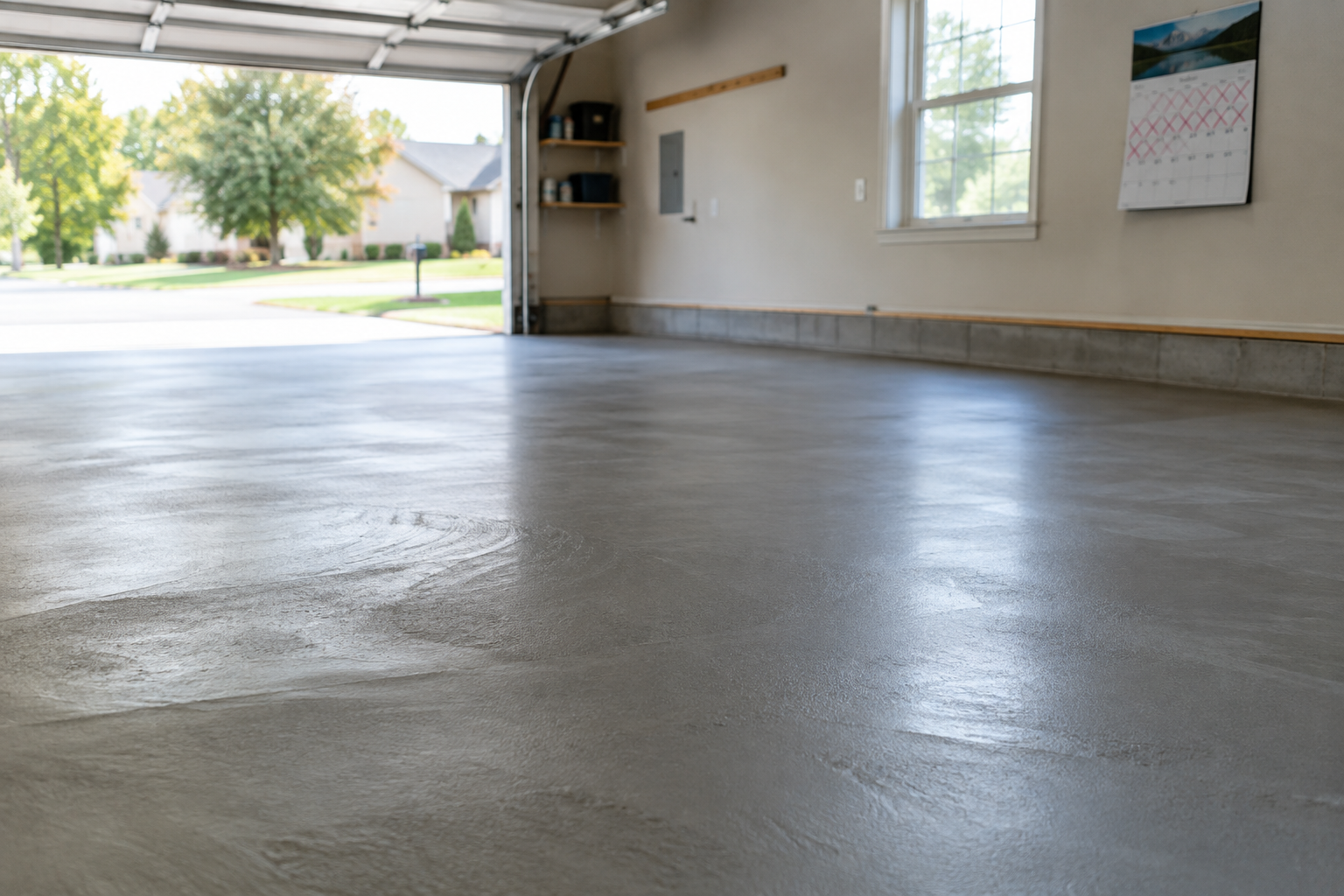
Concrete reaches roughly 95 to 100 percent of its structural strength around 28 days after the pour. That’s the number you’ll see repeated everywhere, and most coating manufacturers list it as an absolute minimum wait time before any film-forming coating goes down.
But strength and dryness are two different things. A slab can hit its 28 day strength mark while still holding a significant amount of internal moisture, especially if it was poured during a cold, humid, or rainy stretch. Concrete cures from the outside in, and moisture trapped deeper in the slab can take much longer to work its way out, particularly on slabs poured directly over soil without a vapor barrier.
That’s why 28 days should be treated as the earliest possible date to even start testing, not the day you assume you’re clear to coat. Many contractors recommend waiting 60 days or longer on slabs poured in cooler or more humid conditions before applying anything that seals moisture in.
Why Moisture Vapor Is the Real Deadline
Concrete is porous, and moisture from the ground constantly tries to move upward through the slab and evaporate at the surface. This is called moisture vapor emission, and it never fully stops in slabs without a proper vapor barrier underneath. It just slows down as the concrete ages and the water content drops.
When you coat too soon, that trapped vapor has nowhere to go. It builds up underneath the coating and eventually pushes it loose from the surface, showing up as bubbling, peeling, or a milky white haze called efflorescence. This is the single most common reason new garage floor coatings fail, and it has nothing to do with how well the coating was applied.
If you want to understand how this plays out over time on slabs of any age, our guide to garage floor moisture problems walks through the diagnosis process in more detail. For new pours specifically, the fix is patience and testing rather than repair.
Testing the Slab Instead of Guessing
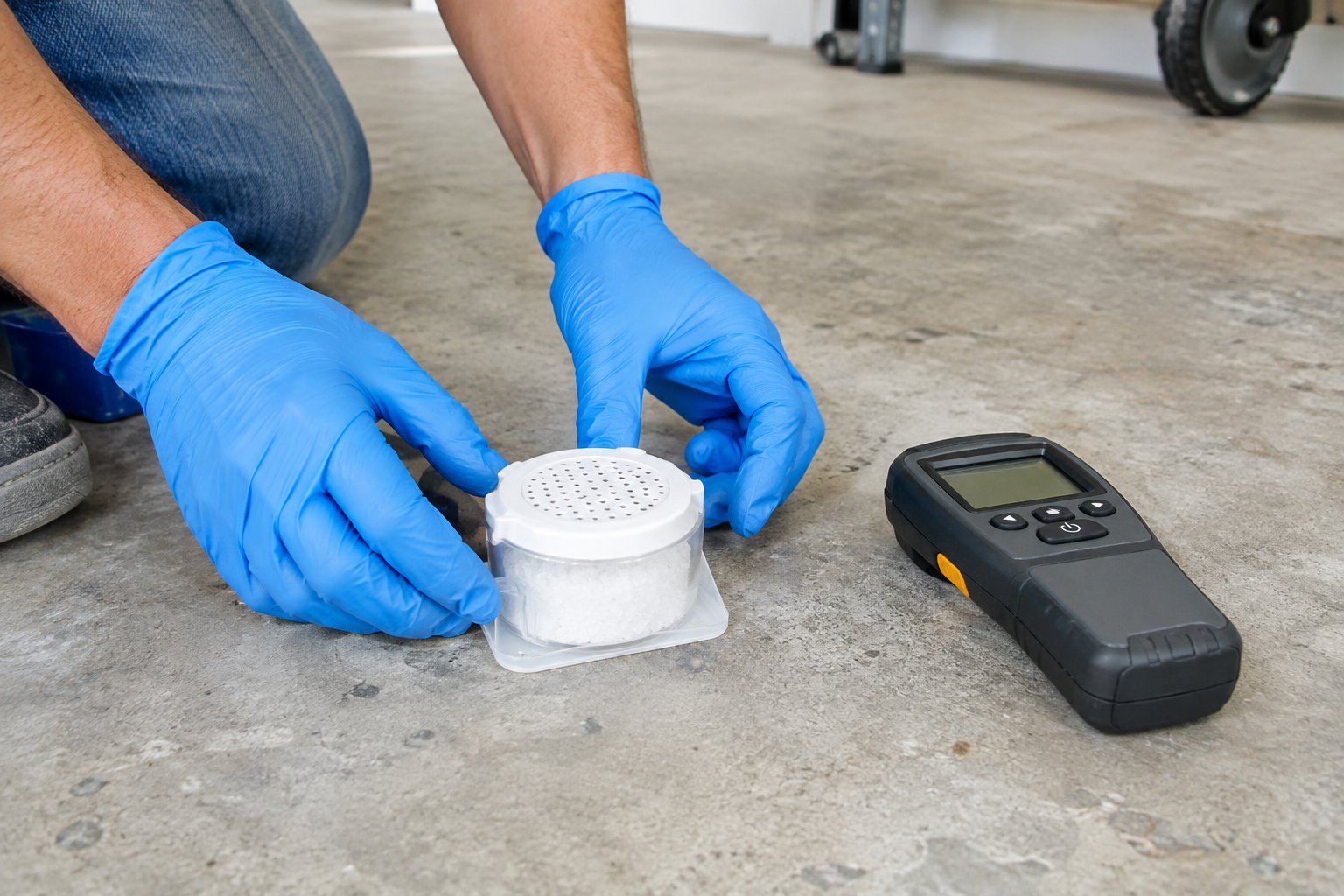
The only reliable way to know if a new slab is ready is to test it, not to count days on a calendar. Two tests are standard in the flooring industry, and both are cheap insurance against a coating failure that could cost you far more to strip and redo.
- Calcium chloride test (ASTM F1869): A small dome is sealed to the slab for 60 to 72 hours and measures the rate of moisture vapor emission in pounds per 1,000 square feet per 24 hours. Most coating manufacturers want a reading below 3 to 5 lbs, depending on the product.
- Relative humidity probe test (ASTM F2170): A hole is drilled into the slab and a probe measures humidity inside the concrete itself. This test is considered more accurate for thicker slabs since it reads moisture at depth rather than just at the surface.
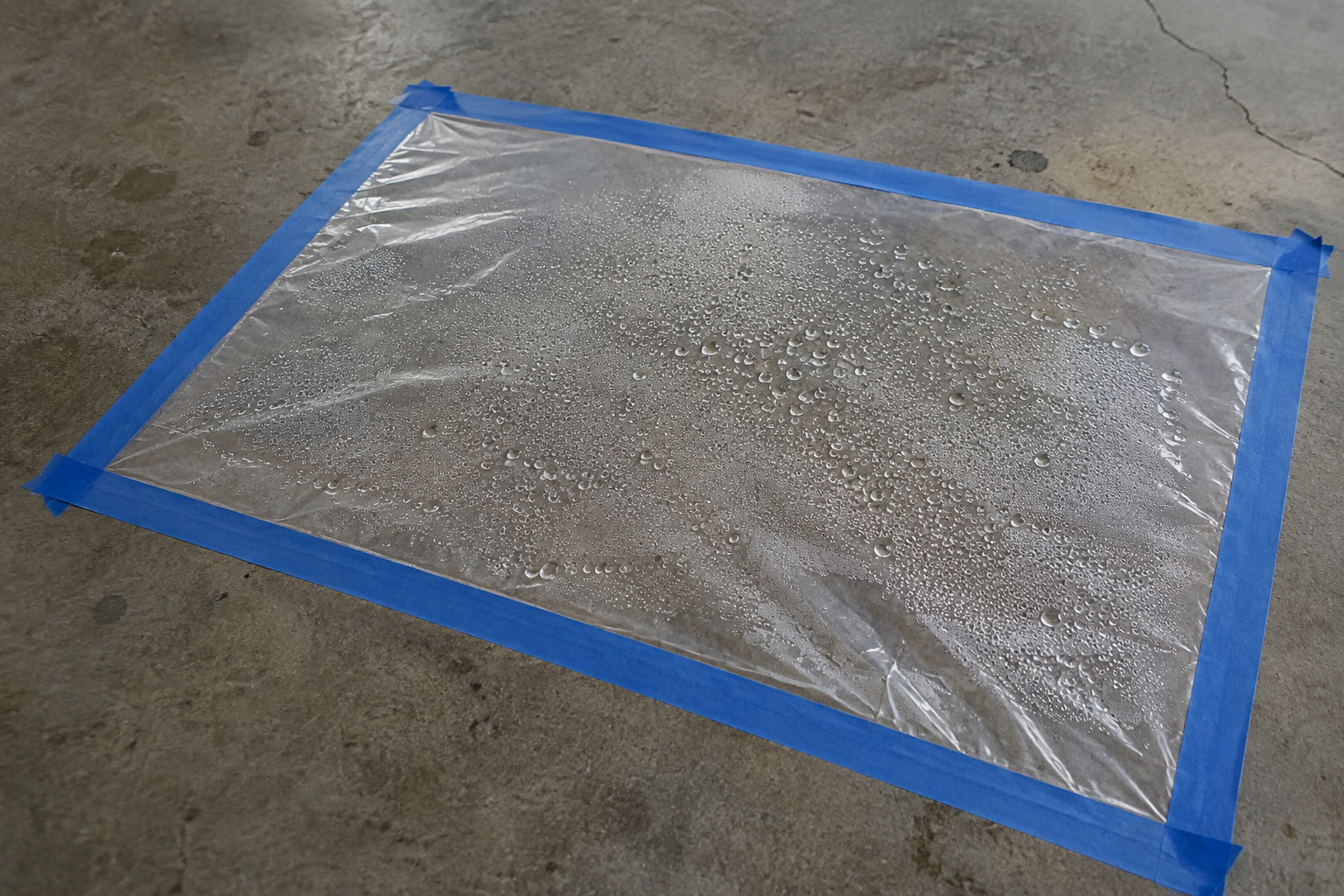
- Plastic sheet test: Not a substitute for the two above, but a free, quick way to get an early read. Tape a two foot square of plastic sheeting to the slab and leave it for 16 to 24 hours. Condensation underneath means the slab is nowhere near ready.
For DIYers who want to check moisture themselves before committing to a coating project, a basic concrete moisture test kit is a reasonable starting point, though for a brand new slab a proper calcium chloride test gives you a real number to compare against manufacturer specs instead of a simple pass or fail reading.
Vaisala Concrete Moisture Test Kit
A more precise option if you want lab-grade moisture readings before committing to a coating on a new slab.
Surface condition matters just as much as moisture content. New concrete often has a hard, glassy layer on top called laitance, along with curing compound residue if the contractor sprayed one on after the pour. Both of these need to be mechanically removed, usually by diamond grinding or shot blasting, so the coating can actually bond to open concrete pores instead of sitting on top of a slick film that will eventually let go.
Follow the Manufacturer’s Instructions Over Any General Rule
Every coating product has its own cure time requirement, and it’s printed right on the technical data sheet for a reason. Some epoxy and polyaspartic systems are rated for new concrete at 28 days under ideal conditions, while others explicitly require 60 to 90 days minimum regardless of test results.
If your contractor used a curing compound on the slab, some coatings won’t bond at all until that residue is fully removed, no matter how long you wait. Always check the data sheet for both the minimum cure time and the maximum acceptable moisture vapor emission rate before buying a coating kit, and don’t assume a generic garage floor product review or forum comment applies to the exact system you’re using.
Once your slab passes testing and you’re ready to prep the surface, our roundup of garage epoxy floor ideas is a good place to plan the finish, and if you’re still deciding between coating types altogether, the garage flooring ideas guide covers the full range of options for a new slab.
Frequently Asked Questions
Can I coat a new garage slab in less than 28 days if I’m using a fast curing product?
No. The 28 day mark refers to the concrete’s own cure time, not the coating’s cure time, and it’s set by concrete chemistry rather than the product you’re applying. Even fast curing epoxies and polyaspartics still require the slab itself to reach that minimum age before application, regardless of how quickly the coating itself dries once applied.
What happens if I coat too early and the slab wasn’t ready?
Trapped moisture vapor typically shows up within a few weeks to a few months as bubbling, peeling, or a white powdery residue under the coating. At that point the only real fix is stripping the coating back off, letting the slab continue drying, and starting the testing process over before recoating.
This article contains affiliate links. We may earn a small commission at no extra cost to you.
