

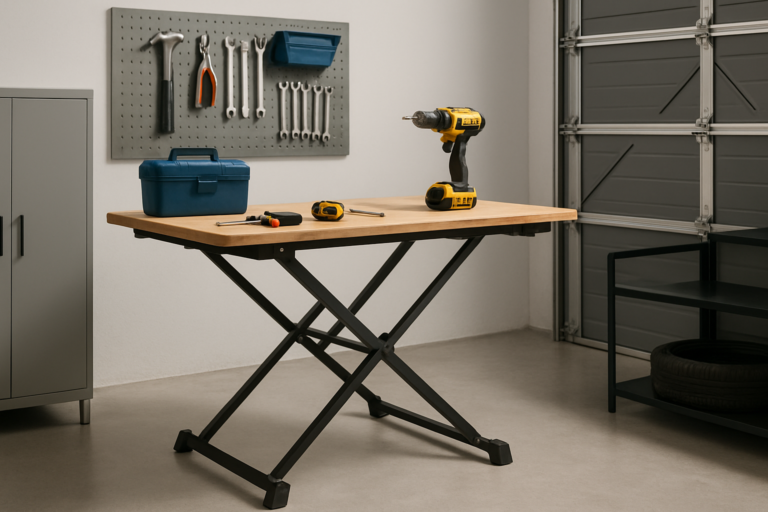
Small garage owners know the struggle all too well. You need a solid workspace for projects, but leaving a full-size workbench set up permanently eats up valuable floor space you just don’t have. That’s where folding workbenches come in, giving you a sturdy work surface when you need it and reclaiming your garage when you don’t.
I’ve tested and researched dozens of folding workbench options, from wall-mounted units that disappear against the wall to portable freestanding models you can tuck in a corner. Some hold up to serious woodworking and metalwork, while others barely support a few hand tools without wobbling. Let me walk you through what actually works.
Wall-Mounted Folding Workbenches: Maximum Space Savings
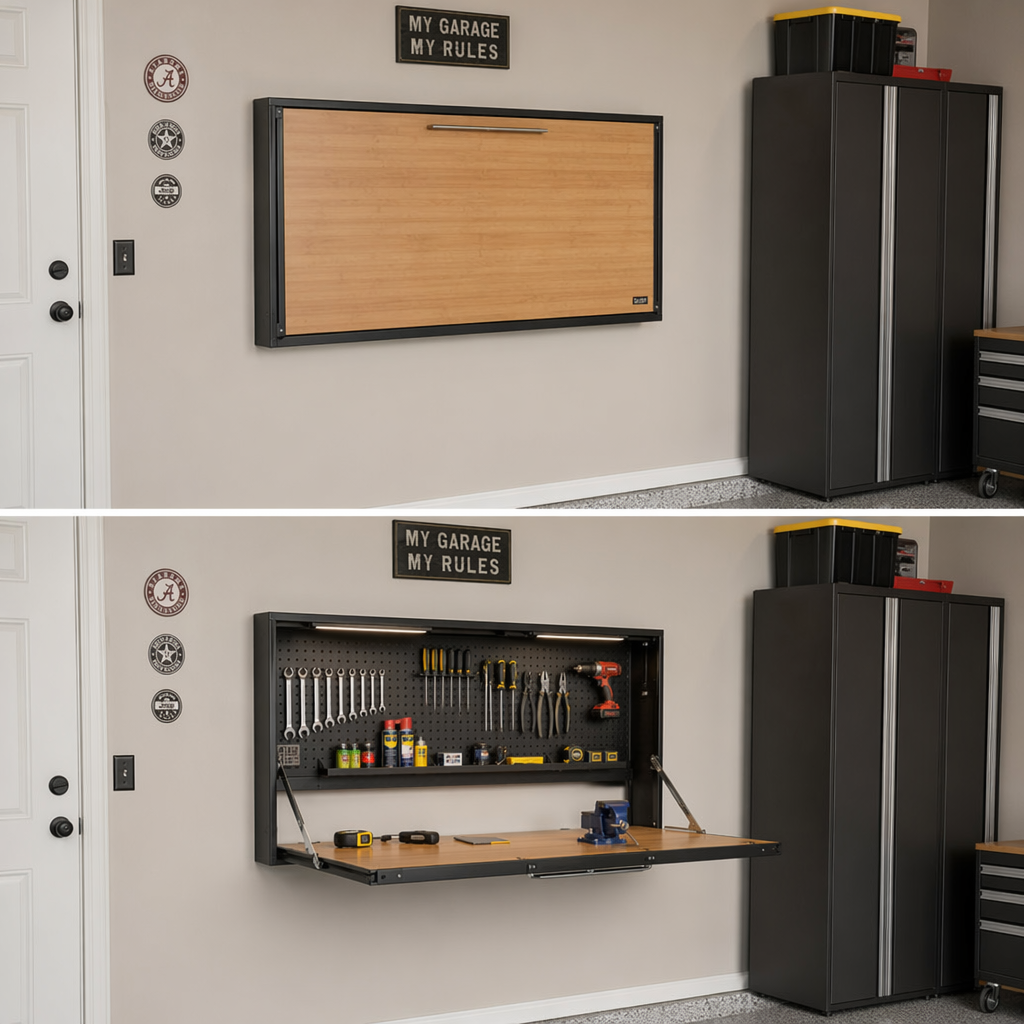
Wall-mounted folding workbenches are the champions of space efficiency. When you fold them up, they typically project just 4 to 8 inches from the wall, leaving your floor completely clear for parking or other activities.
The biggest advantage here is that they’re always ready to go. You don’t need to haul them out of storage or find a place to stash them. Just flip them down, lock them in place, and you’re working within seconds.
Most wall-mounted units attach directly to wall studs with heavy-duty lag bolts. This gives them incredible stability since they’re anchored to the actual structure of your garage. You won’t get the wobble that plagues many freestanding options.
Top Wall-Mounted Options Worth Considering
The Seville Classics UltraHD Wall Mount Folding Workbench sets the standard for this category. It supports up to 1,000 pounds when properly installed, features a bamboo work surface that resists moisture and damage, and folds to just 6.5 inches deep. The hydraulic lift assistance makes operation smooth even when you’re opening it one-handed.

Seville Classics UltraHD Wall Mount Folding Workbench
Best overall wall-mounted option with 1,000-pound capacity and hydraulic assist for smooth operation
For smaller spaces, the Space Saver Wall Mount Folding Workbench offers a more compact 40-inch width compared to the standard 60 inches. It still handles 500 pounds, which is plenty for most garage projects, electronics repair, or craft work.
Installation Considerations
You absolutely must anchor these into wall studs. Drywall anchors won’t cut it, even the heavy-duty ones. The leverage forces when you’re working on a wall-mounted bench can pull anchors right through drywall.
Most manufacturers recommend finding at least two studs (preferably three) and using 3/8-inch lag bolts that penetrate at least 3 inches into the stud. I always add construction adhesive to the back mounting plate for extra security, though it’s not strictly required.
Plan for the bench to sit at 36 to 38 inches off the floor for comfortable standing work. Measure twice and predrill your holes to avoid splitting the studs.
Freestanding Folding Workbenches: Portability and Flexibility
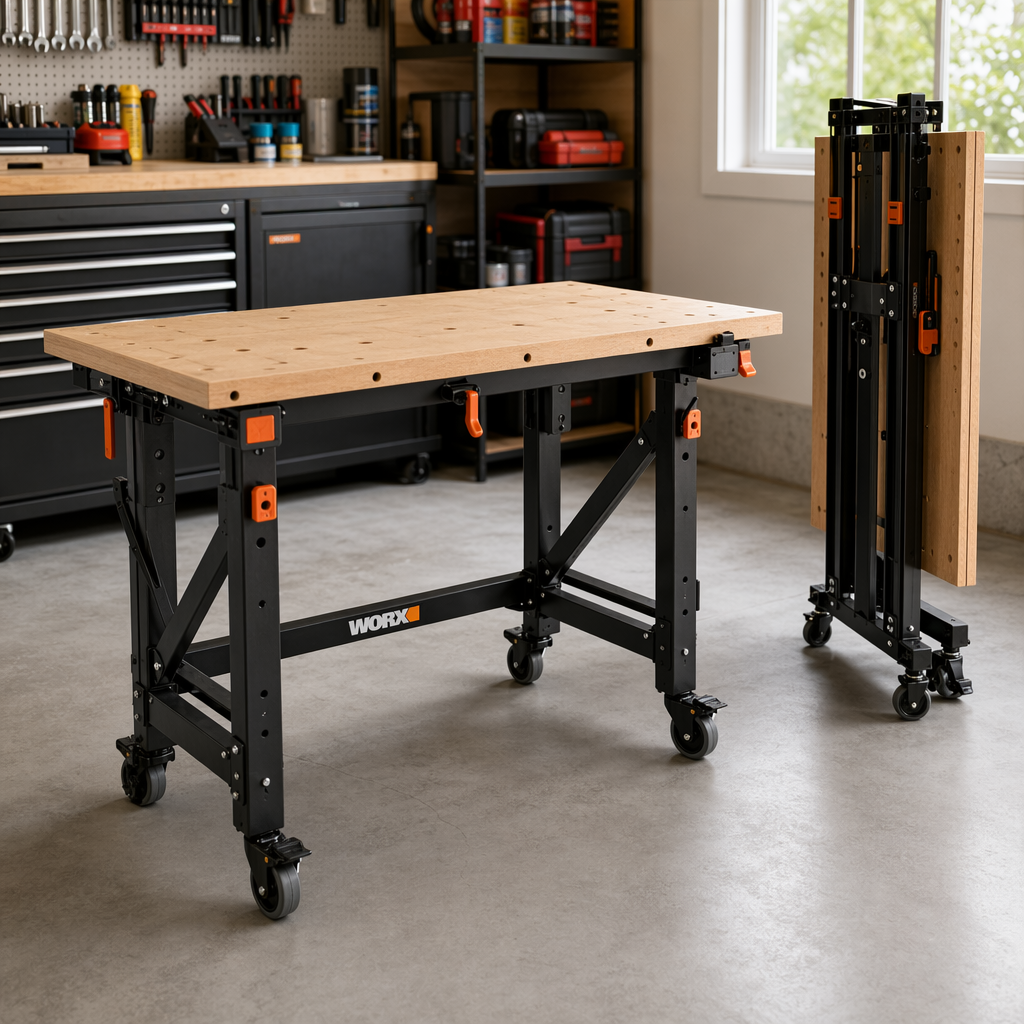
Freestanding folding workbenches give you the freedom to work anywhere. Need to tackle a project in the driveway? Want to set up shop in the backyard? These benches fold up and move wherever you need them.
The trade-off is weight capacity and stability. Physics works against you here. Without being anchored to a wall, freestanding benches rely entirely on their leg geometry and locking mechanisms to stay rigid. Most max out around 300 to 500 pounds, and you’ll notice more flex and movement compared to wall-mounted options.
Best Freestanding Models
The Keter Folding Work Table hits the sweet spot between portability and function. It weighs just 25 pounds but supports 1,000 pounds when used as a stationary surface and 300 pounds as a sawhorse. The dual-height adjustment lets you work at either 30 or 35 inches, and built-in clamps secure materials without needing separate C-clamps.

Keter Folding Work Table
Lightweight and portable with built-in clamps and impressive weight capacity for a freestanding unit
For heavy-duty work, the Worx Pegasus Folding Work Table brings serious functionality. It converts from a workbench to a sawhorse and includes quick clamps, holding pegs, and a lower shelf for tool storage. The folded dimensions are remarkably compact at just 5 inches thick.
Budget-conscious buyers should check out basic folding sawhorse workbenches. These simple designs pair two folding sawhorses with a work surface you add yourself. They’re not fancy, but they work.
Comparing Weight Capacities and Real-World Performance
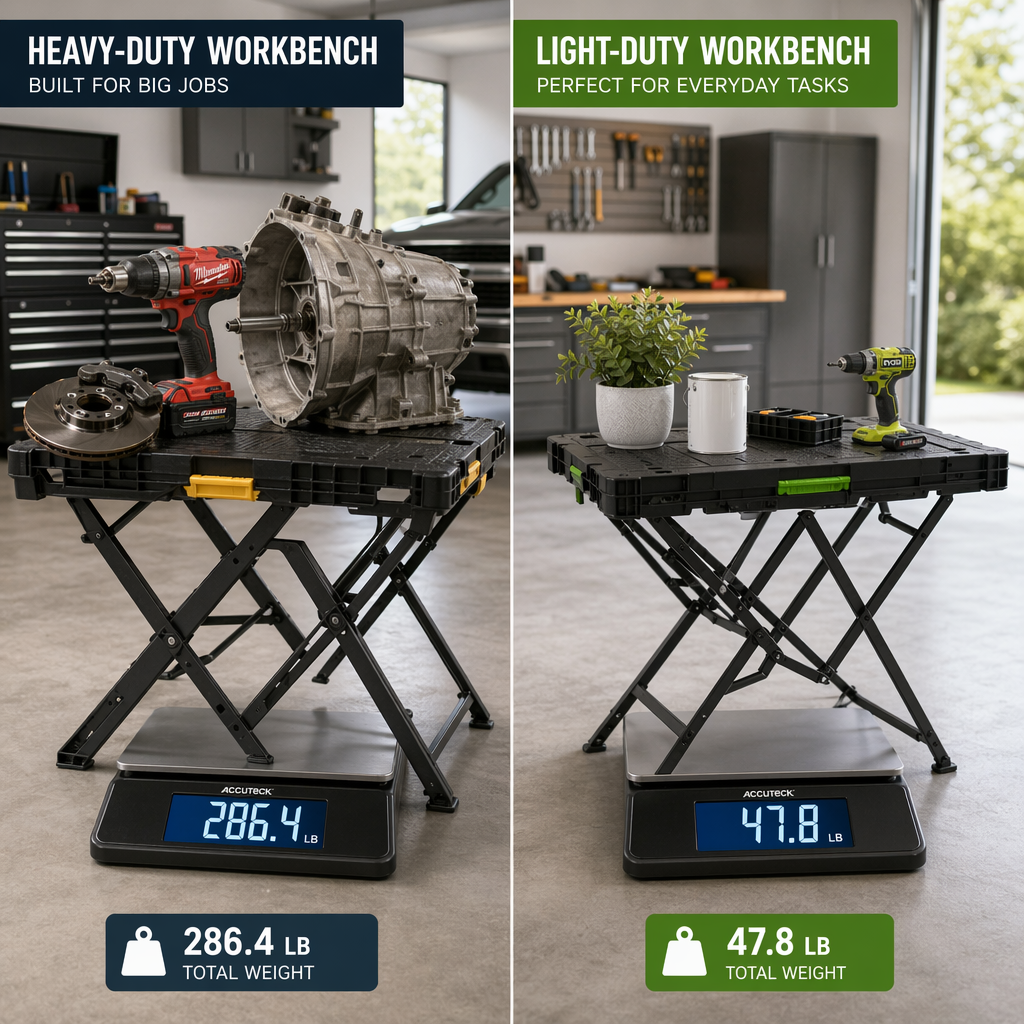
Manufacturer weight ratings can be misleading. A bench rated for 1,000 pounds doesn’t mean you should actually pile 1,000 pounds on it during regular use. These ratings typically assume evenly distributed static loads, not the dynamic forces you create when sawing, hammering, or applying torque with wrenches.
For practical use, I recommend treating the rated capacity as an absolute maximum and working at about 50-60% of that number. A 500-pound rated bench should handle 250-300 pounds of real-world use comfortably.
Wall-mounted benches generally outperform freestanding models at similar weight ratings because they transfer forces directly into the wall structure. A 500-pound wall-mounted bench will feel more stable than a 500-pound freestanding unit.
Testing Stability Before You Trust It
Before you start any serious project, test your folding workbench’s stability. Apply downward pressure at different points across the surface. Try to rack it side to side. Lean against it with your body weight.
Any significant movement or flexing means you need to either reinforce the mounting, tighten the leg locks, or frankly get a different bench. A wobbly workbench is dangerous when you’re using power tools or working with heavy materials.
Folded Dimensions: How Much Space You Really Save
The whole point of a folding workbench is space savings, so folded dimensions matter more than you might think. A few inches difference can mean the gap between parking your car and not.
Wall-mounted benches typically fold to 4-8 inches from the wall. The thinnest models achieve this by using a fold-flat design where the legs tuck completely under the work surface. Thicker models (8-10 inches) usually have stronger leg assemblies that don’t fold as compactly.
Freestanding benches vary wildly. Some collapse to a briefcase-style package just 3-4 inches thick, perfect for storing in a closet or hanging on garage wall hooks. Others fold into awkward shapes that still consume significant storage space.
Measure your intended storage space before buying. Don’t just check the manufacturer’s specs online. Actually measure where you plan to keep it, accounting for any obstacles like electrical outlets, pipes, or other equipment. If you’re working with limited space, implementing strategies for a clutter-free garage can help you make the most of every square foot.
DIY Folding Workbench Plans: Build Your Own
Building your own folding workbench lets you customize every dimension to fit your exact space and needs. You’ll save money compared to premium commercial options, though the savings shrink if you need to buy many tools specifically for the project.
Simple Wall-Mounted Folding Bench Design
The easiest DIY folding bench uses a hinged plywood top attached to a wall cleat with folding leg brackets underneath for support. You’ll need a 2×4 wall cleat secured to studs, a 3/4-inch plywood work surface, two folding shelf brackets rated for at least 200 pounds each, and piano hinge to attach the top to the cleat.
Cut your plywood to your desired size (24×48 inches works well for small garages). Attach the piano hinge to one long edge of the plywood. Mount your 2×4 cleat to the wall studs at your preferred height. Screw the piano hinge to the cleat. Install folding brackets underneath at each end, positioned to support the plywood when it’s horizontal.
The whole project takes about 3-4 hours and costs less than most commercial options when you shop for materials smart. Use heavy duty folding shelf brackets rated for your expected load.
Freestanding Folding Bench Design
A basic freestanding design uses two rectangular frames connected by hinges with a work surface on top. Build two ladder-style leg assemblies from 2x4s, making them identical. Connect them with cross braces and add hinges at the top so they fold flat.
The work surface can be 3/4-inch plywood, MDF with a hardboard surface, or even a solid-core door from a home improvement store. Attach it to the top of your folding frame with hinges or removable bolts.
Add a chain or cable between the legs to prevent them from spreading too far when you open the bench. This is critical for stability and safety.
