

As an Amazon Associate I earn from qualifying purchases.
Kayaks are big, awkward, and expensive , and leaving them on the garage floor is a fast way to warp hulls and trip over them every time you back out the car. Over the years I’ve seen some genuinely clever ways to store them up and out of the way without turning your garage into an obstacle course. In this article I’m covering four approaches: wall-mounted cradles, ceiling hoist systems, freestanding racks, and paddle and gear organization.
Wall-Mounted Cradles
Wall-mounted cradles are probably the most popular way to store a kayak in the garage, and for good reason. They get the boat off the floor, keep it supported along its hull rather than just at the ends, and they free up ceiling clearance for overhead lighting or other gear. The key is mounting them into studs , a kayak can weigh anywhere from 35 to 80 pounds, so you need solid anchor points. If you’re planning a full garage storage overhaul, it helps to read through a complete guide on how much weight your garage walls and ceiling can safely handle before you start drilling. Padded cradles protect the gel coat, which matters a lot if you have a composite or fiberglass boat.
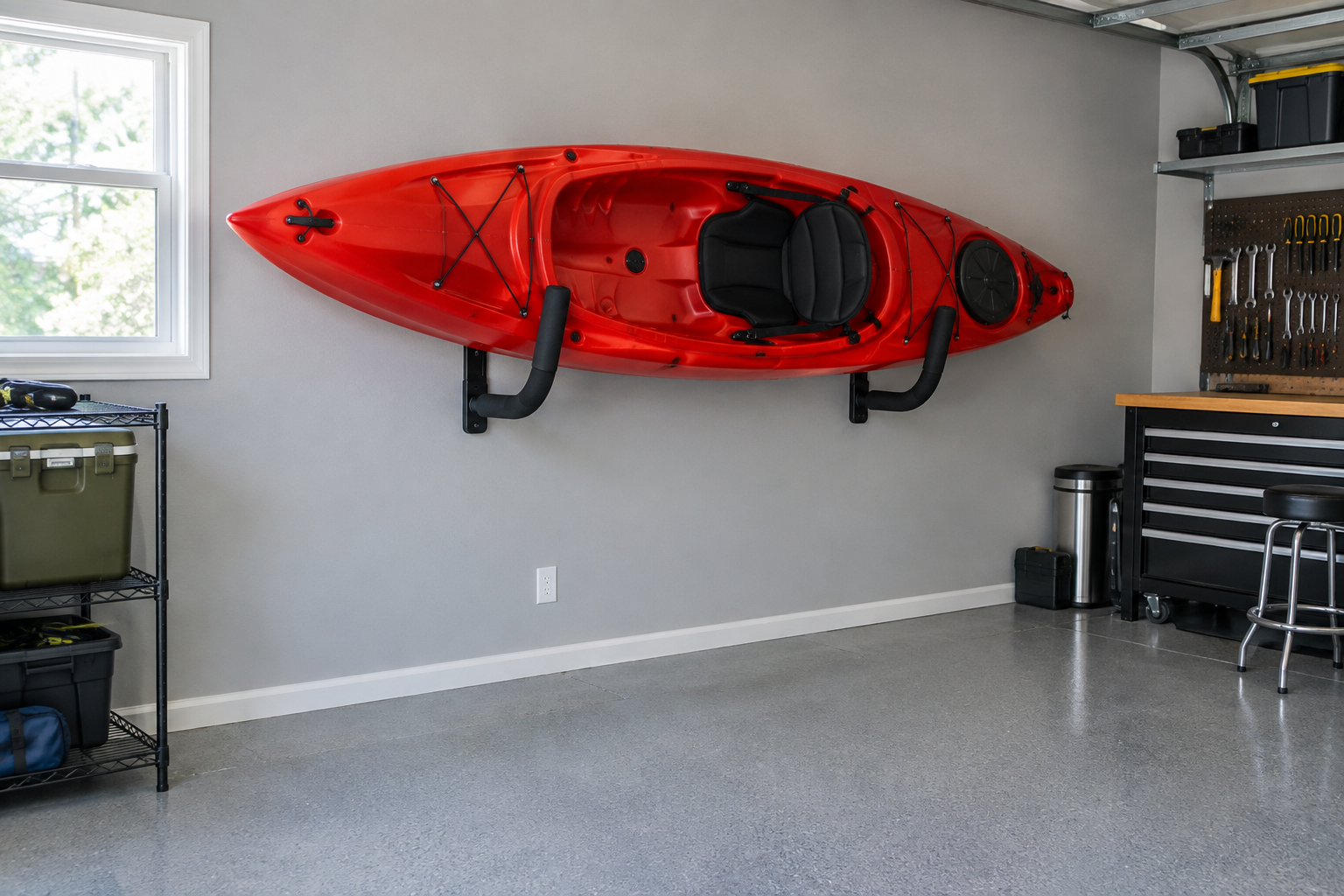
Black powder-coated J-cradles hold this red sit-on-top kayak snug against a light gray wall, keeping the cockpit open and the hull well-supported. The thick foam padding on each arm prevents pressure dents, which is especially important on plastic boats. It’s a clean, low-profile look that takes up almost no visual space.
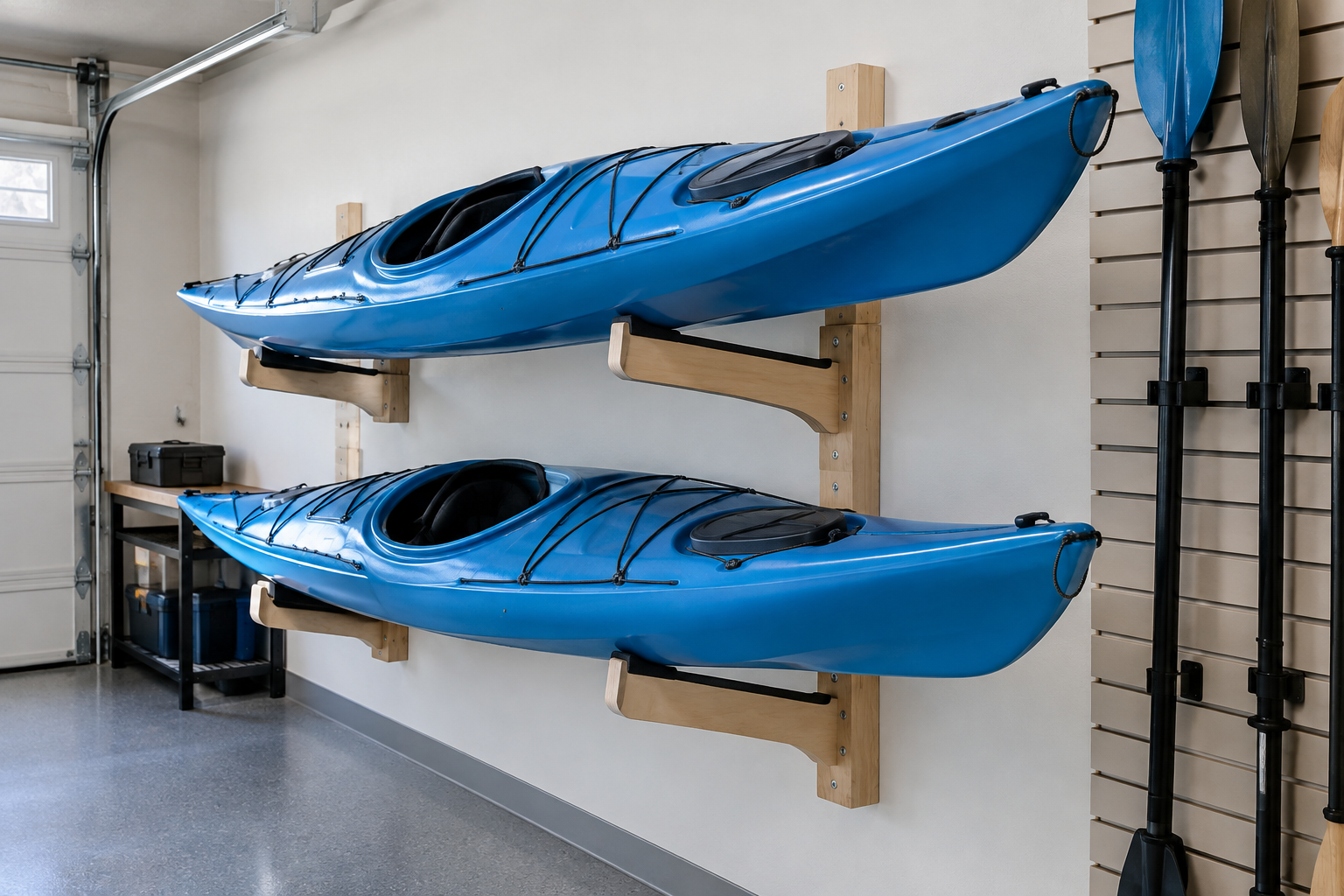
These birch-finish wood cradles give the storage setup a warm, workshop feel that contrasts nicely with the crisp white walls. Stacking two boats vertically on separate cradle pairs is one of the most space-efficient ways to handle multiple kayaks on a single wall. The slatwall panel beside them keeps paddles sorted and within arm’s reach , a pairing that makes gear organization feel intentional rather than improvised.
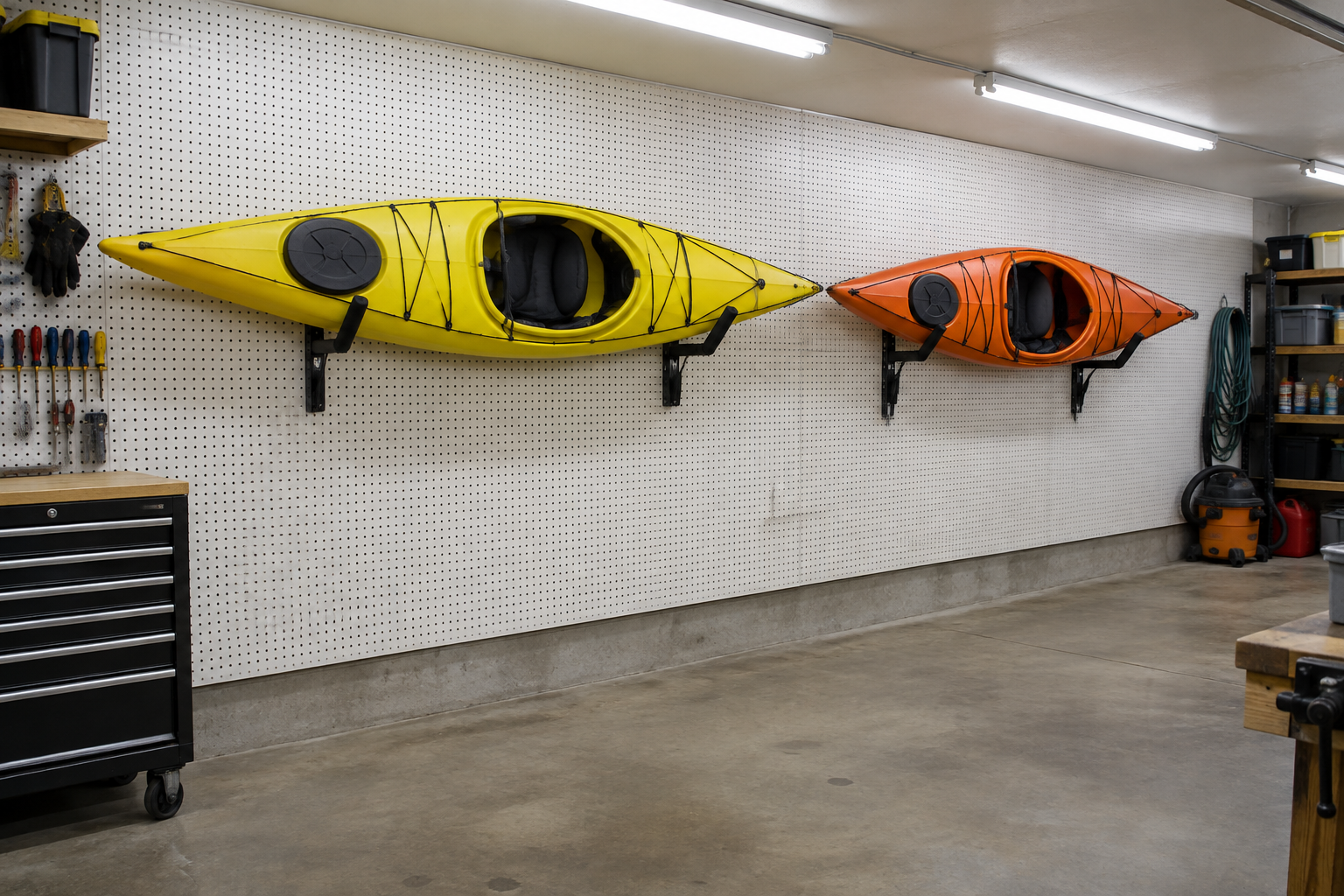
Running two boats side by side along a long wall works well in a wider garage bay, and the white pegboard backdrop makes the yellow and orange hulls pop. Adjustable steel cradles are worth the extra few dollars because you can tweak the width to match different hull shapes. If you use the same wall for other gear, a well-planned pegboard setup behind the boats can hold helmets, dry bags, and smaller accessories without crowding the kayaks.
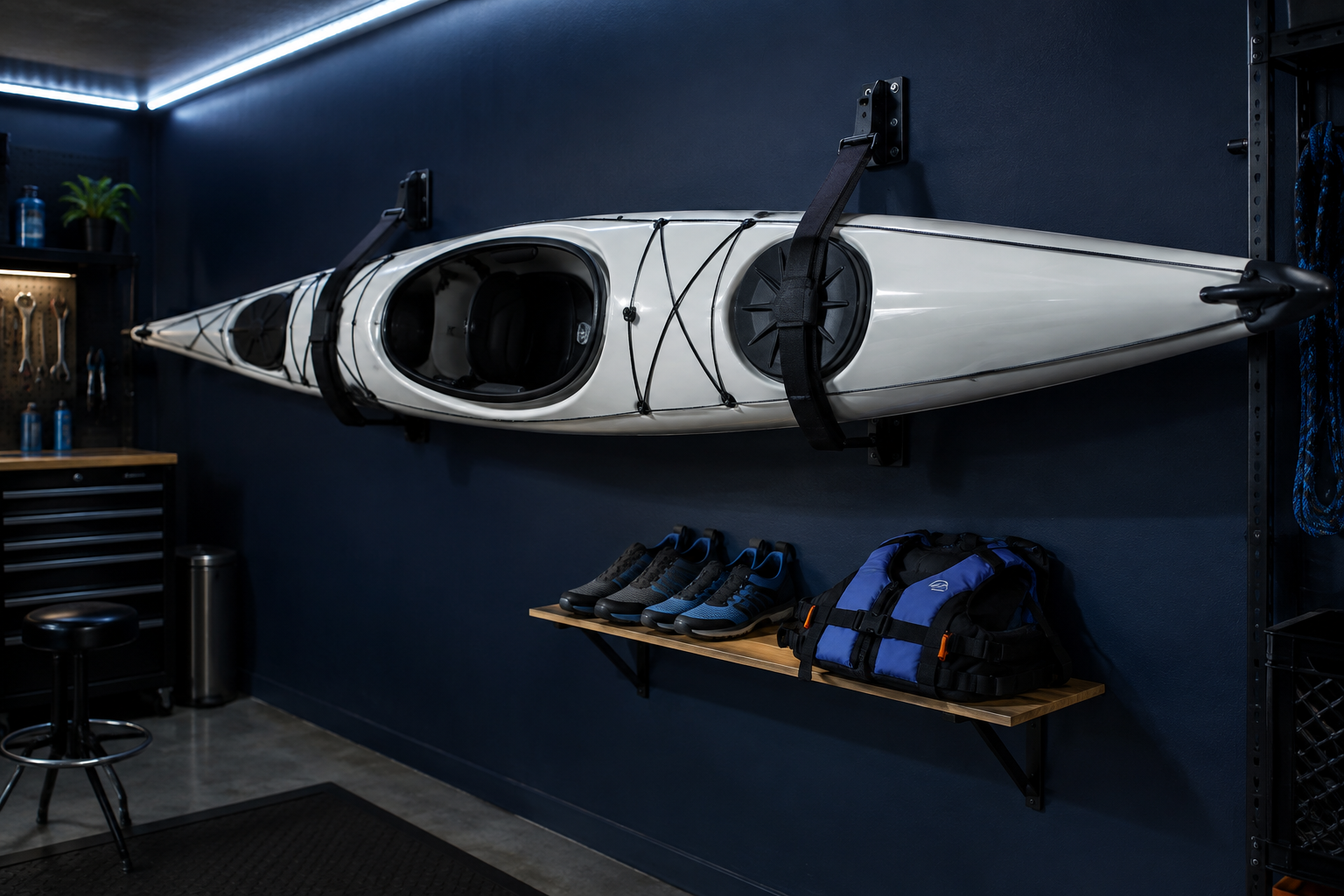
Wall straps offer a softer, more flexible alternative to rigid cradles, and they work particularly well for longer touring kayaks with narrow beams. The dark navy walls make the white hull stand out like a display piece, and the LED strip lighting adds drama without any complicated electrical work. A small shelf directly below the boat keeps paddle shoes and a PFD organized at grab-and-go height.
Ceiling Hoist Systems
Ceiling hoists are my favorite solution when floor and wall space are both at a premium. You run a pair of pulleys from the ceiling joists, attach straps under the hull, and hoist the kayak up until it clears your car roof , then lock it in place. The system takes some planning upfront, but once it’s installed it’s genuinely easy to use. I’d recommend reading up on garage ceiling storage ideas before you commit to a layout, because where you hang the hoist relative to your car doors and garage door opener matters more than people expect. If you’re not confident about your ceiling’s load rating, these seven ceiling storage safety mistakes are worth reading before you drill a single hole.
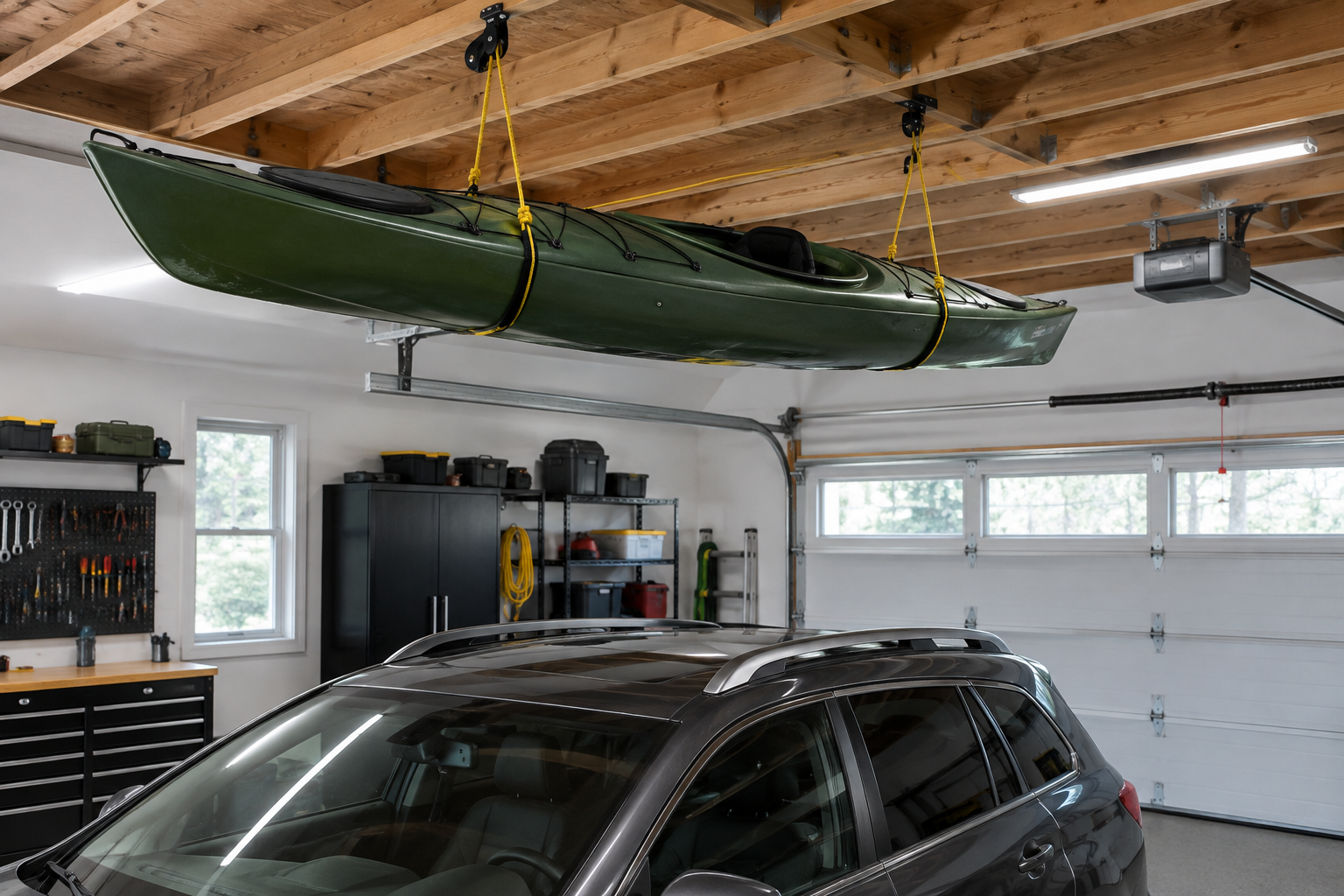
A four-point pulley hoist keeps this green recreational kayak flat and level while it hangs close to the ceiling, leaving a full car-width of clearance below. Yellow ropes make it easy to see which line to pull when you’re lowering it in dim lighting. This kind of setup is one of the most practical ways to reclaim floor space, and it scales well if you later want to add a second hoist for another boat.
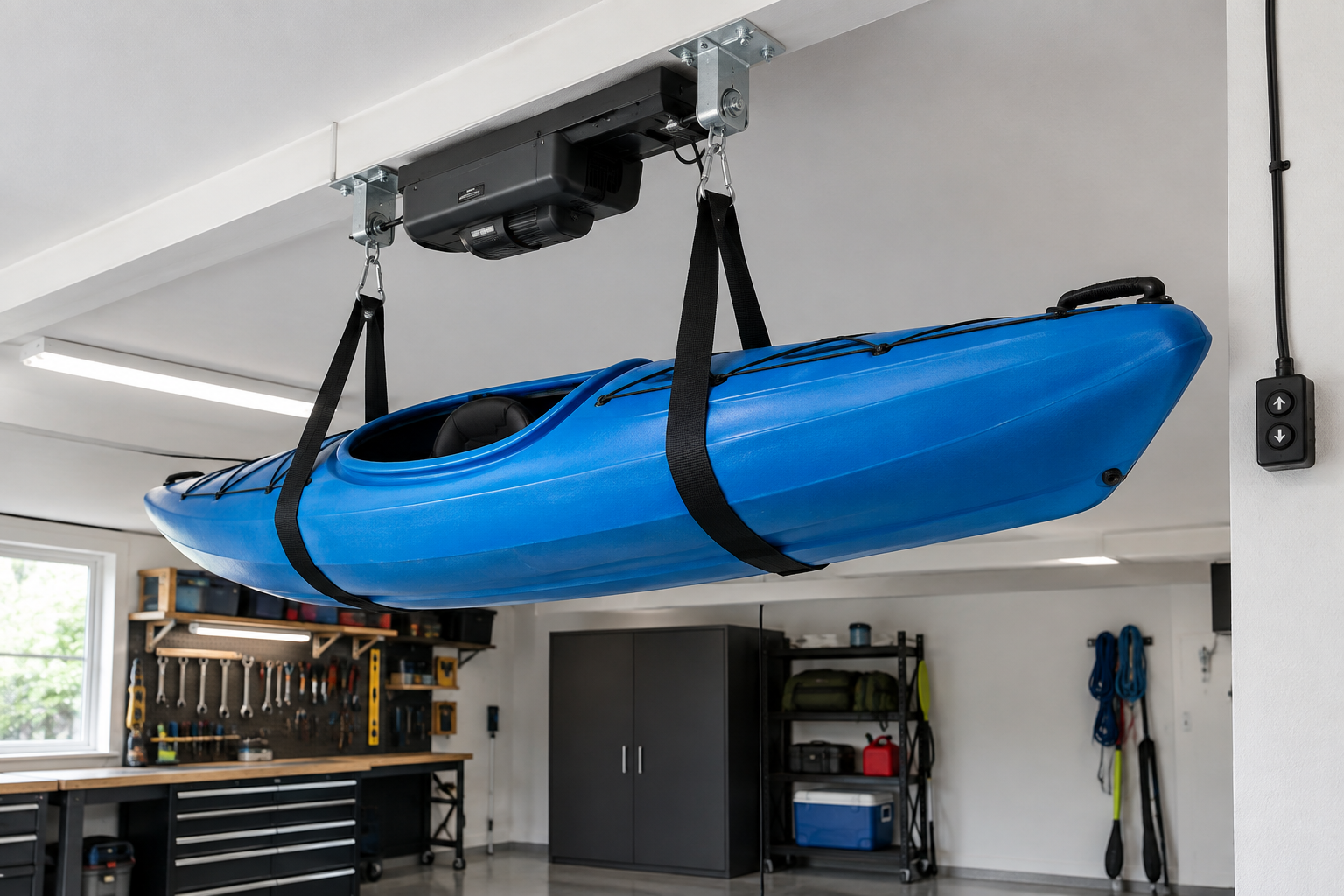
A motorized hoist removes the physical effort entirely , press a button on the wall and the boat comes down to waist height without any rope pulling. Wide black webbing straps distribute the load evenly along the hull, which protects the keel line from point pressure. If you already use overhead racks for bins and seasonal gear, a guide to the best garage ceiling storage lifts can help you figure out which motorized models work alongside existing rack systems.
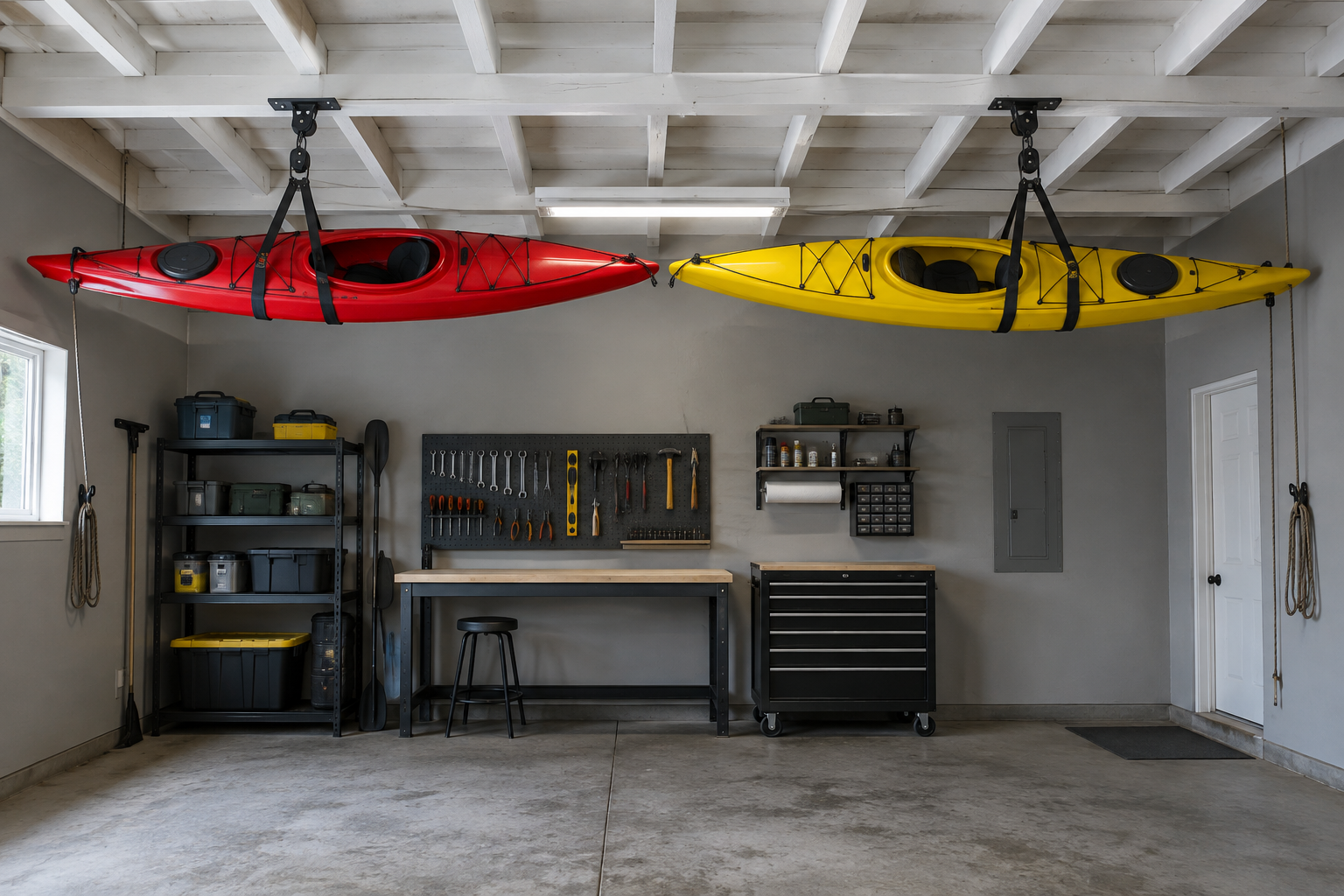
Hanging two boats on separate hoists between parallel joists keeps them neatly organized and easy to lower one at a time without disturbing the other. The white-painted exposed joists give the ceiling a finished look that makes the colorful hulls feel like part of the design rather than an afterthought. Rope cleats on the wall make securing each line fast and tidy once the boats are at height.
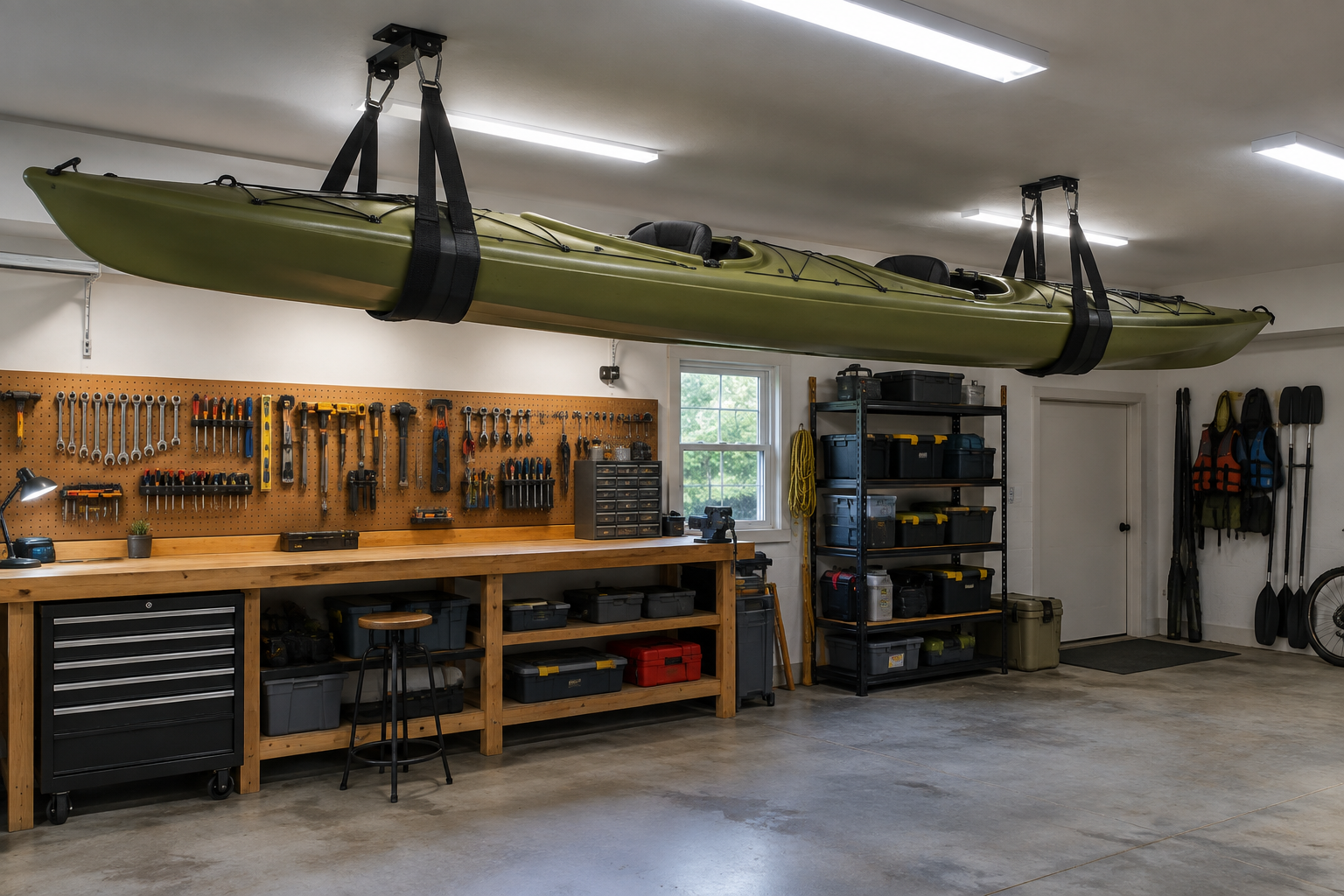
A long tandem kayak needs a heavy-duty hoist with extra strap points to keep the bow and stern from sagging , four attachment points across a 16-foot hull is the minimum I’d recommend. The foam-lined cradle slings on this setup protect the hull finish and prevent the kayak from swinging side to side when it’s parked up high. Even with a low 9-foot ceiling, there’s still enough clearance to walk underneath and use the workbench below without ducking.
Freestanding Racks
Freestanding kayak racks are the easiest entry point if you rent your garage or don’t want to put holes in the walls. They stand on the floor, hold one or more boats in padded arms, and you can move them around as your setup changes. Most are made from powder-coated steel tubing and can handle two to four kayaks stacked vertically. They’re also a natural pairing with bike storage , I’ve seen plenty of garages where a kayak rack sits next to a vertical bike storage rack and the two systems together handle every piece of non-motorized recreation gear the family owns. The trade-off is floor footprint, so measure your open floor space carefully before ordering.
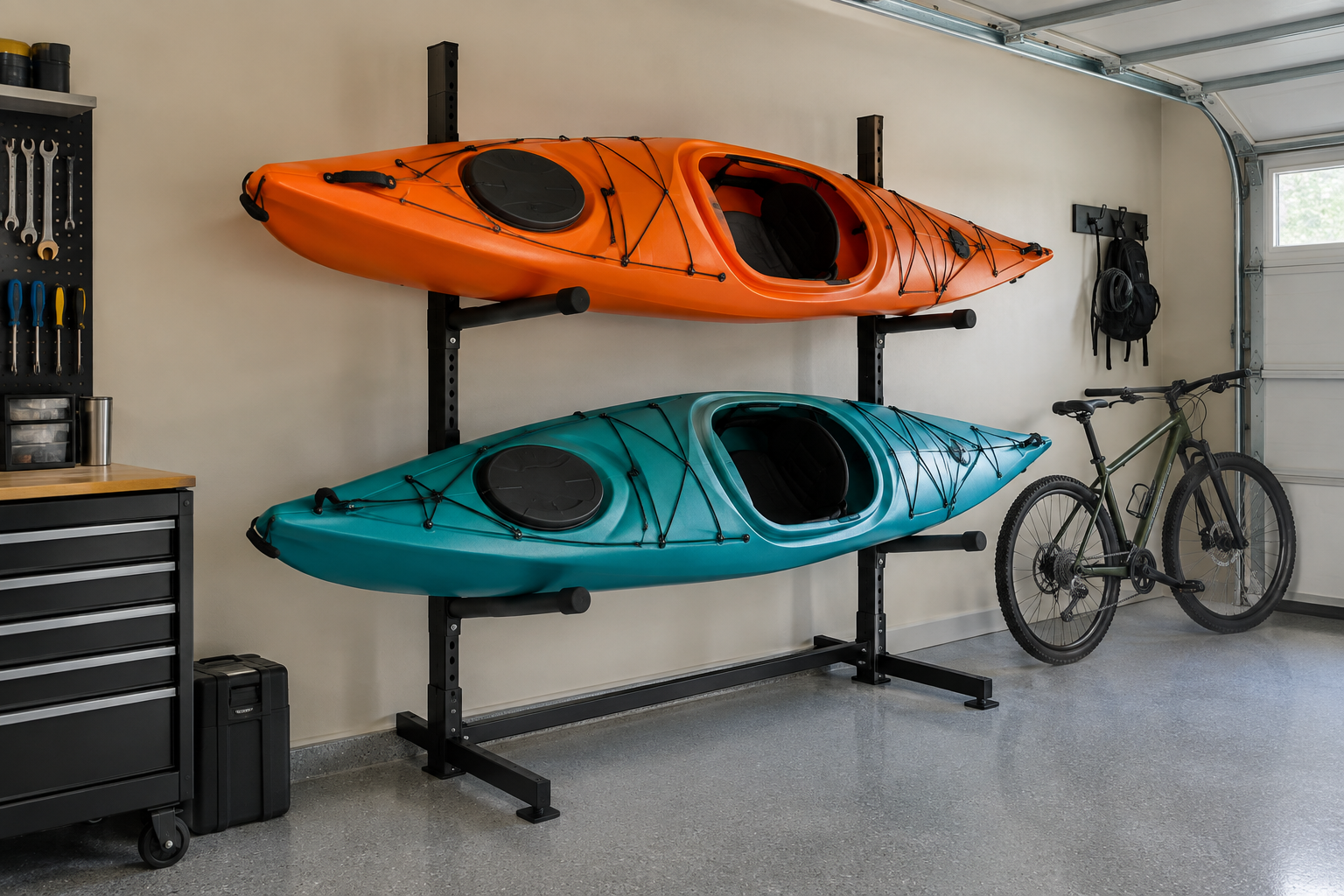
This two-tier freestanding rack stores a teal and an orange kayak one above the other, taking up a footprint roughly the size of a single boat laid flat on the floor. The black powder-coated steel frame is sturdy without being visually heavy, and the padded arms cradle each hull without leaving pressure marks. It’s a solid option for a two-kayak household that wants flexibility to rearrange the garage layout later.
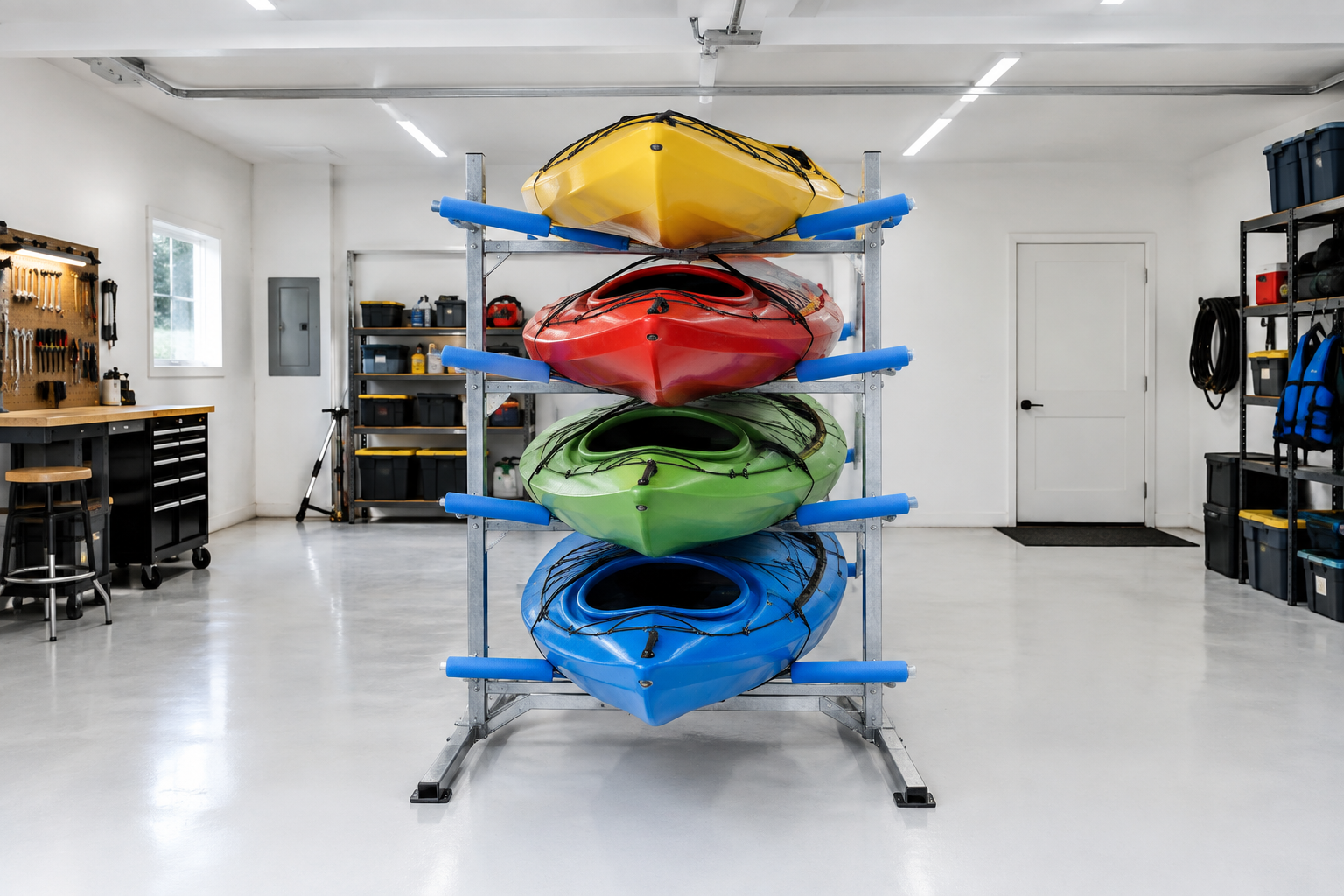
A four-kayak freestanding rack like this one makes sense for families where everyone has their own boat , the alternating stagger positions distribute the weight evenly and make it easy to slide out one kayak without disturbing the others. Blue foam-covered arms are a practical detail that protects every hull, regardless of material. Positioning the rack in the garage center rather than against a wall gives you walk-around access, which is helpful when boats are loaded with gear.
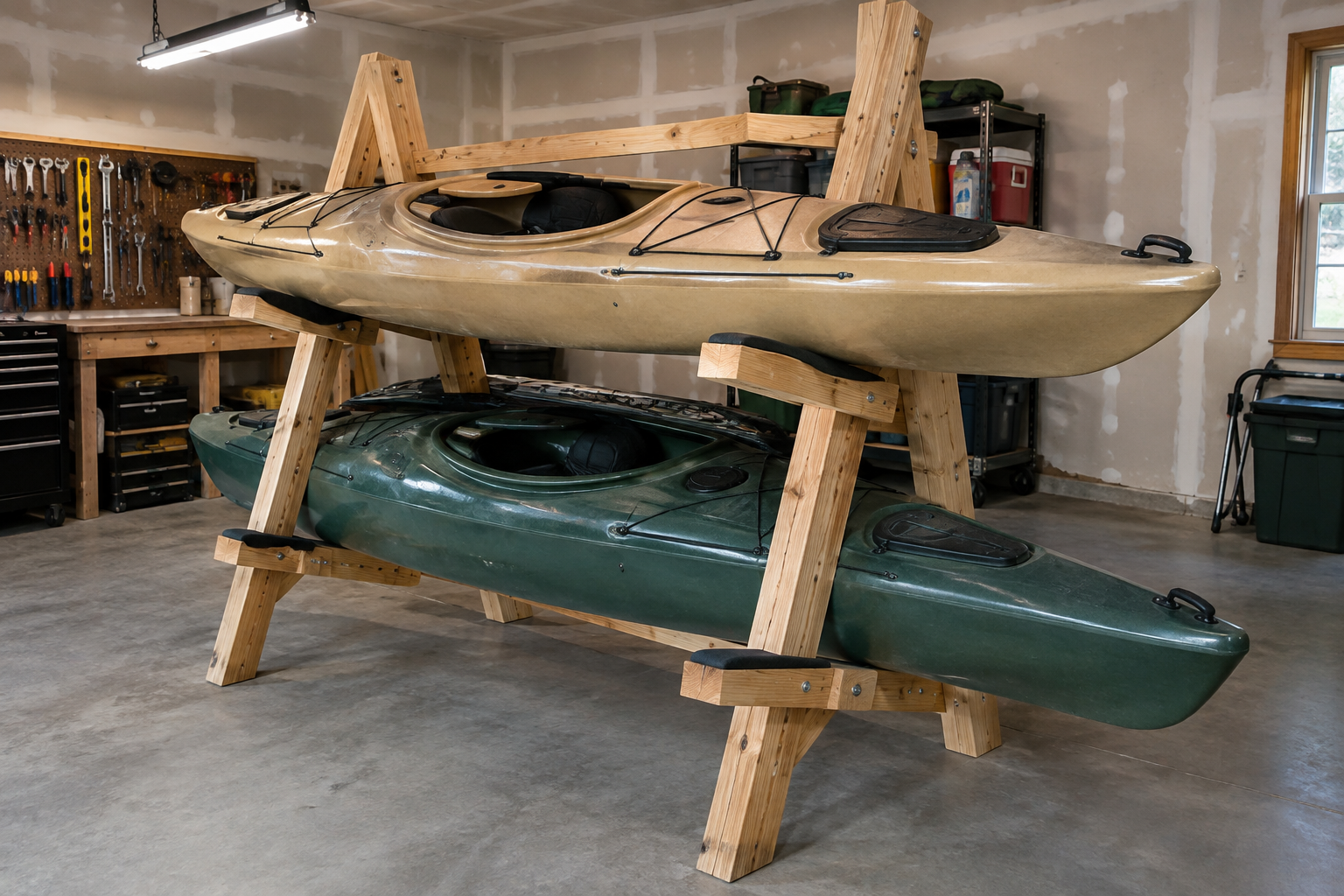
A DIY A-frame rack built from 2x4s costs a fraction of a commercial rack and can be sized exactly to your boats. The natural wood finish gives it a relaxed, outdoorsy look that fits right in with a garage that leans toward the workshop side. If you enjoy building your own storage solutions, the same skills that go into a kayak rack translate well to other projects , like learning how to build a DIY lumber storage rack for the off-cuts left over from the project.
Paddle and Gear Organization
Paddles, life jackets, dry bags, helmets, and car-top straps tend to multiply fast, and if they end up in a pile on the floor the kayaks end up sitting on top of them. Dedicated gear organization turns that chaos into a system you can actually use quickly on a Saturday morning. Wall hooks, slatwall panels, and small shelving units all work well here depending on how much gear you have. For a household that paddles regularly, treating the kayak zone like its own sports equipment storage zone makes the whole system click. A few well-placed hooks and a narrow shelf can handle everything without eating into your floor space.
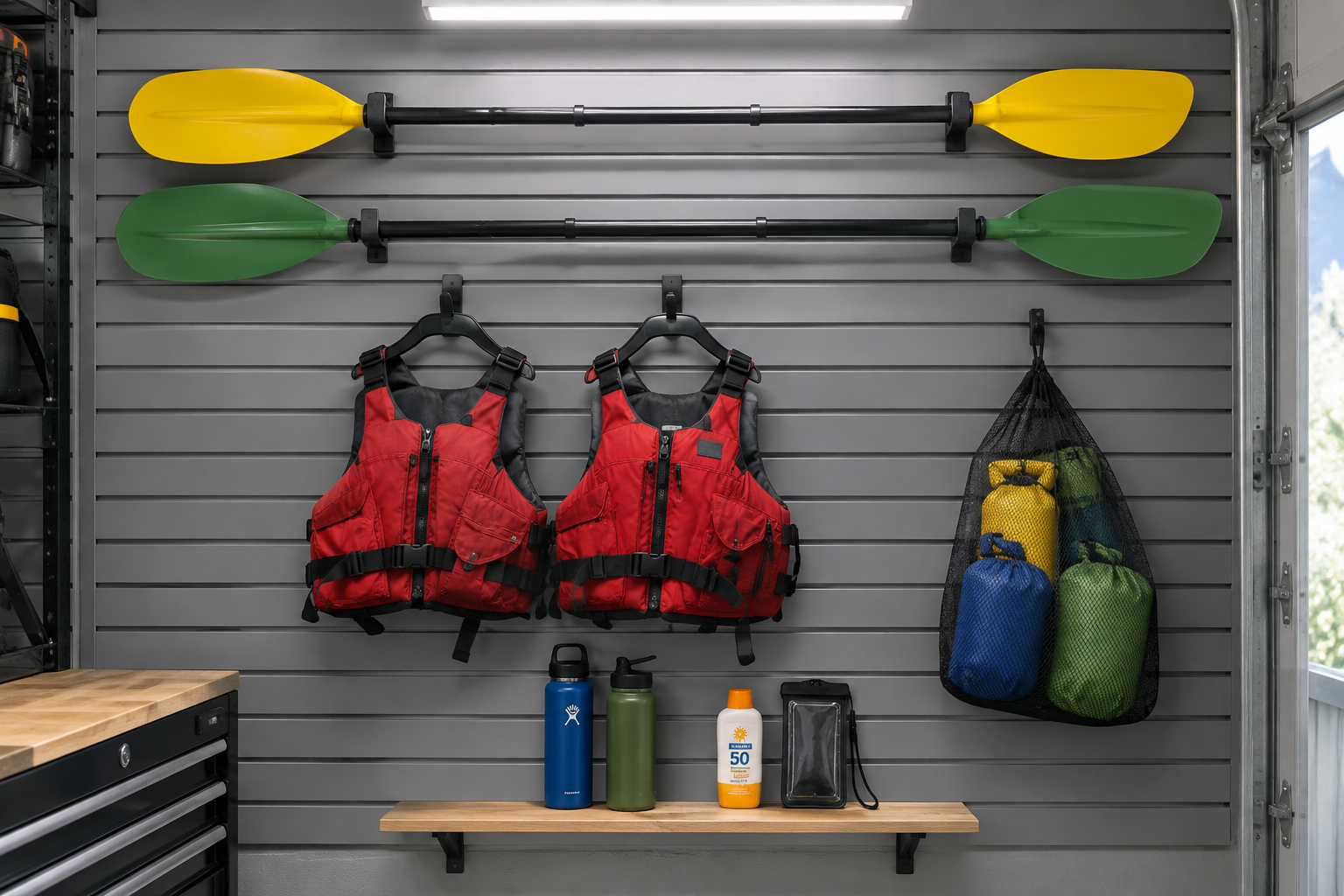
Gray slatwall is one of the most flexible systems you can put on a garage wall , hooks and accessories slide into any slot, so you can rearrange the layout without drilling new holes every time your gear collection changes. Hanging paddles horizontally keeps them straight and prevents the blades from sitting on a surface that could warp them over time. The narrow shelf below corrals the small stuff that always gets lost , sunscreen, a waterproof phone case, and spare straps.
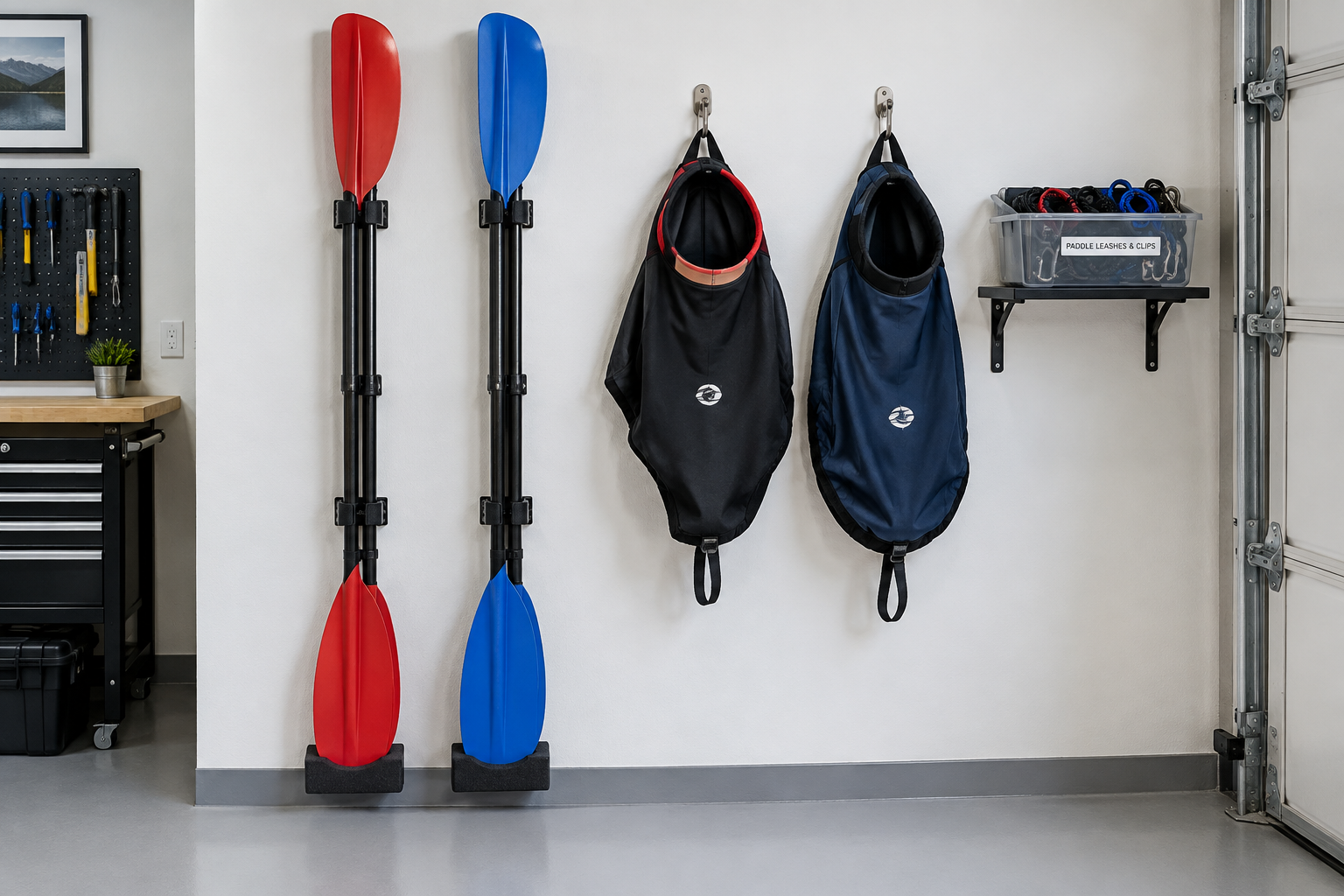
Vertical paddle storage brackets keep the shafts perfectly straight and make grabbing your paddle as easy as lifting it out of a stand. Foam-padded bases protect the blade edges from hard concrete, which matters for carbon fiber and fiberglass blades in particular. Labeled bins for spare leashes and clips might seem like overkill until you’re standing on a boat ramp at 7 a.m. searching for a clip , good labeling habits in the garage pay off every single time you head out.
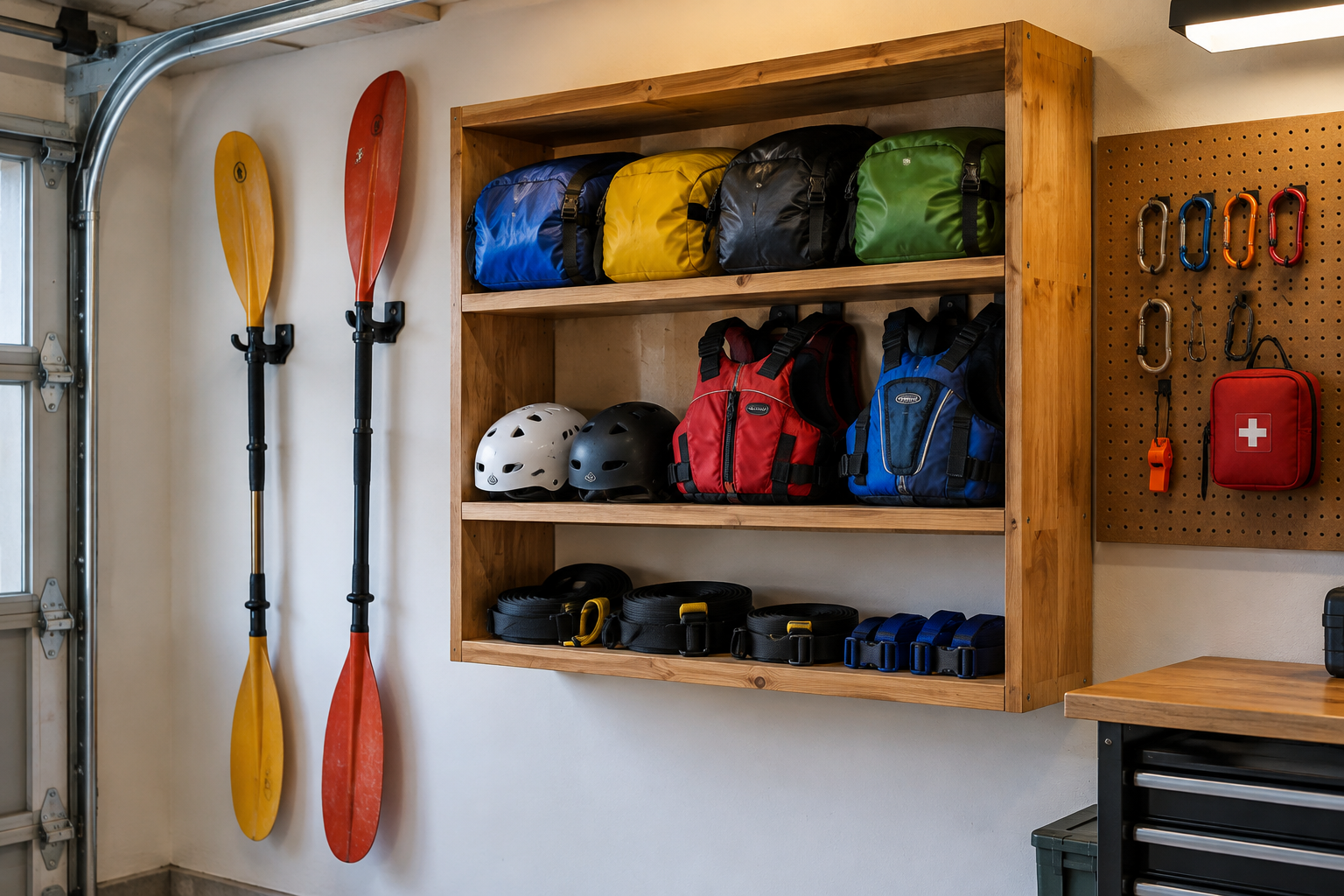
Dedicating a garage corner to a full kayaking kit station means everything you need is in one place before you even load the boats. Open wooden shelves keep PFDs visible and aired out, which extends their foam life compared to stuffing them in a bin. If you want to expand the pegboard section into a full tool and gear wall, a step-by-step pegboard installation guide walks through the whole process from stud-finding to hook layout.
