

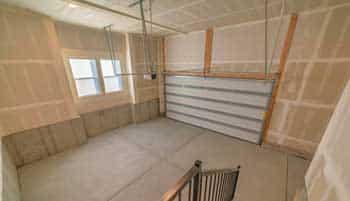
Whether you’re designing and building a new garage or installing a car lift, you may be wondering how high your garage ceiling needs to be.
In this article, we’ll cover all the details you’ll need to know, like building code requirements and recommendations from leading garage door manufacturers. We’ll also look at the minimum ceiling height requirements for some of the most popular car lift manufacturers, including BendPak, Challenger Lifts, LaunchTech, MaxJax Lifts, Mohawk Lifts, and Titan Lifts.
So fasten your seatbelts, and let’s dive in.
What is the Standard\Average Height of a Garage Ceiling?
Like most homeowners, you may wonder, “How high is a typical garage ceiling?” Well, we’ve got your answer.
According to the international building codes, the minimum height of a garage ceiling is 8 feet. However, this can vary significantly depending on your garage’s design and construction, ranging from 7 to 12 feet or even more.
A survey conducted by Houzz shows:
- 58% have a garage ceiling height of 8 feet.
- 28% have a height of 9 feet.
- 9% have a height of 10 feet.
- The remaining 5% have a ceiling height that exceeds 10 feet.
That means the average garage ceiling height is 8.6 feet high.
But remember, these are just averages. Your garage’s ceiling height may vary based on its type, size, and style.
For instance, the ceiling height in an attached garage might differ from that of a detached garage due to structural constraints or design preferences. Similarly, a single garage’s ceiling height might vary from a double or triple garage, often because larger garages sometimes accommodate oversized vehicles or require additional storage.
Finally, the style of your garage can play a role in its ceiling height. A traditional garage might stick with the standard 8 feet, while a modern or rustic style could feature higher ceilings for looks or to accommodate specific vehicles. Some homeowners even use their garage space for seasonal decorating, which benefits from the extra height clearance.

What is the Code Requirement for Garage Ceiling Height?
Garage upgrades often hinge on local building codes and regulations. These codes dictate not only the structure’s safety but also its functionality and potential resale value. As for your garage’s ceiling height, you need to know the minimum and maximum measurements your local building codes allow.
According to the International Residential Code (IRC), the minimum ceiling height for habitable spaces, including rooms, bathrooms, hallways, and laundry rooms, is 7 feet. However, this height can be reduced to 6 feet 8 inches for obstructions such as beams and ducts.
While this is the general rule, remember that local codes can vary significantly based on the state, county, or city where your garage is located. This means that before you pick up that sledgehammer or drill, make sure to check with your local building department for specific requirements.
Depending on how you plan to use your garage, these local codes might have various requirements and exceptions.
For example, suppose you’re converting your garage into a living space, additional storage, or installing a car lift. In that case, your local codes might require a higher ceiling height.
Conversely, a lower garage ceiling height might be permissible if your garage is used strictly for parking or if you have an attached office or workshop. Some building codes even have different specifications for fire-rated ceilings, ventilation openings, or sprinkler systems. Proper airflow is particularly important in hot climates, where adequate ventilation systems become essential for maintaining comfortable temperatures.
Following your local building codes isn’t just a matter of legality. It’s about safety, functionality, and future value. Adhering to these standards ensures your garage is safe and usable for its occupants and vehicles.
Violating these codes can lead to fines, and if you ever decide to sell, it can complicate the process.
What is the Minimum Ceiling Height (Headroom) for Garage Doors?
When talking about your garage ceiling height, you may hear the term ‘headroom.’
Headroom refers to the space between the top of the door and the nearest obstacle above it, like a ceiling, beam, or light. It helps ensure that the garage door has enough room to travel the length of the track without running into anything.
The amount of headroom you need varies depending on the type of garage door and opener you have. Typically, you’ll need anywhere from 6 to 18 inches or more.
If your garage has less than the minimum headroom, you may require specific hardware or track systems to install the garage door properly.
Let’s break it down by the typical garage door sizes.
For each size, we’ll look at the recommendations from the three biggest garage door manufacturers in the United States: Clopay, Raynor, and Wayne Dalton:
7ft Garage Door
Clopay states that a 7-foot garage door has a minimum headroom requirement of 4.5 inches for extension spring systems and 9.5 inches for front-mount torsion spring systems.
For garages with low headroom, you could opt for rear-mount torsion spring systems, which only require 5 inches of headroom.
8ft Garage Door
An 8-foot garage door has similar minimum height requirements.
Raynor specifies a minimum headroom requirement of 4.5 inches for extension spring systems and 9.5 inches for front-mount torsion spring systems. You need only 5 inches of headroom with rear-mount torsion spring systems.
10ft Garage Door
Unfortunately, you’ll need more headroom for the larger 10-foot garage doors.
According to Wayne Dalton, you’d need between 6 to 15 inches of headroom for residential garage doors and 12 to 18 inches for commercial ones, depending on the type of spring and track system installed.
If you don’t have enough vertical space, you can opt for a low-headroom conversion kit, which reduces the headroom requirement to as low as 6 inches.
Remember, the minimum headroom ensures your garage door functions properly. This means you will avoid common issues such as difficulty opening the door, unnecessary wear and tear, and potential damage to your vehicle.
Recommended Garage Ceiling Height for Car Lifts
When shopping for a car lift for your garage, your choice may be limited by the garage ceiling height. Another important consideration is ensuring proper air quality in your workspace, which may require installing exhaust fans for ventilation to remove fumes safely.
In this section, I’ll outline several popular car lift manufacturers’ minimum ceiling height requirements:.
Advantage Lifts
Based on information from the official Advantage Lifts website, the minimum garage ceiling height requirement ranges between 9′ and 12′, depending on the lift model you choose.
Additional space is recommended for safety and operational convenience. The Advantage Lifts website offers a guide on measuring your ceiling height and choosing the best location for your 2-post lift.
- The DX-9000-HD and SS-11000-WD models have a minimum ceiling height of 9′ (108″).
- The DX-9000-XLT has a typical garage height of 10.5′-12′, but this varies depending on what vehicle you’re putting on the lift.
- The Backyard Buddy Work Force model has a maximum lifting height of 82 inches with corner posts that stand at 104″ tall. Advantage recommends at least a ceiling height of 10′, but this depends on the size of your vehicle.
- The ML-2000 motorcycle single-post lift is 9′ 4″ tall, with a maximum lifting height of 72″.
- The Advantage AL-SC10 2-post lift is one of the tallest garage lifts they make, standing at 11′ 10″ tall, with a minimum ceiling requirement of 12′.
BendPak
According to the official BendPak website, their 2-post lifts require a minimum ceiling height of 12 feet due to their maximum lifting height of 69 inches. You’ll need at least 73 inches of clearance plus additional space for safety and convenience. The BendPak website provides a guide on measuring your ceiling height and selecting the best location for your 2-post lift.
For 4-post vehicle lifts, the BendPak website does not list a general garage ceiling height requirement but does detail the following models:
- Bendpack 2-post lifts have an overhead support beam that ranges in height between 145″ (12′ 1″) for the 10AP model to 181″ (15′ 1″) for the 10APX-181. Your garage ceiling must be slightly higher than the beam height to allow for installation.
- 4-post lifts have column heights that range from 89″ (7′ 5″) for the GP-9F and HD-9 models to 110.25″ (9′ 2.25″) for the HD-7W. The maximum rise ranges between 70″ and 82″.
- The HD-7PXW model is a super-tall four-post lift that stands at a whopping 158″ (13′ 2″) high. It can lift a 7,000lb vehicle as high as 140″ (11′ 6″).
- Bendpack Parking Lifts range between 118.5″ (9′ 10″) high for the PL-12000DP tandem parking lift and 173″ (14′ 5″) high for the HD-973PX tri-level parking lift. The maximum rise ranges from 70.2″ to 151.5″.
Extra space is always recommended for safety and convenience when operating these lifts.
