

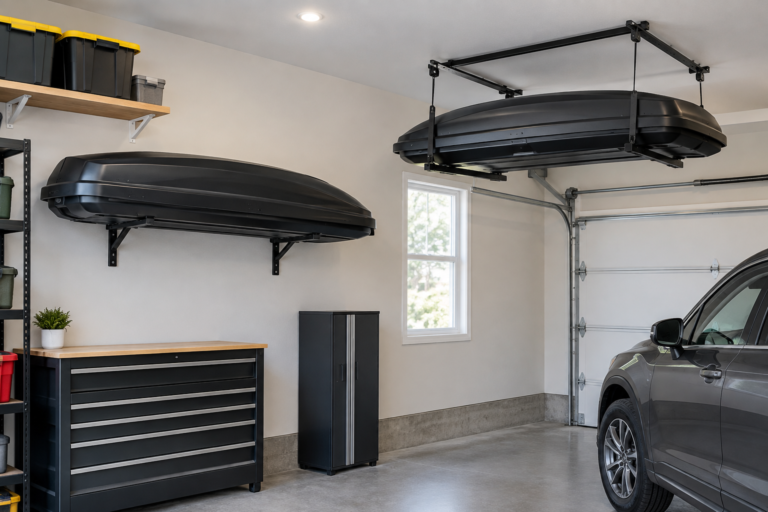
Once ski season ends or the road trip is over, your roof cargo box turns into a giant, awkward problem. It’s too big for a shelf, too expensive to leave sitting on the garage floor where it’ll get scratched or run over, and too bulky to just lean against a wall. Getting it up and out of the way, without cracking the shell or blocking your garage door, takes a little more planning than most garage storage projects.
This guide walks through the real options for storing a roof box off the vehicle: wall brackets, ceiling hoists, strap systems, and shelf storage, so you can pick the setup that actually fits your garage and your box.
What You Need to Know Before Choosing a Storage Method
Roof boxes are big, but they’re not heavy. Most empty cargo boxes weigh between 40 and 60 pounds, yet they can measure 6 to 8 feet long and 2.5 to 3 feet wide. That size is the real challenge, not the weight. Any mounting hardware rated for at least 75 pounds will handle the box itself with room to spare.
Before you pick a storage method, measure three things: the box’s full length and width, the height of your garage ceiling, and the clearance your garage door needs when it opens. A lot of people mount a ceiling hoist too close to the door track and then can’t lift the box high enough without it hitting the roller assembly. If you’re still working out your garage’s overall layout, our garage floor plans and dimensions guide is a good starting point for mapping out clearances like this.
Also check the shell material. Most roof boxes are ABS plastic or a plastic composite, and both can deform under point pressure if you store the box resting on narrow straps or hard edges for months at a time. Wide, padded contact points matter more than raw strength here.
Wall Mount Brackets
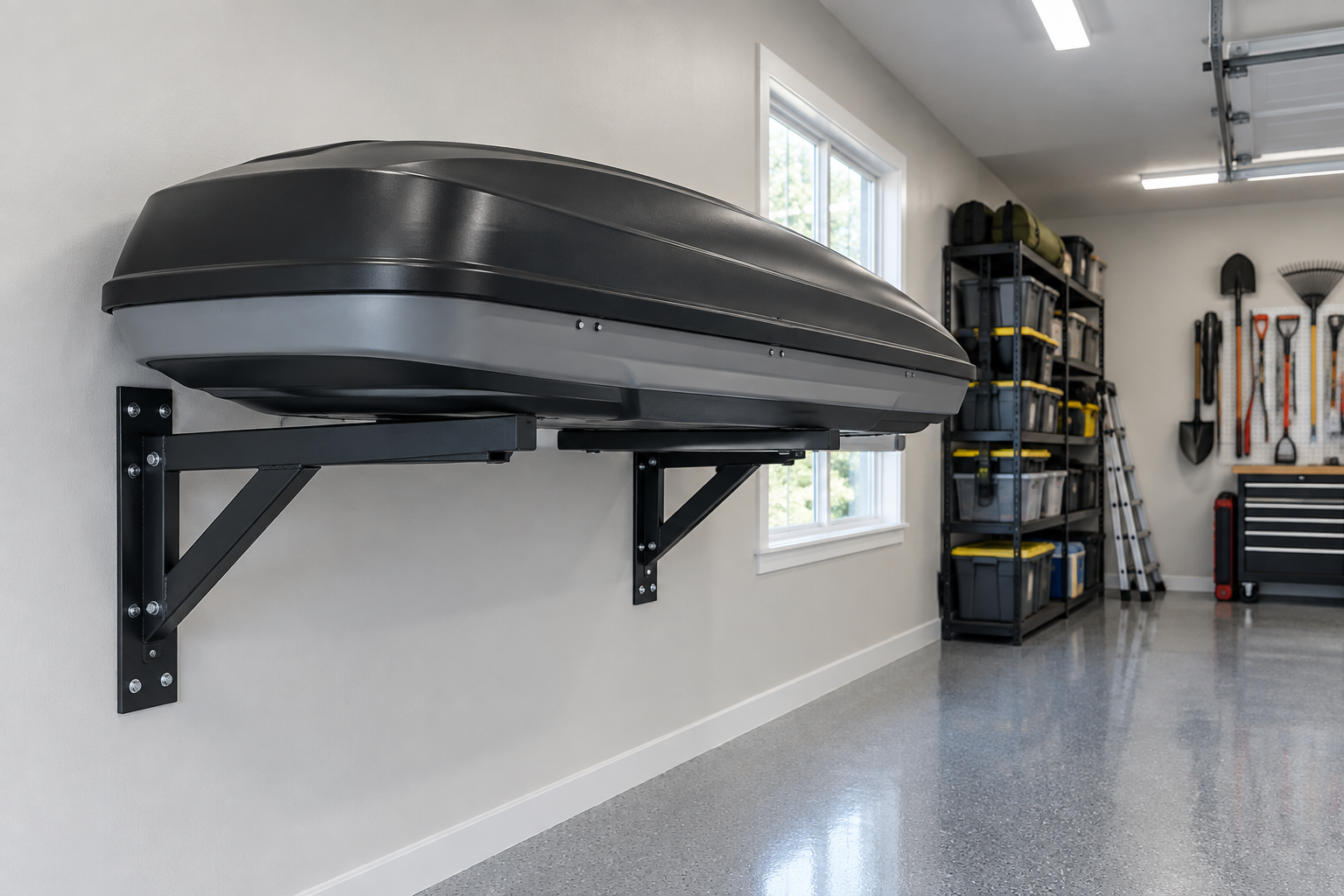
Wall brackets are the easiest option if you’ve got open wall space and don’t want to deal with a pulley system. You bolt L-shaped or J-shaped brackets into wall studs, then slide the box on horizontally or angle it slightly for a smaller footprint.
The upside is simplicity and cost. There’s nothing to hoist, no ropes to learn, and installation usually takes under an hour with a stud finder and a drill. The downside is that the box sticks out from the wall by 2 to 3 feet, which eats into space you might want for a workbench or bike storage.
Look for brackets with a rubberized or foam-lined cradle rather than bare steel. Bare metal brackets are the number one cause of scuff marks and stress cracks on cheaper roof boxes. If your garage doubles as a workspace, pairing wall brackets with some open shelving nearby can help keep straps, roof rack bars, and mounting hardware organized. Our garage shelving ideas article has layouts that work well around bulky wall-mounted items like this.
Ceiling Hoists
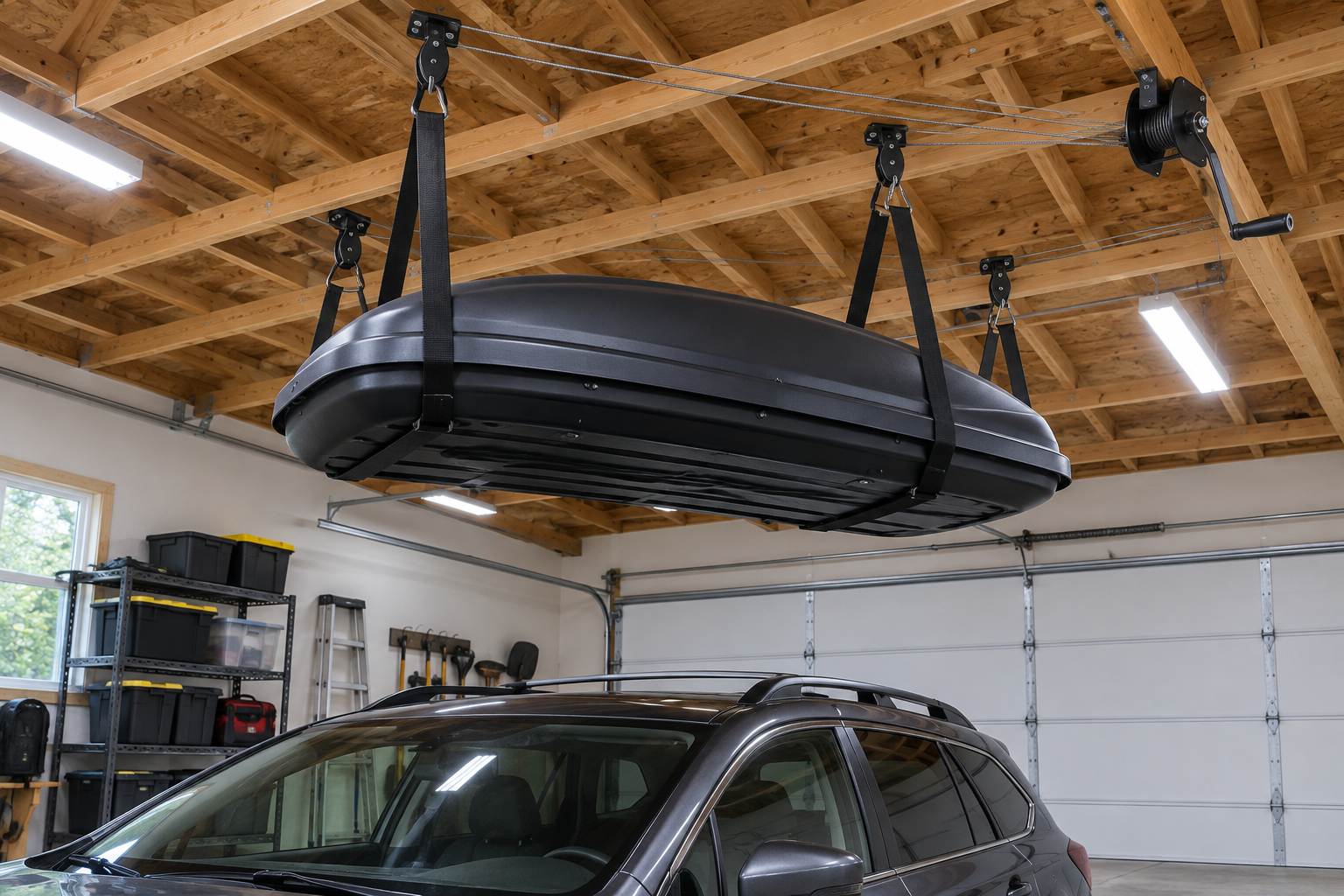
If floor space and wall space are both tight, a ceiling hoist is the better answer. These systems use a pulley and rope (or a crank in motorized versions) to lift the box flat against the ceiling, completely clearing the floor and walls below.
Roof Box Ceiling Hoist Storage Lift
A pulley-based hoist that lifts a roof box flat to the ceiling, freeing up wall and floor space in tighter garages.
Ceiling hoists need to be anchored into ceiling joists, not just drywall, so find your joists first or use a stud finder rated for ceiling work. Most residential hoist kits are rated for 100 to 150 pounds, which is more than enough for a roof box, but you still want at least two mounting points spread across the width of the box to avoid warping it while it hangs.
The clearance issue comes up most with ceiling hoists near garage doors. If your door track runs close to where you want to mount the hoist, raise the mounting points further back into the garage, or check our guide on garage door track alignment if you’re not sure how much clearance your track actually needs. For garages with lower ceilings, this is also where you want to double check headroom using the tips in our garage ceiling ideas article before you drill anything.
Straps and Tie-Down Storage
Ratchet straps looped over ceiling joists are the budget version of a hoist, and they work fine for occasional use. The tradeoff is that straps concentrate weight into narrow lines across the box shell, which is exactly the kind of point pressure that causes long-term deformation.
If you go this route, use wide cargo straps, at least 2 inches across, and never thin rope or bungee cords. Add a folded towel or foam pipe insulation under each strap where it touches the box to spread the load and prevent scratches.
Wide Ratchet Cargo Straps
Wide webbing spreads pressure across the box shell better than thin rope or bungee cords, reducing the risk of dents.
Shelf Storage: When It Actually Works
Shelf storage only makes sense if you’ve got heavy-duty overhead shelving with enough depth to fully support the box, not just the ends. A box resting unsupported in the middle will sag over time, especially in warmer garages where the plastic softens slightly in summer heat.
If you already have sturdy shelving installed, look at units built for loads over 150 pounds with at least 30 inches of depth. Our garage cabinet ideas roundup covers heavy-duty shelving options that can handle this kind of oversized item alongside your usual storage bins.
Wall vs Ceiling: Which One Wins
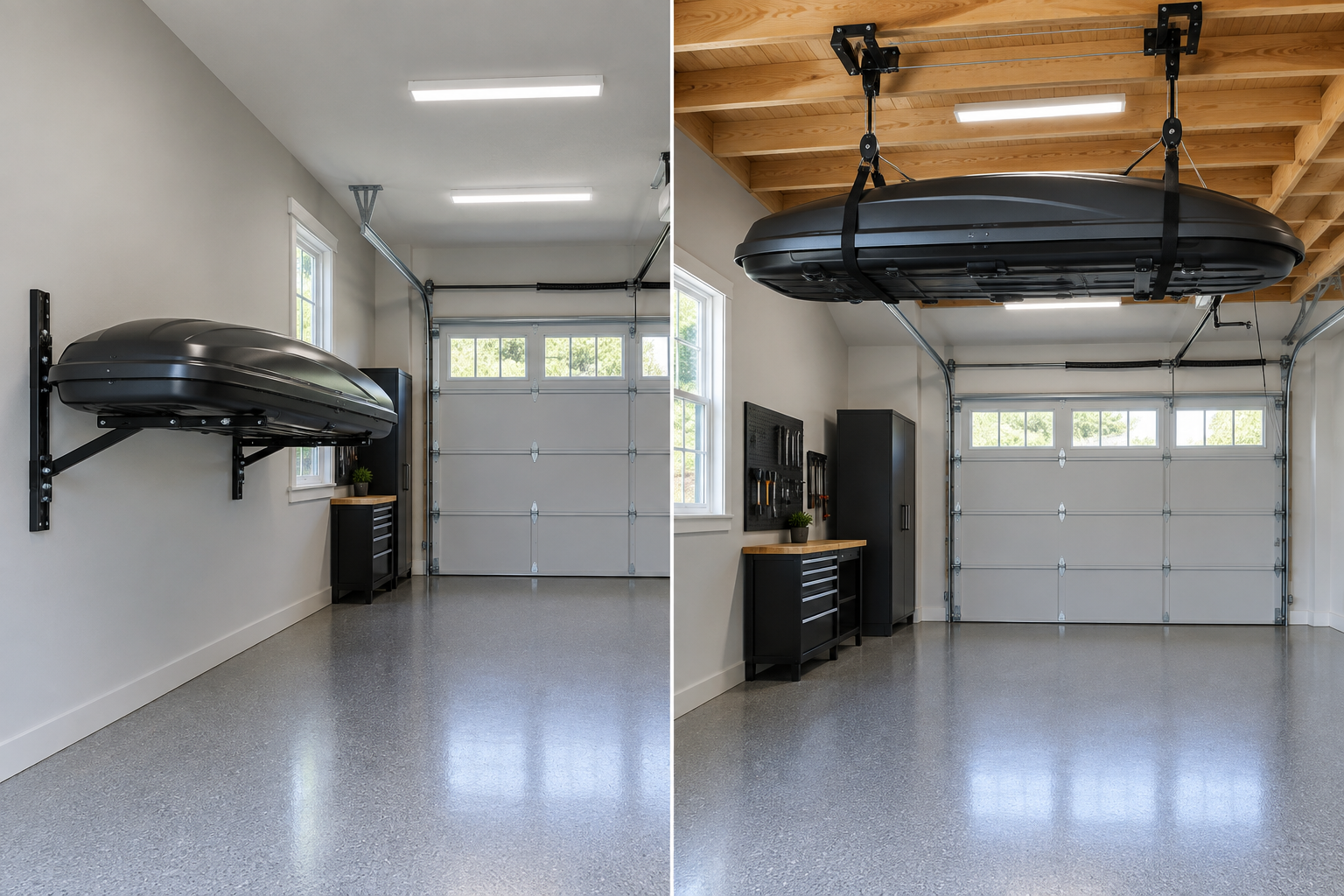
For most garages, a ceiling hoist is the better long-term choice. It clears the floor completely, keeps the box out of the way of car doors and bike handlebars, and spreads weight evenly if you install it with two anchor points instead of one. Wall brackets are the runner-up, best for garages with a spare stretch of open wall and owners who don’t want to deal with pulleys.
Skip strap-only storage unless it’s genuinely temporary, and only use shelving if it’s rated and deep enough to support the whole box without sagging in the middle.
Frequently Asked Questions
Can storing a roof box in the garage damage it?
Yes, if it’s resting on narrow contact points like thin straps or bare metal brackets for extended periods. The plastic shell can develop soft spots or hairline cracks under sustained point pressure, especially in a hot garage. Wide, padded support points prevent most of this damage.
How much ceiling clearance do I need for a hoisted roof box?
Plan for at least 12 to 16 inches between your garage door track and the bottom of the hoisted box, plus the box’s own height once it’s raised. Measure your garage door’s full open clearance first, since torsion springs and tracks often sit lower than people expect.
This article contains affiliate links. We may earn a small commission at no extra cost to you.
