

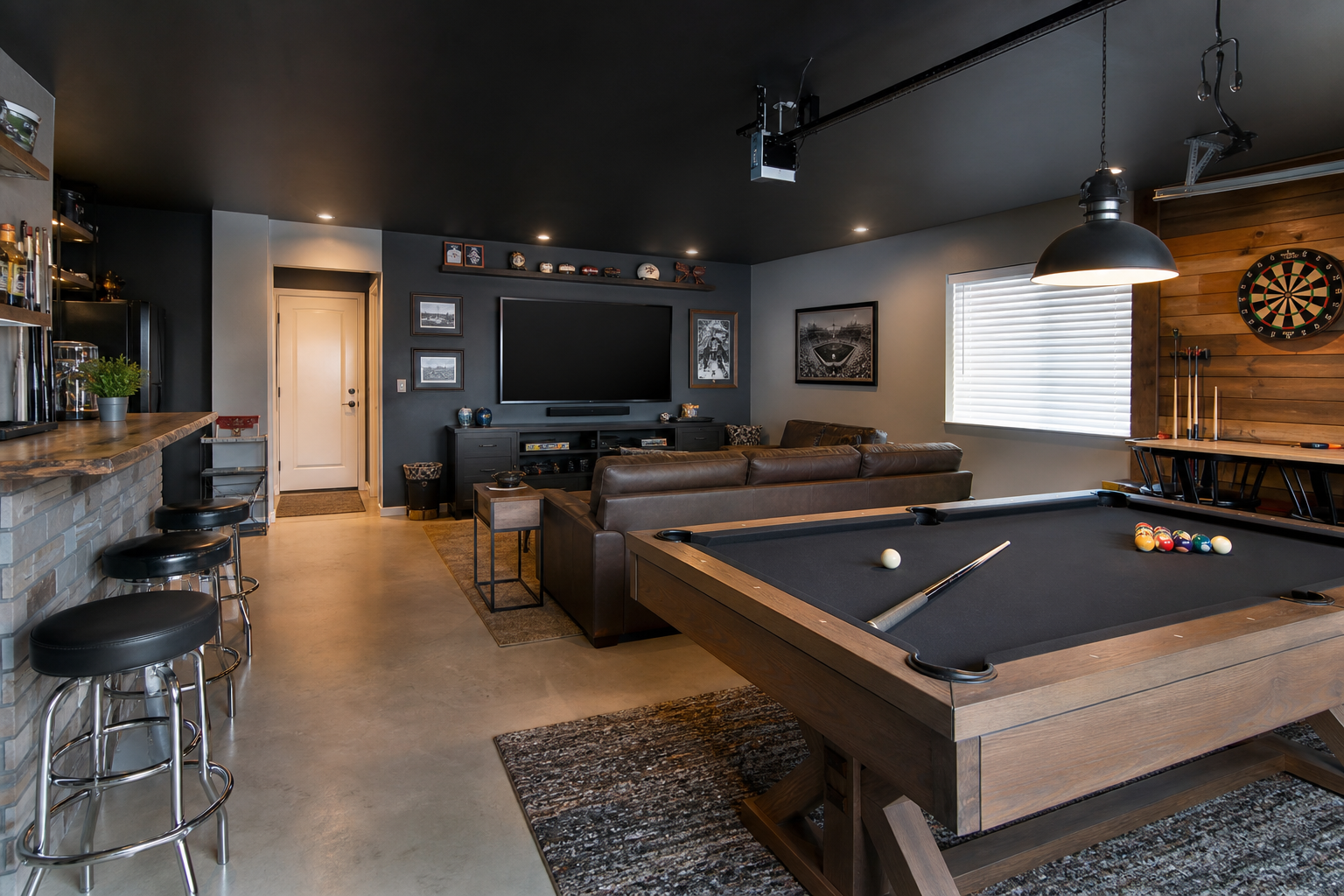
Whether you’ve been planning to convert garage into man cave on budget for months or decided to tackle it this weekend, a clear roadmap makes all the difference. Preparation accounts for about 80% of the success in projects like this.
Everything you need is below: tools, materials, step-by-step instructions, and the common pitfalls to avoid.
Understanding the Basics
LED shop lights are the standard: 50,000+ hour lifespan, low electricity consumption, and instant full brightness. Linkable models daisy-chain from one outlet. Most manufacturers limit chains to 4 to 8 fixtures to prevent voltage drop that causes dimming or flickering on distant units.
Placement matters as much as total output. Evenly spaced fixtures eliminate dark spots. Four to six 4-foot LED shop lights in rows cover most two-car garages well. Add a task light directly above the workbench, positioned so you don’t cast your own shadow on the work surface.
Target 50 lumens per square foot for general garage use. A 400 square-foot two-car garage needs at least 20,000 lumens total. For workbench detail, boost to 300 lumens per square foot with dedicated task lighting positioned to minimize shadows.
Color temperature (Kelvin) determines light quality. 5000K (daylight) gives crisp, color-accurate illumination ideal for garages. 4000K (neutral white) is slightly warmer if you find daylight too harsh. Avoid warm-white bulbs (2700-3000K) for workshop use since they make it harder to see fine detail.

LED Shop Light 4ft Linkable
Perfect for creating bright, even lighting throughout your man cave
Flooring That Holds Up to Heavy Use
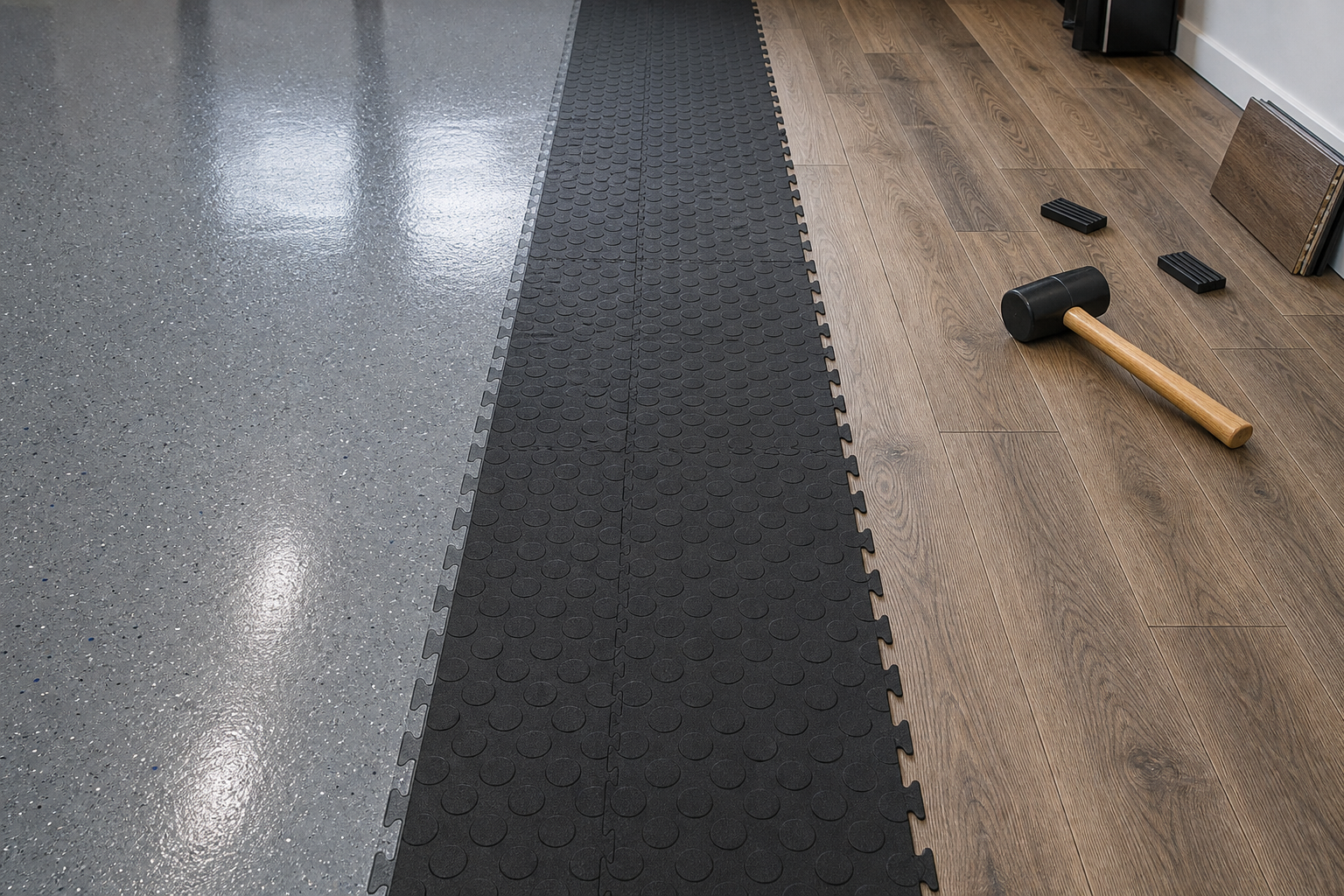
Your floor sets the tone for the whole space. Bare concrete looks unfinished and shows every oil stain. A quality coating makes cleaning easy and transforms the visual impact of the room.
Epoxy kits cover a two-car garage if you do the work yourself. Application takes a weekend: day one for prep and primer, day two for the topcoat. Surface prep matters more than the coating itself. Skip the acid etch if your concrete is older than a few months. Grind or mechanically abrade instead. Acid etching on aged concrete often fails to open the pores enough for good adhesion.
Polyaspartic coatings cost more but cure faster and handle temperature swings better. You can walk on them in 24 hours, drive on them in 48. They’re more forgiving in cold weather, which matters if you’re working in late fall or early spring.
Interlocking floor tiles are the no-cure option. PVC or polypropylene tiles run competitively priced to competitively priced per square foot. A 400 square-foot garage competitively priced to competitively priced in materials. Installation is simple: sweep the floor, snap tiles together, trim edges with a utility knife. No downtime, no fumes, and you can reconfigure or remove them if you move.
Avoid the cheapest epoxy kits sold at big-box stores. They thin out too much during application, resulting in weak coverage that wears through in high-traffic areas within a year. Spending an extra competitively priced on a mid-tier product makes the difference between a floor that lasts three years and one that lasts ten.
Insulation and Climate Control
An uninsulated garage in winter is miserable. In summer, it’s a heat trap. Basic insulation makes the space usable year-round and cuts the cost of heating or cooling dramatically.
Fiberglass batts are the budget choice: competitively priced to competitively priced per square foot for R-13 rated material. For walls in a two-car garage (roughly 800 square feet of wall area), expect competitively priced to competitively priced in materials. Add vapor barrier (competitively priced to competitively priced) and drywall or plywood sheathing (competitively priced to competitively priced). Total DIY cost: competitively priced to competitively priced.
Rigid foam board insulation costs more upfront (competitively priced to competitively priced per square foot) but installs faster and offers better moisture resistance. It’s worth considering if your garage sees condensation issues or if you’re in a humid climate.
Skip the spray foam unless you’re hiring pros. DIY spray foam kits are tricky to apply evenly, and mistakes are expensive to fix. Professional spray foam runs competitively priced to competitively priced per square foot installed, putting it outside most budget builds.
For heating, a small electric space heater (1,500 watts) handles spot warming. If you need whole-room heat, a wall-mounted electric or propane heater runs competitively priced to competitively priced. Propane units require proper venting. Never run an unvented propane heater in an enclosed garage overnight.
Portable air conditioners work for cooling small man caves but expect high electricity bills. A 10,000 BTU unit cools about 300 square feet. Mini-split systems offer better efficiency and year-round climate control but competitively priced to competitively priced installed, which eats most of a competitively priced budget.
Wall Finishes and Soundproofing
Drywall is the standard finish: smooth, paintable, and cheap. Half-inch drywall runs competitively priced to competitively priced per 4×8 sheet. A two-car garage needs roughly 20 sheets for walls (competitively priced to competitively priced). Add joint compound, tape, screws, and primer for another competitively priced. Paint competitively priced to competitively priced per gallon; two gallons cover most garages.
If you want more detailed tips on finishing your walls professionally, check out our garage drywall finishing guide for beginners.
Plywood or OSB sheathing costs about the same as drywall but offers impact resistance if you’re mounting heavy shelving or anticipate rougher use. It doesn’t look as finished unless you paint it.
Soundproofing adds cost but matters if you’re running power tools, playing music, or watching games at high volume. Resilient channel (metal strips that isolate drywall from studs) competitively priced to competitively priced per linear foot. For a two-car garage, budget competitively priced to competitively priced. Add a second layer of drywall with Green Glue damping compound between layers. Green Glue runs competitively priced to competitively priced per tube; you’ll need 15 to 20 tubes (competitively priced to competitively priced). The second layer of drywall adds another competitively priced to competitively priced.
For budget-friendly soundproofing options, our garage acoustic panels guide covers additional solutions that won’t break the bank.
Basic soundproofing (resilient channel, one extra drywall layer, Green Glue) runs competitively priced to competitively priced in materials. That’s on top of your base drywall cost, so total wall finish jumps to competitively priced to competitively priced for a soundproofed two-car garage.
Acoustic panels are an alternative if you’ve already finished the walls. Foam panels absorb sound but don’t block it. They reduce echo and make the room more comfortable for audio but won’t stop noise from leaving. For blocking sound transmission, you need mass and isolation, which means multiple drywall layers or specialty products like mass-loaded vinyl (competitively priced to competitively priced per square foot).
Electrical Upgrades for Entertainment and Convenience
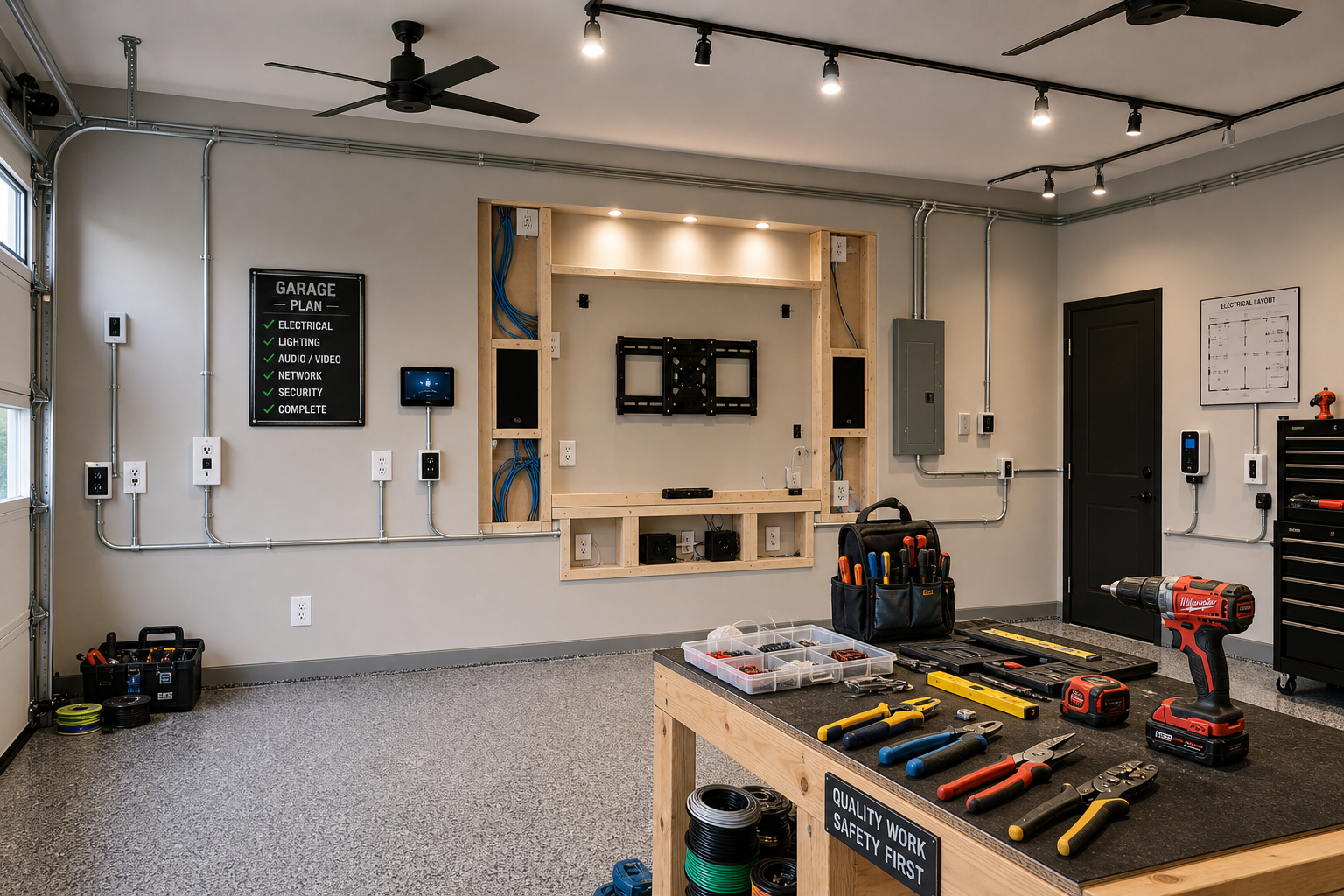
GFCI protection is code-required for all garage outlets. These devices trip at small current leaks, preventing electrocution in damp conditions. In garages, trips can be caused by moisture, cold temperatures, or brief startup surges from motor-driven tools.
Adding outlets competitively priced to competitively priced per location if you hire an electrician. DIY installation competitively priced to competitively priced per outlet box, plus wire. Running new circuits from the panel requires a permit in most areas. If your panel is full, a subpanel installation runs competitively priced to competitively priced in materials, or competitively priced to competitively priced installed.
A dedicated 20-amp circuit handles a mini-fridge, TV, sound system, and lighting without tripping breakers. If you’re adding a window air conditioner or space heater, put it on its own circuit. Most portable AC units and heaters pull 12 to 15 amps, leaving no margin on a shared circuit.
USB outlets are convenient for phone charging and small devices. They competitively priced to competitively priced each versus competitively priced to competitively priced for standard outlets, but eliminate the need for plug-in adapters.
For entertainment setups, plan your outlet placement around where furniture will sit. Outlets behind the couch or TV stand prevent visible cords snaking across the floor. Measure twice before running wire or cutting drywall.
Seating and Furniture on a Budget
A man cave needs somewhere to sit. New furniture eats budget fast. Used or DIY options stretch dollars further.
Bar-height seating works well in garages with existing workbenches. Add a few stools (competitively priced to competitively priced each) and you have instant seating without dedicating floor space to a full couch.
Used couches and recliners from Craigslist, Facebook Marketplace, or estate sales run competitively priced to competitively priced. Inspect for stains, structural damage, and smells before hauling anything home. Garage furniture takes more abuse than living room pieces, so prioritize durability over style.
DIY pallet furniture costs almost nothing if you source free pallets. Sand them smooth, add cushions (competitively priced to competitively priced for outdoor cushions that handle moisture), and you have seating for under competitively priced. Pallet couches are heavy and crude but functional.
Folding chairs and tables store flat when not in use. A folding table (competitively priced to competitively priced) and four chairs (competitively priced to competitively priced each) handle game nights or poker without permanent floor space commitment.
Entertainment and Tech
A wall-mounted TV saves floor space and positions the screen at comfortable viewing height. Mounts run competitively priced to competitively priced depending on size and features. Used TVs are plentiful and cheap: 40-inch to 50-inch models go competitively priced to competitively priced on local marketplaces.
If you’re interested in creating the ultimate entertainment experience, check out our guide on garage home theater ideas for inspiration on layout and equipment.
Sound systems range from basic (competitively priced Bluetooth speaker) to serious (competitively priced+ surround setup). For most man caves, a soundbar hits the middle ground: better than TV speakers, simpler than full surround. If your garage sees oil changes and project work alongside entertainment, skip the expensive audio. Dust and grime kill speakers.
Streaming requires internet. Run ethernet cable if possible (competitively priced to competitively priced per foot, plus connectors and tools). Wi-fi extenders work if the garage is close to your router. Powerline adapters use your home’s electrical wiring to carry network signal, which works when walls block Wi-fi.
A mini-fridge is essential for any man cave. Compact models (3 to 4 cubic feet) fit under counters or beside seating. Full-size models take more space but hold beer cases without restocking every weekend. Check the energy rating. Cheap mini-fridges sometimes cost more to run annually than the purchase price.

Compact Mini Fridge for Garage
Energy-efficient option perfect for storing drinks and snacks
Storage and Organization
A man cave still needs storage for tools, sports gear, or hobby supplies. Slatwall panels run competitively priced to competitively priced per square foot. A 4×8 section competitively priced to competitively priced and holds hooks, baskets, and shelves in configurable layouts.
For detailed installation tips, check out our guide on how to install garage slat wall accessories.
Overhead storage racks (competitively priced to competitively priced for ceiling-mounted units) reclaim vertical space. Most units hold 300 to 600 pounds, enough for bins of seasonal gear or rarely used equipment.
Metal shelving units are cheap and sturdy. Industrial-grade models handle 2,000 to 4,000 pounds total capacity when weight is distributed across shelves.
Pegboard costs less than slatwall (competitively priced to competitively priced per 4×8 sheet) but offers fewer accessories and lower weight capacity. It works fine for hand tools and light items, less well for heavier gear.
Step-by-Step Transformation
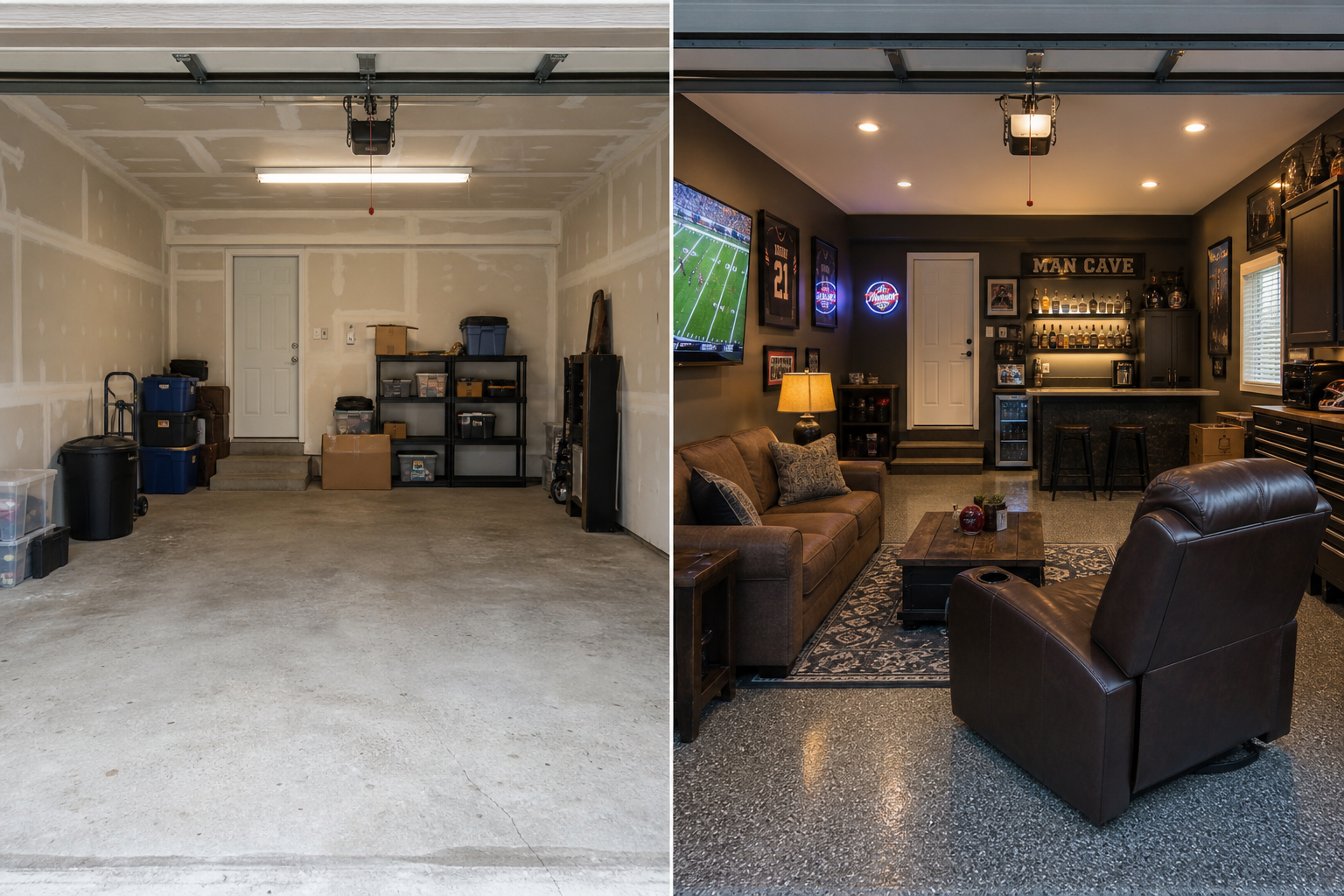
Flooring, wall finishes, lighting, mini-fridge wiring, and soundproofing. Understanding the specifics of your situation helps you choose the right approach. Your garage’s age, construction type, and local climate all influence what works best and what to avoid.
Start with a clean sweep. Remove everything from the garage. Throw out junk, donate unused items, and consolidate what’s left. This step reveals the actual space you’re working with and exposes any issues (cracks, moisture stains, damaged drywall) that need attention.
Tackle structural and safety issues first. Fix water leaks, patch foundation cracks, upgrade faulty wiring, replace broken garage door hardware. Building comfort and entertainment features over unresolved problems wastes money.
Insulate and finish walls before flooring. Drywall dust and insulation scraps will fall. Getting them on bare concrete is easier to clean than getting them on a fresh epoxy coating.
Install electrical upgrades and run any network cables while walls are open. Fishing wire through finished walls is possible but slower and messier.
Apply floor coatings after walls are complete and before moving in furniture. Coatings need clean, dust-free surfaces. Temps between 50 and 85 degrees are ideal. Humidity below 80% prevents moisture from interfering with cure.
Add lighting last. Fixtures stay cleaner if they’re not installed during dusty construction phases.
Document every product you use: brand, color, batch number, application date. Future touch-ups need exact material matches. Tape the info inside a cabinet door or take a quick phone photo for your records.
Work in small, manageable sections for better quality control. For floor coatings, that means strips the width of your roller from back to front. For wall systems, complete one section fully before starting the next. Rushing large areas creates inconsistencies and errors.
Expect at least one surprise during the project. Hidden moisture, non-standard dimensions, or outdated wiring are common discoveries. Having backup materials and a flexible timeline reduces the stress when they appear.
