

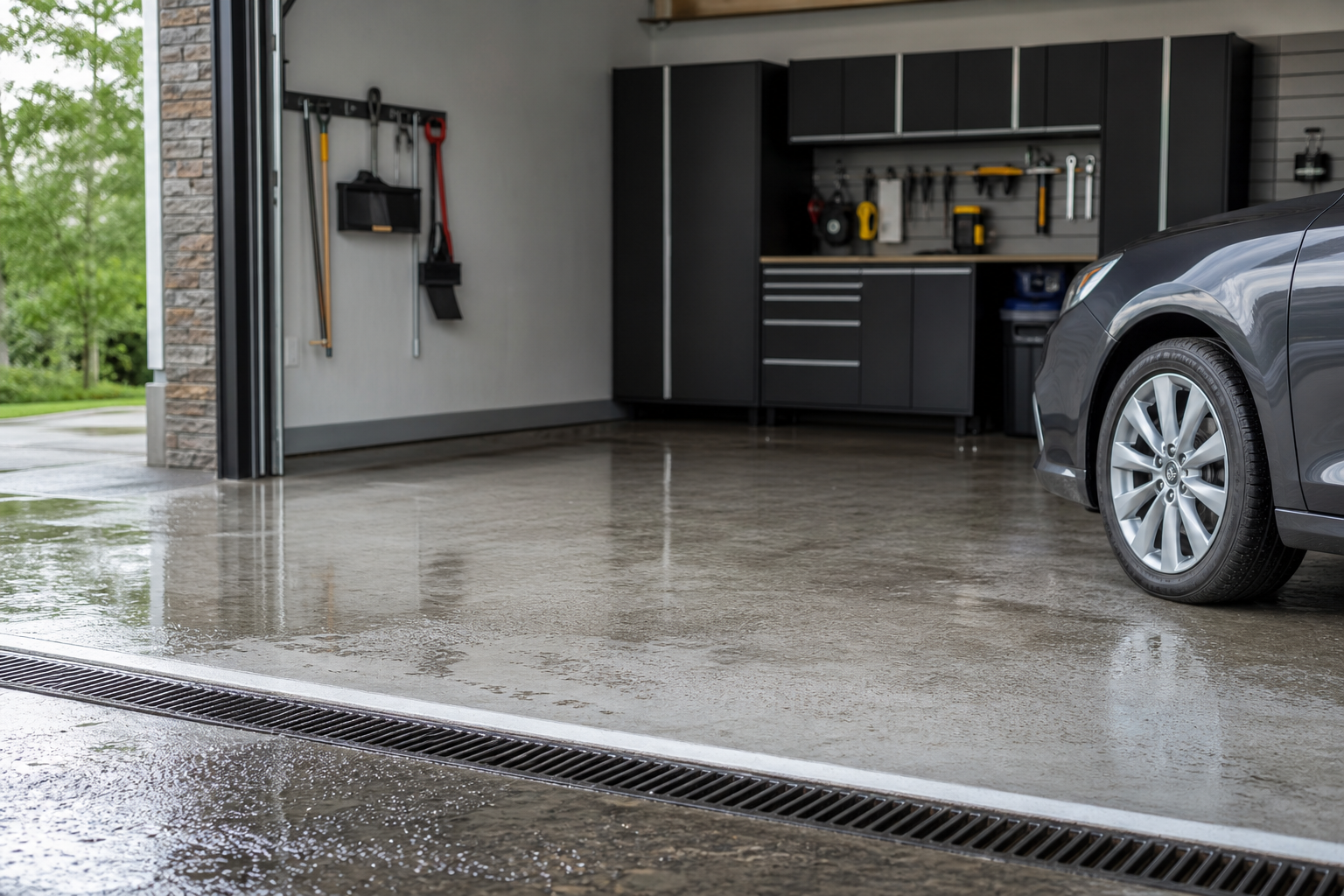
If your garage floor becomes slippery when wet, you’re dealing with one of the most reported garage issues. Climate, age, and usage all play a role, but the root causes fall into a surprisingly short list.
This troubleshooting guide covers each possibility with clear explanations and actionable fixes. By the end, you’ll have the problem solved or know exactly what to tell a technician.
Understanding the Basics
Surface preparation drives roughly 80% of a coating’s long-term performance. Concrete needs a CSP 2 to 3 surface profile for proper adhesion. Diamond grinding achieves this reliably. Acid etching is a budget alternative on clean, unsealed concrete but creates a lighter profile that’s less durable in high-traffic areas.
Never shortcut cure time. Most two-part epoxies need 24 hours for foot traffic, 72 hours for heavy use, and 7 days before vehicle parking. Polyaspartic systems cure faster, often allowing vehicles within 24 hours. Parking too early causes tire marks, soft spots, or full sheet delamination.
Apply coatings when temperatures are falling, not rising. Warming concrete expels trapped air through the wet coating (outgassing), creating bubbles. Evening application avoids this. Most epoxies perform best between 55 and 85 degrees Fahrenheit with the slab surface in the same range.
The CSP profile matters more than most installers admit. CSP 1 looks clean but won’t hold a coating under tire traffic. CSP 4 is overkill for residential garages and wastes coating in the deep valleys. CSP 2 to 3 hits the zone where mechanical bond forms without excessive material use. You can verify profile with a NIST comparator card, but experienced contractors know it by feel after running their hand over the prepped surface.
Moisture testing shouldn’t be skipped. Tape a 2-foot square of plastic sheeting to the floor overnight. If condensation forms underneath, you have a moisture issue that will lift any coating you apply. This test costs nothing and prevents expensive do-overs. Concrete less than a year old often fails this test. Older slabs in humid climates can fail too, especially if there’s no vapor barrier under the slab.
Broadcast Anti-Slip Media During Application
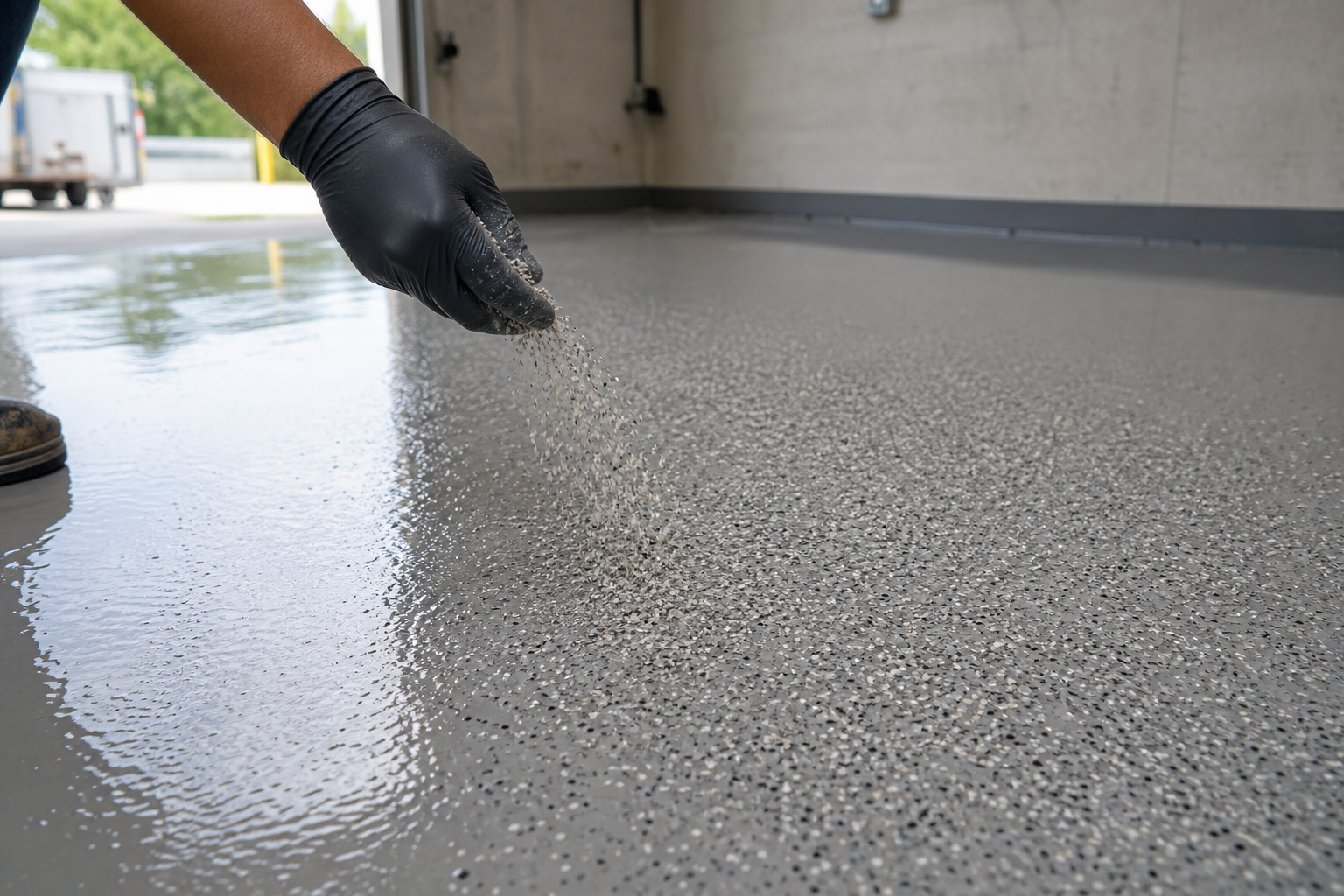
Broadcasting anti-slip aggregate into wet epoxy or polyaspartic is the most reliable traction method. The media embeds in the coating as it cures, creating permanent texture that won’t wear smooth under tire traffic.
Choosing the Right Aggregate
Aluminum oxide is the standard choice. It’s angular, hard, and available in multiple grit sizes. 60-grit is common for residential garages. 36-grit is more aggressive for commercial bays or areas where you need maximum bite. 80-grit works in low-traffic storage areas where you want some texture without the roughness underfoot.
Silicon carbide costs more but outlasts aluminum oxide in high-traffic zones. It’s harder and sharper. Some contractors reserve it for the tire tracks where most wear occurs and use aluminum oxide elsewhere to control cost.
Polymer grit is the newest option. It’s lighter than mineral aggregates, so it broadcasts more evenly and uses less material per square foot. The texture feels less abrasive under bare feet, which matters if you use the garage as workspace where you might kneel or sit. Durability is good but not quite at silicon carbide levels.

Anti-Slip Aggregate
60-grit aluminum oxide provides excellent traction for residential garages
Application Technique
Broadcast rate determines how much traction you get. Light coverage (5 to 10 pounds per 100 square feet) adds subtle grip. Medium coverage (10 to 20 pounds per 100 square feet) is the sweet spot for most garages. Heavy coverage (20+ pounds per 100 square feet) creates a noticeably rough surface that’s overkill unless you’re coating a steep driveway transition.
Timing the broadcast is critical. Wait too long and the aggregate sits on top instead of embedding. Broadcast too early and it sinks out of sight. The coating should be tacky but not liquid. Most products hit this window 10 to 20 minutes after application, but check the technical data sheet. Temperature affects working time significantly.
Broadcast from waist height in a sweeping motion. Too low and you get clumps. Too high and the media bounces instead of sticking. Walk backward as you work so you don’t step on freshly applied coating. Overlap your passes by half to avoid bare spots.
After the coating cures, sweep up loose aggregate. There will be some. This isn’t wasted material, it’s proof you broadcasted enough. A light second topcoat seals the aggregate fully and smooths the surface slightly while maintaining traction. Some installers skip this step to save money, but sealed aggregate lasts longer and cleans easier.
Use Textured Topcoats
Textured topcoats build traction into the final layer without requiring broadcast media. These products contain suspended particles that create a slightly rough finish as the coating cures.
Non-skid additives come in powder form. You mix them into the topcoat before application. The particles suspend in the wet coating and protrude slightly as it levels. Coverage rate is usually 4 ounces per gallon for light texture, up to 8 ounces per gallon for more aggressive grip.
Fine-grade additives (200 to 400 mesh) create subtle texture that’s barely visible but noticeably less slippery than bare epoxy. Medium-grade additives (100 to 200 mesh) produce a satin finish with clear tactile feedback. Coarse-grade additives (60 to 100 mesh) approach broadcast-level traction but apply faster since you’re not managing a separate material.
Pre-textured topcoats eliminate the mixing step. The manufacturer suspends the additive at the factory, so every gallon delivers consistent texture. This removes one variable from the application process, which matters when you’re working alone or on a tight timeline. The tradeoff is less control over texture level.
Textured polyurethane topcoats offer the best chemical resistance. They hold up to spilled gasoline, antifreeze, and brake fluid better than textured epoxy. The texture also wears more evenly since polyurethane is slightly softer than epoxy, so the high points don’t abrade as quickly.
Application Tips
Application technique affects results. Roll in one direction for the first pass, then cross-roll perpendicular for the second pass. This works the texture into an even pattern. Single-direction rolling can leave subtle lines where the texture concentrates along roller edges.
Don’t thin textured coatings. The viscosity is calibrated to keep particles suspended. Adding solvent causes them to settle, and you’ll end up with smooth coating on top and gritty coating on the bottom of each section. If the coating is too thick to roll smoothly, the problem is usually temperature (too cold) or age (past shelf life), not viscosity.
Retrofit Traction Strips or Mats
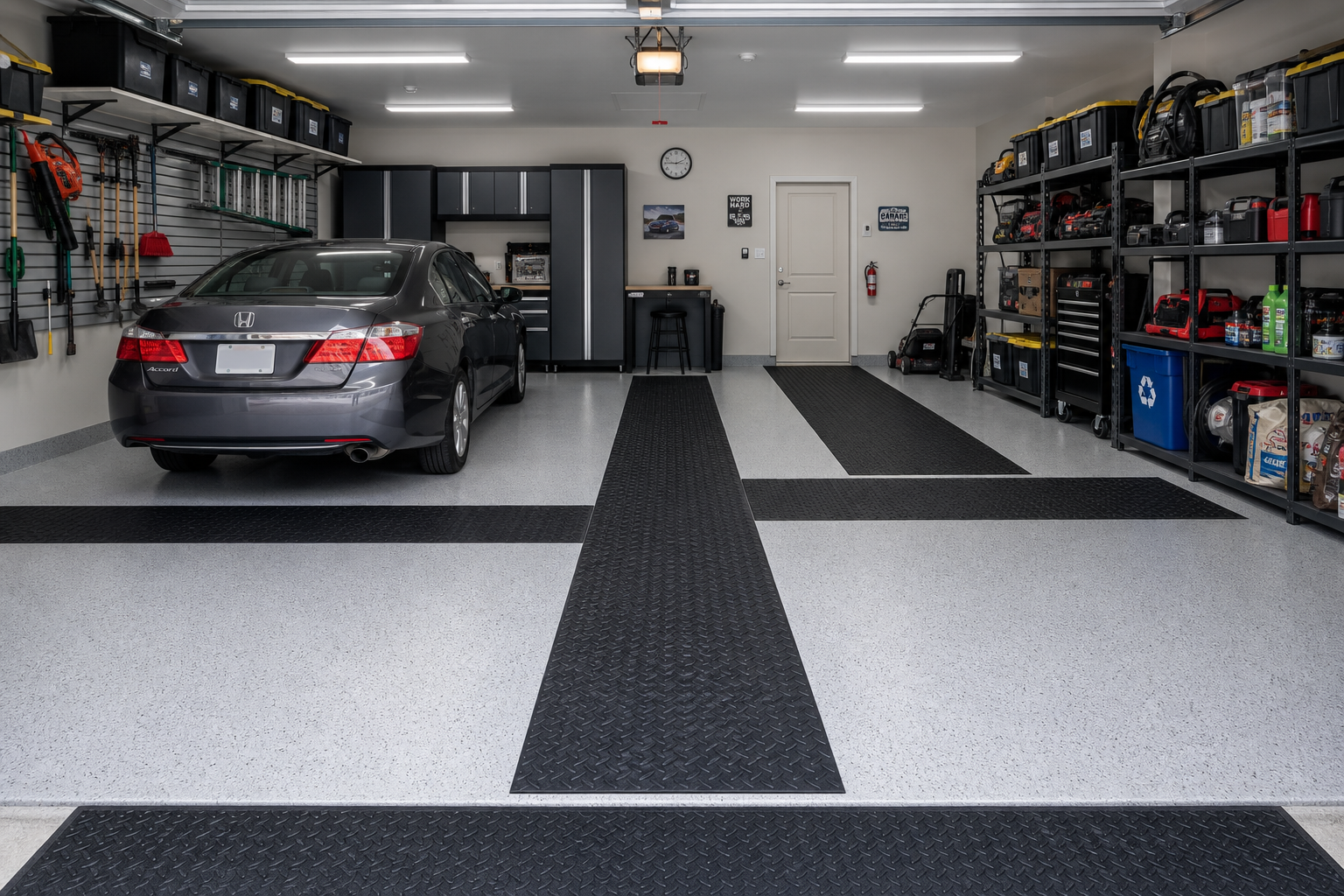
Traction strips apply directly to cured coatings when you need grip in specific zones. This works well for the transition slope from driveway to garage floor, around workbenches where spills are common, or near entry doors where wet shoes track in moisture.
Adhesive Traction Strips
Adhesive-backed strips use aggressive acrylic adhesive that bonds to epoxy, polyaspartic, concrete, and sealed surfaces. The grit layer is typically aluminum oxide or carbide embedded in a polymer base. Strips come in rolls (2 to 6 inches wide, 5 to 60 feet long) or pre-cut treads (10 to 12 inches wide, 24 to 48 inches long).
Installation is permanent. Clean the surface with denatured alcohol, let it dry fully, peel the backing, and press the strip down firmly. A J-roller ensures full contact and eliminates air bubbles. Once bonded, these strips don’t peel without taking coating with them.
Commercial-grade strips last 3 to 5 years under vehicle traffic. Residential-grade strips are thinner and less expensive but wear through in 1 to 2 years in tire tracks. Reserve the cheaper versions for low-traffic areas.
Color-coding helps with organization. Yellow strips mark hazard zones, black blends into dark coatings, gray works on lighter floors. Some garages use different colors for different vehicle parking spots or to outline workspace zones.
Removable Mats
Rubber mats offer removable traction. They sit on top of the coating without adhesive, so you can shift them as needed or take them up for cleaning. Drainage mats have raised nubs that hold the mat surface above standing water. This keeps your feet dry and prevents slipping on the wet mat itself.
Mat sizing matters. Too small and they shift underfoot. Too large and they’re hard to move for cleaning. A 3-by-5-foot mat fits the footprint where you step out of most vehicles. A 4-by-6-foot mat covers the entry door zone. Mats with beveled edges reduce trip hazards.
Nitrile rubber mats resist oil and chemicals better than standard rubber. They cost more but don’t degrade when antifreeze or gas drips on them. This extends mat life from 2 to 3 years up to 5 to 7 years in typical garage conditions.

Garage Floor Mats
Nitrile rubber provides the best chemical resistance for garage environments
Address Water Pooling Issues
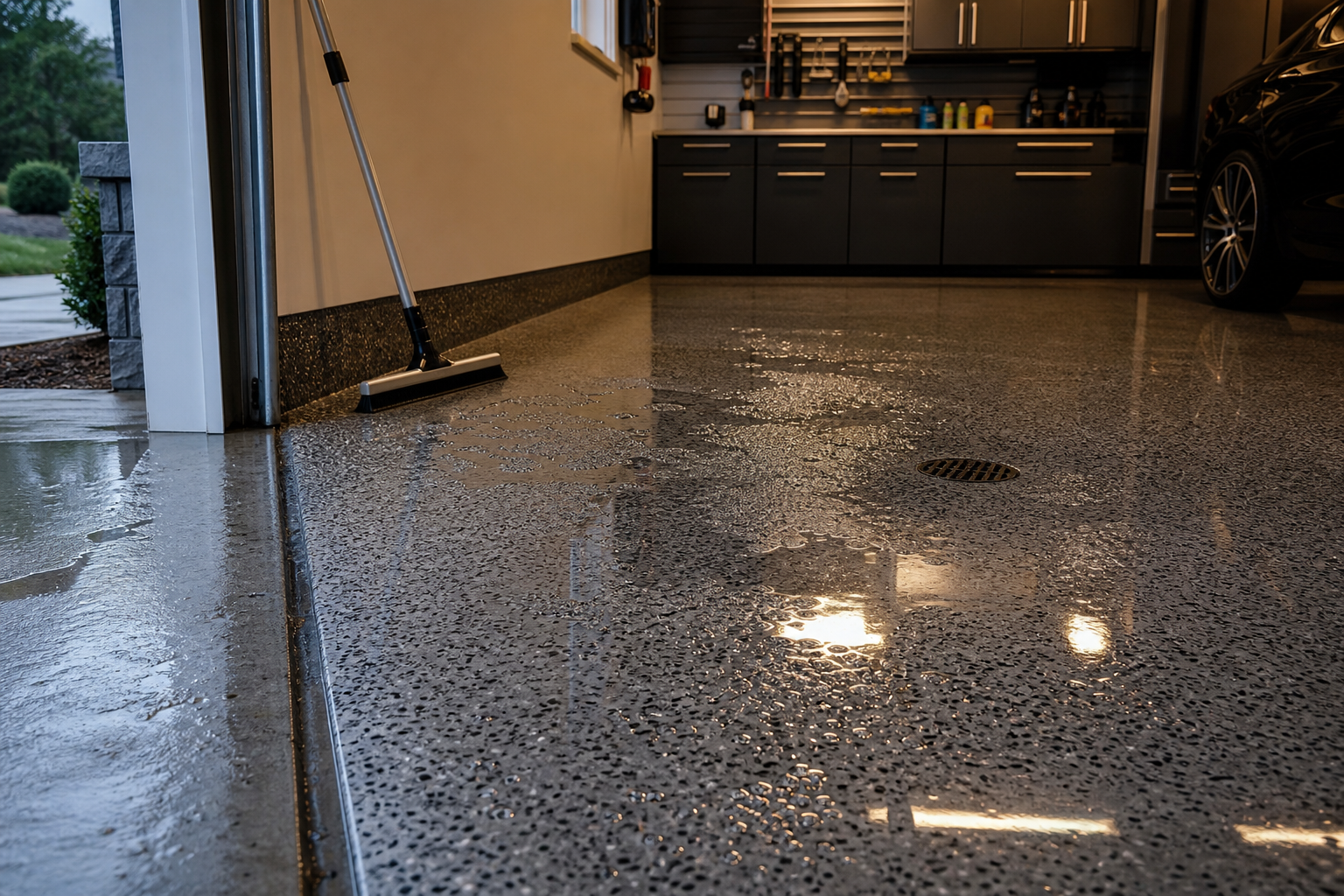
Traction additions won’t solve slipping if water pools on the floor. Proper drainage eliminates standing water before it becomes a slip hazard.
Most garage floors slope toward the door at 1/8 to 1/4 inch per foot. This grade moves water out naturally. If your floor is dead flat or slopes the wrong direction, water sits until it evaporates. You’ll notice this during rain or snow melt when puddles form in the same spots repeatedly.
A garage floor drain installed at the low point captures water before it spreads. Trench drains work well across the full width of the door opening. Point drains handle localized low spots. Both require cutting into the slab, so this is a bigger project than coating alone.
Self-leveling concrete fills low spots without a full resurfacing job. These products flow to level and cure in 24 to 48 hours. You can coat over them once cured. Depth capacity is usually 1/2 to 1 inch, enough to correct most pooling issues. Deeper depressions need multiple lifts with cure time between each.
Check your door threshold. If it’s too high, water backs up inside instead of draining out. Threshold height should be no more than 1/2 inch above the garage floor. Adjustable thresholds let you fine-tune this without replacing the entire door frame.
A quality garage dehumidifier reduces ambient moisture that condenses on cold floors. This doesn’t replace drainage but it cuts down on the slick film that forms when humid air hits a cool slab.
Choose the Right Coating Sheen
High-gloss coatings look great in photos but turn into skating rinks when wet. Satin and semi-gloss finishes hide imperfections better and provide more grip.
Gloss level is measured in sheen units at a 60-degree angle. High-gloss finishes register 70+ units. They reflect light sharply and show every dust particle and scuff mark. Semi-gloss finishes run 35 to 70 units. They have some shine without the mirror effect. Satin finishes are 10 to 35 units. They look almost flat but clean easier than true matte coatings.
Traction correlates loosely with sheen. Lower gloss means more surface texture at the microscopic level, which translates to better grip when wet. The difference isn’t huge but it’s measurable. A satin polyaspartic floor is noticeably less slippery than the same product in high-gloss.
Marketing images skew toward high-gloss because it photographs well. Showrooms use it because it’s impressive under bright lights. Real garages benefit more from satin or semi-gloss, especially in climates with wet winters.
You can’t change sheen after application without recoating. If you went high-gloss and regret it, a satin topcoat fixes the problem. This adds cost but it’s cheaper than stripping and starting over.
Consider Climate-Specific Solutions
Four-season climates need different traction strategies than mild regions. Salt, sand, and freeze-thaw cycles affect both coating performance and slip resistance.
Winter tires track in road salt that etches some coatings. Polyaspartic and polyurethane hold up better than epoxy against salt damage. If you coat an epoxy floor in a snow belt, plan on a polyurethane topcoat for chemical resistance.
Freeze-thaw cycling can delaminate poorly bonded coatings. The concrete expands and contracts underneath. If the coating isn’t mechanically locked into a proper surface profile, this movement pops it loose. Once delamination starts, water infiltrates and the problem accelerates. Proper prep is the only defense.
Sand and gravel embedded in tire treads act like sandpaper on your floor. This abrasion wears down texture over time. Coatings with broadcast aggregate hold up better because the hard media protects the resin underneath. Textured topcoats wear smoother as the high points erode.
Humidity swings affect curing and long-term adhesion. High summer humidity slows cure times and can cause blushing (a milky appearance) on some coatings. Low winter humidity speeds cure but increases brittleness in some formulas. Check the product data sheet for acceptable humidity ranges and don’t push the limits.
Black ice forms when melting snow refreezes overnight. This is less common inside a garage but it happens near the door where cold air pools. Aggressive traction (broadcast aggregate or coarse strips) in this zone prevents falls.
Maintain Traction Over Time
Traction degrades as the coating wears. Regular maintenance preserves grip and extends coating life.
Sweep weekly to remove grit that acts as an abrasive. Sand, salt, and small gravel particles grind into the coating every time a tire rolls over them. A push broom or shop vacuum removes this material before it does damage.
Mop monthly with a pH-neutral cleaner. Acidic or alkaline cleaners etch the coating gradually and smooth out texture. Dish soap diluted in water works fine. Avoid degreasers unless you have a real oil spill, they’re harsher than needed for routine cleaning.
Inspect high-traffic areas twice a year. Look for spots where texture is wearing smooth or where the coating is thinning. Catch these early and you can spot-repair with a textured topcoat. Wait too long and you’ll need to recoat the whole floor.
Reapply topcoat
